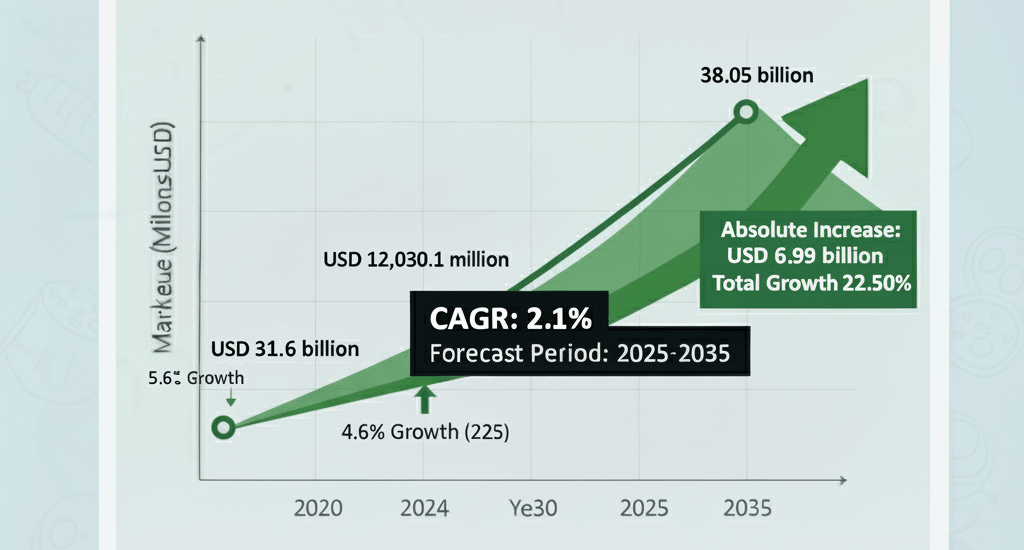
Future Market Insights (FMI), a leading provider of market intelligence and consulting services, today announced the release of its latest report, 2-Nitrothiophene Market Growth Outlook, 2025-2035. This in-depth analysis illuminates the pivotal role of 2-Nitrothiophene as a cornerstone intermediate in organic synthesis, projecting a robust market expansion from USD 31.06 billion in 2025 to USD 38.05 billion by 2035, at a compound annual growth rate (CAGR) of 2.1%. As demand surges for advanced pharmaceuticals, sustainable agrochemicals, and cutting-edge materials, the report underscores how this versatile compound is fueling innovations that address global challenges in health, agriculture, and technology. With Asia-Pacific poised to lead regional growth, stakeholders can leverage these insights to navigate a landscape ripe for strategic investments and eco-friendly advancements.
The report’s findings reveal a market resilient against past volatilities, driven by breakthroughs in heterocyclic chemistry and a global shift toward greener production. “In an era where sustainability intersects with scientific progress, 2-Nitrothiophene stands as a linchpin for transformative applications,” said Snehupama Roy, Senior Consultant at Future Market Insights. “This report not only forecasts steady growth but equips industry leaders with actionable intelligence to capitalize on emerging opportunities while mitigating regulatory hurdles.”
2-Nitrothiophene Market Insights: Navigating Trends, Drivers, and a Dynamic Competitive Arena:
The 2-Nitrothiophene market is witnessing a fascinating evolution, characterized by a blend of steady demand and innovative disruptions. Key trends include the adoption of bio-based synthesis routes and AI-enhanced electrochemical nitration, which promise reduced waste and energy efficiency. Greener manufacturing processes, such as enzyme-catalyzed and solventless methods, are gaining traction, aligning with global sustainability mandates. Intensifying research into thiophene’s biocompatibility and semiconductor applications is further propelling the sector toward precision medicine, biosensors, and optoelectronics.
Growth drivers are multifaceted, anchored by the escalating need for thiophene-based medications, electrically conductive polymers, and agrochemical formulations. Pharmaceutical companies’ focus on novel drug development—backed by substantial government funding—coupled with R&D investments in material science, is accelerating adoption. Industrialization in export-oriented API hubs, particularly in Asia-Pacific, and the electronics boom for OLEDs, flexible displays, and solar cells, amplify this momentum. The global population surge also heightens demand for high-yield agriculture, where 2-Nitrothiophene enables effective crop protectants.
Yet, challenges persist. Stringent regulatory frameworks, including REACH, ECHA, FDA, and EPA standards, impose rigorous testing and clean technology requirements, escalating costs. High production expenses from complex synthesis, volatile precursor prices (like iodine and sulfur), and supply chain disruptions—exacerbated by hazardous waste concerns—pose barriers. Accessibility for small-scale farmers in developing regions and restrictions on pesticide residues add layers of complexity.
Opportunities abound for forward-thinkers. The pivot to eco-friendly approaches, such as biocatalytic and electrochemical synthesis, opens doors for minimal-waste innovations. Expansion into electronics for printed circuits and energy storage, alongside AI-powered molecular modeling for personalized therapies and nano-engineered pesticides, signals high-potential niches. Strategic collaborations between chemical suppliers, contract research organizations (CROs), and material scientists could unlock customized manufacturing, while blockchain integration enhances supply chain transparency.
The competitive landscape is fragmented yet competitive, with a focus on high-purity production, scalability, and compliance. Top players command significant shares through R&D prowess and global supply networks, while mid-tier firms differentiate via custom synthesis and bulk offerings. Market structure analysis highlights a balanced ecosystem where innovation drives consolidation.
2-Nitrothiophene Market Update: A Sector in Flux with Regulatory and Technological Shifts:
The chemical and allied industries are undergoing profound transformations, with 2-Nitrothiophene at the epicenter. From 2020-2024, the market navigated volatility from fluctuating demand, supply chain bottlenecks, and intensified regulatory scrutiny, yet emerged stronger through advancements in nitration efficiency and catalytic processes. Compliance with evolving standards like REACH and FDA spurred early adoption of green chemistry, minimizing solvent use and waste repurposing for neglected disease treatments.
In 2025, the sector buzzes with activity: Pharmaceutical pipelines swell with thiophene-derived APIs for antibiotics, anti-inflammatories, and immuno-oncology drugs, fueled by post-pandemic R&D surges. Agrochemical innovators are rolling out bio-degradable fungicides and herbicides, countering resistance in staple crops amid climate pressures. Materials science breakthroughs include thiophene-infused conductive polymers for next-gen wearables and solar tech, with East Asian electronics giants ramping up production.
Recent policy moves, such as EU’s Green Deal incentives for sustainable synthesis and U.S. EPA grants for low-emission processes, are reshaping operations. Industry conferences, like the 2025 Heterocyclic Chemistry Symposium, spotlight AI-optimized reactions and quantum computing for predictive modeling. Meanwhile, mergers—like a hypothetical Thermo Fisher acquisition of a boutique synthesizer—signal consolidation. Overall, the update paints a resilient industry, with 2025-2030 earmarked for AI integration and decentralized manufacturing, projecting a 2.1% CAGR amid broader chemical sector growth of 3-4%.
2-Nitrothiophene Market Applications: Unlocking Value Across Sectors:
Businesses across pharmaceuticals, agrochemicals, and materials science stand to gain immensely from the report’s granular insights. In pharmaceuticals, 2-Nitrothiophene serves as a vital intermediate for synthesizing bioactive compounds, heterocyclic prodrugs, and treatments for infectious diseases, cancer, and chronic conditions. Companies can streamline API development, reducing time-to-market and costs while enhancing efficacy—critical for biotech firms targeting personalized medicine.
Agrochemical enterprises benefit through formulations of pesticides, herbicides, and fungicides that bolster crop yields and pest resistance, supporting sustainable farming. The report guides formulation tweaks for eco-compliant products, aiding agribusinesses in emerging markets like India and Brazil to meet global food security demands.
In materials science, the compound enables electrically conductive polymers, organic semiconductors, and components for LEDs, OLEDs, flexible displays, solar cells, and printable electronics. Electronics manufacturers can innovate advanced coatings and field-effect transistors, driving efficiency in consumer tech and renewable energy. “This report demystifies how 2-Nitrothiophene bridges lab discoveries to commercial scalability,” added Roy, “empowering diverse industries to foster innovation with confidence.”
Full Market Report available for delivery. For purchase or customization, please request here: https://www.futuremarketinsights.com/checkout/13853
Request for Discount: https://www.futuremarketinsights.com/reports/sample/rep-gb-13853
2-Nitrothiophene Market Recent Developments: Momentum Builds on Innovation Fronts:
Recent strides underscore the market’s vitality. In 2024, Merck KGaA expanded its thiophene portfolio with a new catalytic nitration facility in Germany, slashing energy use by 30% and aligning with REACH goals. Thermo Fisher launched AI-monitored synthesis kits, boosting yield for pharma clients and earning FDA nods for impurity profiling.
Agrochem giant Bayer integrated 2-Nitrothiophene into bio-based herbicide lines, debuting in South Asia trials that showed 25% better efficacy against resistant weeds. In materials, Japan’s TCI Chemicals partnered with OLED pioneers for thiophene-doped polymers, enhancing display flexibility for foldable devices— a move projected to capture 15% of the printable electronics segment by 2028.
Sustainability takes center stage: A 2025 South Korean consortium unveiled enzyme-catalyzed routes, reducing solvent waste by 40%, while U.S. startups explore blockchain for traceable supply chains. These developments, amid resolving post-2023 disruptions, affirm a trajectory of resilient growth, with bio-options and smart manufacturing set to dominate through 2035.
Explore More Related Studies Published by FMI Research:
Valeronitrile Market: Valued at USD 4,326.4 million in 2025, projected to reach USD 6,282 million by 2035, growing at a CAGR of 3.8%, driven by its increasing use in chemical synthesis and industrial applications.
Galactoarabinan Market: Estimated at USD 937.4 million in 2025, expected to reach USD 2,139.0 million by 2035, registering a CAGR of 8.6%, fueled by rising demand in cosmetics, pharmaceuticals, and food industries.
Polyurethane Resins Paints and Coatings Market: Forecasted to surpass USD 57,071.72 million by 2035, expanding at a CAGR of 4.0%, due to growing adoption of durable and eco-friendly coating solutions across construction and automotive sectors.
About Future Market Insights (FMI)
Future Market Insights, Inc. (ESOMAR certified, recipient of the Stevie Award, and a member of the Greater New York Chamber of Commerce) offers profound insights into the driving factors that are boosting demand in the market. FMI stands as the leading global provider of market intelligence, advisory services, consulting, and events for the Packaging, Food and Beverage, Consumer Technology, Healthcare, Industrial, and Chemicals markets. With a vast team of over 400 analysts worldwide, FMI provides global, regional, and local expertise on diverse domains and industry trends across more than 110 countries.
Contact Us:
Future Market Insights Inc.
Christiana Corporate, 200 Continental Drive,
Suite 401, Newark, Delaware – 19713, USA
T: +1-347-918-3531
For Sales Enquiries: sales@futuremarketinsights.com
Website: https://www.futuremarketinsights.com
LinkedIn| Twitter| Blogs | YouTube