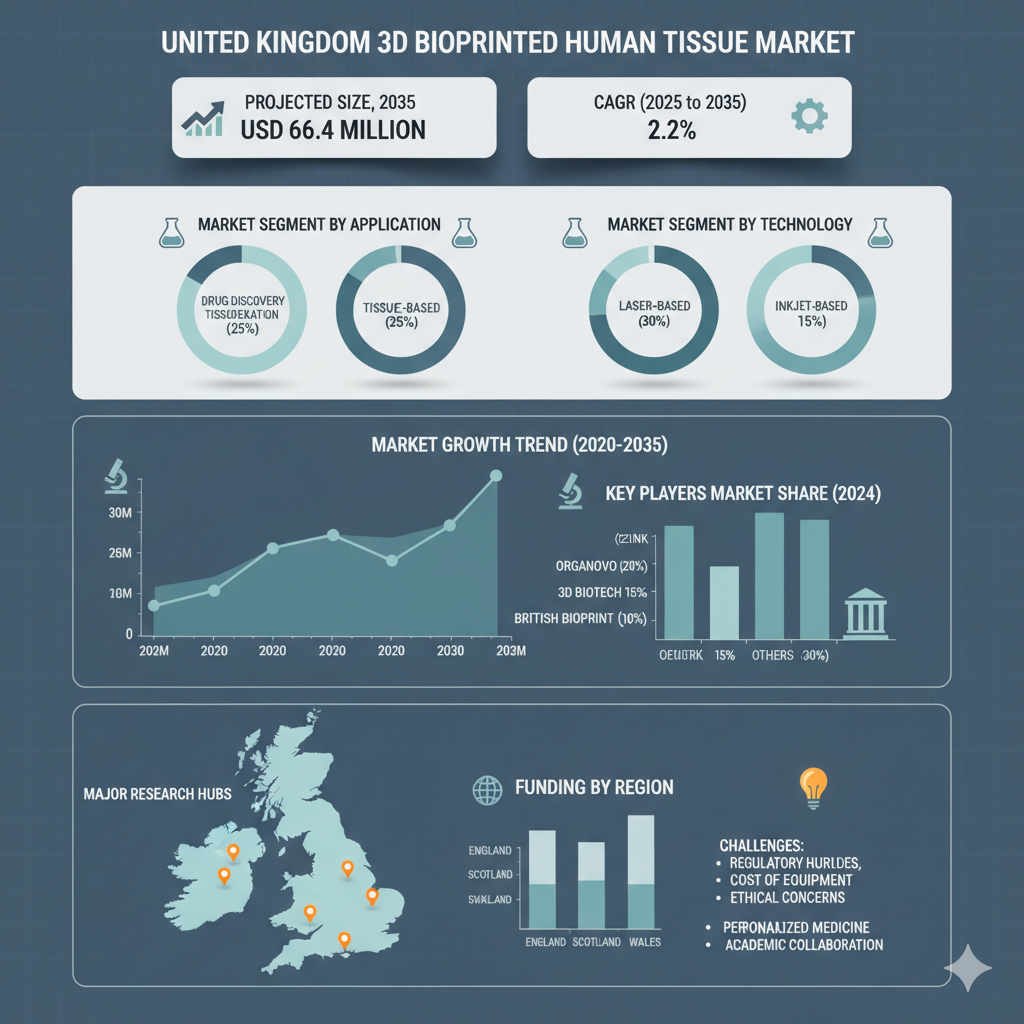
The United Kingdom’s regenerative medicine sector is on the brink of remarkable transformation as the 3D bioprinted human tissue market gains momentum. Valued at around USD 53.2 million in 2025 and projected to reach approximately USD 66.4 million by 2035, the market is expected to expand at a steady CAGR of 2.2%. This growth presents vast opportunities for both established industry leaders and new entrants eager to innovate and scale in this rapidly evolving field.
Established Giants and New Innovators Drive Market Evolution
The UK market features prominent global leaders such as Cellink Global, Stratasys Ltd., and Organovo Holdings, Inc., who collectively hold a major share of the industry. These companies continue to set benchmarks in research, product development, and large-scale adoption of 3D bioprinting across medical and pharmaceutical applications.
At the same time, a wave of emerging manufacturers and start-ups is reshaping the competitive landscape. These new players are pushing boundaries with advancements in bioink formulations, tissue-specific bioprinting, and artificial intelligence–driven workflows. Their focus on customization, precision, and cost efficiency is enabling the development of more complex, lifelike tissue constructs—bridging the gap between lab innovation and clinical application.
Why This Is the Right Moment for Expansion
Several factors are converging to make this the perfect time for manufacturers to expand their presence in the UK’s 3D bioprinting sector:
- Robust Infrastructure: The UK’s advanced healthcare system and world-class research institutions provide an ideal foundation for technology validation and adoption.
- Government Support: Increased investment and policy backing for biotechnology and life sciences are creating fertile ground for market growth.
- Rising Demand: There is growing need for bioprinted tissue in regenerative medicine, reconstructive surgery, and drug discovery—driving adoption across healthcare and research sectors.
- Technological Advancements: AI integration, improved bioinks, and scalable bioprinting systems are reducing barriers to entry and enabling faster, more reliable production.
For established companies, the key lies in expanding collaborative partnerships, refining bioprinting platforms, and scaling up operations to meet rising clinical and research demands. For newcomers, this is a chance to leverage technological agility, target niche applications, and introduce specialized, value-driven solutions to the market.
Overcoming Challenges and Unlocking Growth
Despite the promising outlook, manufacturers face significant challenges. High equipment and material costs, combined with regulatory complexities, continue to be major hurdles. Nonetheless, sustained innovation and supportive policy frameworks are helping companies navigate these barriers.
By 2035, 3D bioprinted human tissues are expected to play a transformative role in healthcare—from addressing organ shortages and enhancing transplant success rates to enabling personalized therapies and next-generation drug testing models. The technology’s potential to reduce dependence on animal testing and accelerate precision medicine further strengthens its value proposition.
Opportunities for Manufacturers and Investors
The UK’s 3D bioprinted human tissue market offers a unique blend of stability and innovation. Established manufacturers can capitalize on their scale and expertise to expand product portfolios and deepen their integration with medical institutions. Meanwhile, start-ups and smaller firms can focus on breakthrough areas such as vascularized tissue scaffolds, AI-guided printing, and patient-specific tissue engineering.
As collaboration between academia, healthcare providers, and technology developers intensifies, the industry is poised to create a vibrant ecosystem that fosters rapid innovation and ethical commercialization.
About the Market Outlook
The 3D bioprinted human tissue industry in the UK is positioned for steady long-term growth. Among various tissue types, skin tissue remains a leading segment, accounting for nearly one-third of the market share in 2025. Hospitals, specialty clinics, and research centers are expected to remain key end-users, driving demand for scalable, high-precision printing solutions.
Forward-Looking Vision
As technological breakthroughs continue to emerge, the UK’s 3D bioprinted human tissue market is set to become a cornerstone of modern regenerative medicine. Both established and emerging manufacturers are encouraged to seize this moment—collaborating, innovating, and shaping a future where engineered human tissues become a mainstream reality in medical practice.