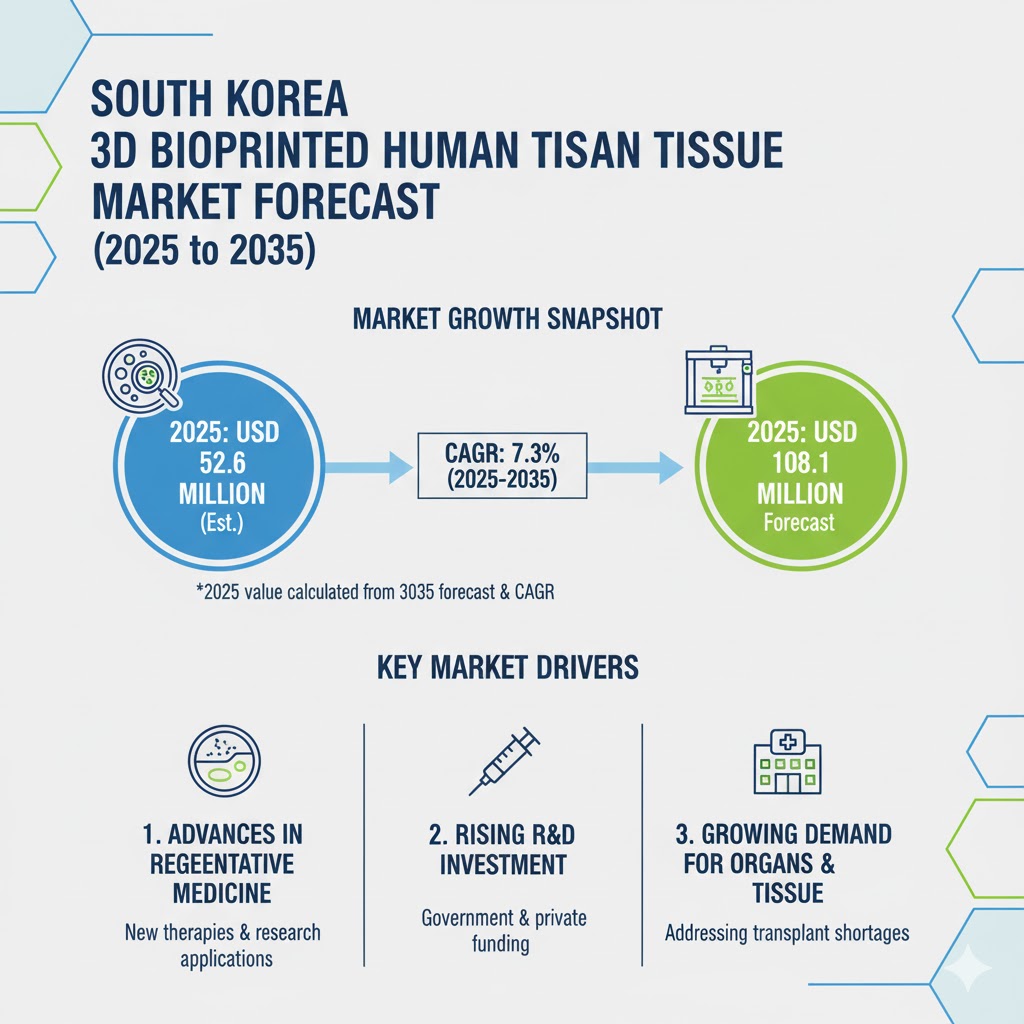
 The South Korea 3D Bioprinted Human Tissue Market is on a remarkable growth trajectory, poised to reach USD 108.1 million by 2035, growing at a CAGR of 7.3% from 2025 to 2035. The rise of bioprinting technology in the country signifies a major leap forward for regenerative medicine, drug testing, and clinical research. With a strong biotechnology base, forward-looking healthcare infrastructure, and active government support, South Korea is emerging as a key player in the global bioprinting ecosystem.
A Rapidly Growing Market Fueled by Innovation and Healthcare Needs
The market’s growth is deeply tied to South Korea’s aging population, increasing chronic disease incidence, and expanding research activities in life sciences. In 2024, the market was valued at USD 49.8 million, growing to USD 53.4 million in 2025, and expected to more than double by 2035.
At the heart of this progress is the country’s commitment to R&D and policy support. South Korea’s Ministry of Health and Welfare and Ministry of Science and ICT continue to back biotechnology startups and academic research with funding and infrastructure to accelerate 3D bioprinting adoption in hospitals and laboratories.
The integration of AI-powered bioprinting systems and the development of customized bioinks have opened new frontiers in creating functional and transplant-ready human tissues. These technologies are transforming possibilities in organ repair, wound healing, drug testing, and personalized medicine.
Industry Dynamics: Collaboration, Innovation, and Clinical Integration
South Korea’s 3D bioprinting ecosystem thrives on strong academic–industrial partnerships. Major universities and research institutions are collaborating with biotech firms to advance tissue engineering, improve scalability, and ensure reproducibility in tissue fabrication.
Hospitals now account for 34.2% of the market share, as they integrate bioprinting solutions into reconstructive surgeries, burn treatment, and organ repair procedures. Specialty clinics are increasingly offering customized cosmetic and regenerative treatments, while academic research centers lead the development of functional tissues for experimental and therapeutic purposes.
Meanwhile, pharmaceutical companies are adopting bioprinted tissues to conduct drug testing and toxicity studies in a more ethical and reliable manner, reducing reliance on animal testing and accelerating new drug discovery timelines.
Technological Advancements Shaping South Korea’s Bioprinting Future
South Korean companies and research institutions are redefining the frontiers of precision bioprinting. The latest generation of bioprinters can print highly detailed, cell-rich tissues using AI-guided calibration, enhancing accuracy and reducing production time.
Key technological trends include:
- Custom Bioinks: Researchers are formulating bioinks that mimic the biological characteristics of specific tissues, such as skin, cartilage, or vascular structures.
- Regenerative Medicine Applications: 3D printed tissues are increasingly used in organ transplantation, wound care, and tissue regeneration.
- AI-Driven Bioprinting: Artificial intelligence is improving real-time monitoring, quality control, and process automation in tissue fabrication.
- Automation and Scalability: Innovations in robotics and multi-material printing are making large-scale tissue manufacturing feasible and cost-effective.
The skin tissue segment, with a 34.8% market share in 2025, is leading adoption due to its vital role in drug testing and dermatological research, while vascularized tissue and organ patches are expected to become key growth areas in the next decade.
Industry Landscape: Established Players and Emerging Innovators
The South Korea 3D bioprinted human tissue market remains moderately fragmented, with an evolving mix of global leaders, domestic startups, and academic spin-offs contributing to its expansion.
- Tier 1 companies, including Cellink Global, Stratasys Ltd., and Organovo Holdings, Inc., command 53.7% of the market share. These firms bring advanced technologies and global collaborations to support hospitals and research organizations.
- Tier 2 players such as EnvisionTEC, Inc., Cyfuse Biomedical K.K., and Poietis collectively hold 33.2%, focusing on specialized tissue applications and bioink innovations.
- Tier 3 innovators, including Allevi, Inventia Life Science PTY LTD, and Vivax Bio, LLC, account for 13.1%, emphasizing cost-effective, experimental, and customizable solutions suited for smaller-scale labs and startups.
This blend of expertise fosters a dynamic competitive environment, encouraging partnerships that accelerate bioprinting scalability and innovation.
Access Expert Analysis & Forecasts – Buy Now Before Prices Rise! https://www.futuremarketinsights.com/checkout/20146
Explore trends before investing — request a sample report today! https://www.futuremarketinsights.com/reports/sample/rep-gb-20146
Drivers of Growth: A Convergence of Policy, Science, and Societal Demand
The market’s robust momentum is supported by several structural and demographic drivers:
- Advanced Biotech Ecosystem – South Korea’s thriving biotechnology sector, coupled with strong research networks, has laid a solid foundation for 3D bioprinting innovation.
- Aging Population – The rising proportion of elderly citizens is increasing the demand for regenerative medicine and organ replacement solutions.
- Government Support – Favorable policies, tax incentives, and public-private R&D funding initiatives are spurring innovation among startups and established firms.
- Ethical Drug Testing – The shift away from animal testing is boosting the use of bioprinted human tissues for drug development and toxicology studies.
Challenges to Overcome: Costs and Regulation
Despite strong growth prospects, several barriers persist. The high initial costs associated with bioprinting equipment, maintenance, and bioink materials limit adoption in smaller research centers and hospitals. Additionally, stringent regulatory frameworks for medical-grade tissues prolong the approval and commercialization process.
However, these challenges are being addressed through collaborative R&D, public funding, and the emergence of low-cost bioprinting solutions. The integration of AI and robotics is also expected to improve efficiency, reduce costs, and accelerate production cycles over the coming decade.
About Future Market Insights (FMI)
Future Market Insights, Inc. (ESOMAR certified, recipient of the Stevie Award, and a member of the Greater New York Chamber of Commerce) offers profound insights into the driving factors that are boosting demand in the market. FMI stands as the leading global provider of market intelligence, advisory services, consulting, and events for the Packaging, Food and Beverage, Consumer Technology, Healthcare, Industrial, and Chemicals markets. With a vast team of over 400 analysts worldwide, FMI provides global, regional, and local expertise on diverse domains and industry trends across more than 110 countries.
Contact Us:
Future Market Insights Inc.
Christiana Corporate, 200 Continental Drive,
Suite 401, Newark, Delaware – 19713, USA
T: +1-347-918-3531
For Sales Enquiries: sales@futuremarketinsights.com
Website: https://www.futuremarketinsights.com
LinkedIn| Twitter| Blogs | YouTube