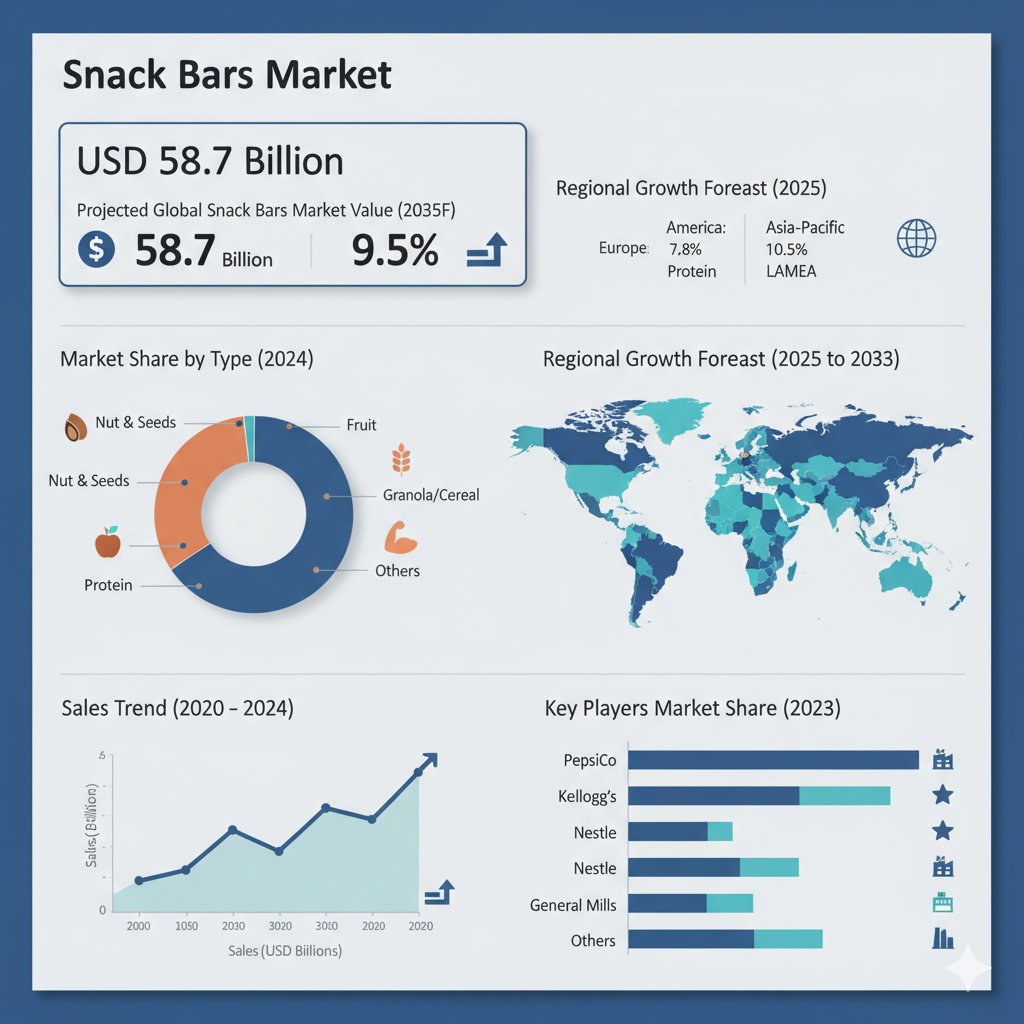
The global snack bars market is witnessing a remarkable growth trajectory, presenting an exciting landscape for both well-known manufacturers and emerging players looking to expand their business horizons. The industry is projected to reach USD 58.7 billion by 2035 from an estimated USD 25.9 billion in 2025, growing at a healthy CAGR of 9.5% over the forecast period.
This dynamic market presents a rare convergence of scale and innovation—an environment in which established manufacturers can leverage their brand recognition and supply-chain efficiencies, while newcomers and niche players can carve out space by embracing new technologies, ingredient innovation, and evolving consumer demands.
Established Players: Scaling with Purpose
Major global firms such as General Mills, Kellanova, Mondelez International, Nestlé, Mars, Incorporated, and The Hain Celestial Group are among the key market leaders. For these established players, the opportunity is two-fold: expand within existing geographies and product categories, and invest in next-generation technologies and supply-chain innovations to capture emerging segments like plant-based, allergen-free, and personalized nutrition.
Key trends such as consumers’ growing appetite for snack bars that support active lifestyles, along with increasing demand for clean-label, plant-based, and allergen-free options, are driving market evolution. These companies are well-positioned to deploy their R&D capabilities, scale production, and tap into new distribution channels—making now the time to double down on innovation, particularly in automated manufacturing, sustainable packaging, traceability technologies, and agile product development.
New & Emerging Manufacturers: Leap-Frogging into Innovation
On the other end of the spectrum, emerging manufacturers and startups such as GoMacro, Perfect Snacks, RXBAR, Thunderbird Real Food Bars, and Bobo’s are recognized for their disruptive potential. These companies are innovating in niche categories—plant-based, vegan, paleo, allergen-free, and functional snack bars—and are capitalizing on direct-to-consumer (D2C) models, digital engagement, and agility in formulation and packaging.
For new entrants, the message is clear: carve a unique value proposition, adopt smart manufacturing technologies like flexible machinery, IoT-enabled production lines, and traceability systems, and align with consumer values around health, sustainability, and transparency. This is the moment to think big and act fast—while the market is still evolving.
Collective Opportunity: Innovation Meets Expansion
Across the board, manufacturers—whether legacy or startup—are being called to adopt and invest in new technologies. Trends such as customization of snack bars via digital tools and AI-enabled platforms, sustainability in packaging and ingredient sourcing, and inclusive formulations (gluten-free, dairy-free, soy-free) are shaping the next chapter of this market.
In practical terms:
- Established manufacturers should explore modular, agile manufacturing setups that allow faster launches of specialized bars.
- Emerging players should leverage flexible contract manufacturing or small-batch automated lines to scale while staying nimble.
- Both groups should invest in digital traceability, e-commerce, and omnichannel distribution—especially in high-growth regions such as Asia Pacific, Latin America, and the Middle East, where demand is booming.
- Sustainability and “clean-label” credentials are no longer optional—investments in green packaging, renewable energy operations, and transparent supply networks now provide vital competitive differentiation.
Market Outlook & Strategic Implications
With the snack bars market forecast to more than double in value over the next decade, the window of opportunity is wide open. Whether you’re a large manufacturer with an established footprint or a nimble newcomer with a bold idea, the ingredients for success are innovation, agility, and alignment with consumer values.
The growth levers are clear: convenience, health-driven nutrition, specialized diet segments, and global expansion into underserved markets. Manufacturers that harness smart production technologies, partner for supply-chain excellence, build brand trust, and move quickly to meet evolving consumer needs will be the ones to seize leadership in this vibrant and rapidly expanding market.