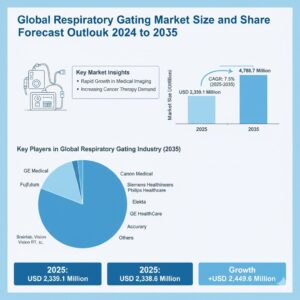
The global respiratory gating market is on a significant upward trajectory, expected to rise from USD 2,339.1 million in 2025 to USD 4,788.7 million by 2035, growing at a CAGR of 7.5%. In 2024, global revenues stood at USD 2,162.5 million, underscoring steady growth as healthcare institutions increasingly adopt advanced imaging and treatment synchronization systems.
The respiratory gating industry plays an essential role in improving diagnostic imaging accuracy and enhancing treatment precision by compensating for the natural motion of the heart and lungs. As a result, it has become indispensable in radiotherapy, MRI, CT scans, and nuclear medicine procedures, especially in cases involving cancers, cardiovascular, and respiratory disorders.
Technological Innovations and AI Integration Drive Market Growth
The market is witnessing rapid transformation, powered by AI-enabled gating systems, hybrid imaging technologies, and software-driven synchronization platforms. Manufacturers are investing heavily in advanced algorithms and real-time monitoring systems to enhance the accuracy of motion tracking during imaging and treatment.
Companies such as Philips Healthcare, Siemens Healthineers, and GE HealthCare are at the forefront of these developments, with innovations that combine imaging precision and automation. For example, Philips’ Spectral CT 7500 RT, launched in November 2024, integrates respiratory-gated imaging capabilities to provide precise radiation therapy planning.
These innovations align with the global shift toward personalized medicine, where individualized diagnostic and treatment planning is essential for better clinical outcomes.
Minimally Invasive Procedures Accelerate Demand
The medical field’s shift toward minimally invasive procedures has significantly fueled the adoption of respiratory gating technologies. Patients and clinicians alike prefer these methods due to shorter recovery times, lower risk of complications, and improved procedural precision.
Varian Medical Systems, for instance, continues to lead innovations in respiratory gating for lung cancer radiotherapy. Its technologies help hospitals deliver more accurate, patient-specific radiation doses, reducing the risk of damage to surrounding healthy tissues.
This trend reflects a broader movement across cardiology and oncology, where respiratory gating is becoming a standard component of high-precision, minimally invasive treatment protocols.
Rising Cancer Cases Reinforce Market Demand
Globally, lung cancer remains one of the leading causes of death, intensifying the need for high-accuracy radiotherapy solutions. Respiratory gating systems synchronize radiation delivery with patients’ breathing cycles, ensuring tumors receive precise doses while safeguarding healthy organs.
Studies show that respiratory gating can cut radiation exposure to healthy tissues by up to 30%, improving patient safety and treatment success rates. Top-tier institutions such as Memorial Sloan Kettering Cancer Center have already integrated gating systems into their oncology departments to achieve higher precision.
The integration of gating systems with proton therapy and stereotactic radiation techniques further enhances targeting accuracy, driving widespread clinical adoption and strengthening the market outlook.
Precision Medicine and Real-Time Imaging Propel Market Expansion
As healthcare moves toward precision medicine, respiratory gating systems have become a cornerstone for targeted therapy. By aligning imaging and treatment with patients’ natural physiological movements, these systems enable more accurate targeting of diseased tissues while minimizing collateral damage.
Recent advances in real-time 4D imaging, particularly in the United States, have accelerated the uptake of gating systems. These systems eliminate motion artifacts in imaging, ensuring clear visualization of complex cardiac and pulmonary structures.
Manufacturers such as Canon Medical Systems and Elekta are actively developing real-time tracking technologies that integrate seamlessly with MRI and CT platforms to enhance diagnostic reliability and therapeutic safety.
Regional Market Insights: North America, Europe, and Asia Pacific
The United States remains a leading market, projected to grow at a CAGR of 4.3% through 2035. Integration of real-time respiratory gating with 4D CT and MRI systems is driving clinical adoption, especially for cardiac and lung disease management.
In Germany, the market is expected to expand at a CAGR of 6.1%, led by the growing use of portable and point-of-care gating devices. These innovations are extending advanced imaging capabilities to rural areas, aligning with Germany’s healthcare accessibility goals.
Meanwhile, India is emerging as a promising market, forecast to grow at a CAGR of 8.5%. The country’s rising adoption of gating systems in pediatric imaging has improved diagnostic accuracy and reduced radiation exposure for young patients, reflecting India’s shift toward advanced, patient-friendly healthcare technologies.
China, too, is a standout performer in the Asia Pacific region, with a remarkable 13% CAGR projected through 2035, driven by expanding cancer care infrastructure and government-backed digital health initiatives.
Access Expert Analysis & Forecasts – Buy Now Before Prices Rise! https://www.futuremarketinsights.com/checkout/20678
Explore trends before investing — request a sample report today! https://www.futuremarketinsights.com/reports/sample/rep-gb-20678
Market Structure: Tiered Competition and Innovation Strategies
The respiratory gating market is characterized by a tiered structure:
- Tier 1 players (69.1% market share): Siemens Healthineers, GE HealthCare, Philips Healthcare, Canon Medical Systems dominate due to their vast R&D capabilities and global reach.
- Tier 2 companies (22.7% share): Elekta, Accuray Incorporated, Brainlab AG, Vision RT Ltd., Schiller AG, Fujifilm Holdings hold strong regional presence and competitive niche technologies.
- Tier 3 players (14.1% share): C-RAD, MIM Software Inc., Anzai Medical Co., SDX (DYN’R Medical Systems) and others focus on specialized, cost-effective innovations, supporting technological diversity in the sector.
Strategic collaborations and mergers—such as Anzai Medical’s 2024 partnership with Leo Cancer Care in Japan—are helping smaller players expand their international footprint while enhancing product portfolios.
Cost Barriers and Market Challenges
Despite promising growth, the high cost of respiratory gating systems remains a significant challenge. Advanced imaging integration, hardware maintenance, and software upgrades demand substantial investment, limiting adoption in resource-constrained healthcare facilities.
As a result, leading companies are exploring cost-optimized, AI-assisted, and cloud-integrated gating solutions to make the technology more accessible to mid-sized hospitals and emerging healthcare markets.
About Future Market Insights (FMI)
Future Market Insights, Inc. (ESOMAR certified, recipient of the Stevie Award, and a member of the Greater New York Chamber of Commerce) offers profound insights into the driving factors that are boosting demand in the market. FMI stands as the leading global provider of market intelligence, advisory services, consulting, and events for the Packaging, Food and Beverage, Consumer Technology, Healthcare, Industrial, and Chemicals markets. With a vast team of over 400 analysts worldwide, FMI provides global, regional, and local expertise on diverse domains and industry trends across more than 110 countries.
Contact Us:
Future Market Insights Inc.
Christiana Corporate, 200 Continental Drive,
Suite 401, Newark, Delaware – 19713, USA
T: +1-347-918-3531
For Sales Enquiries: sales@futuremarketinsights.com
Website: https://www.futuremarketinsights.com
LinkedIn| Twitter| Blogs | YouTube