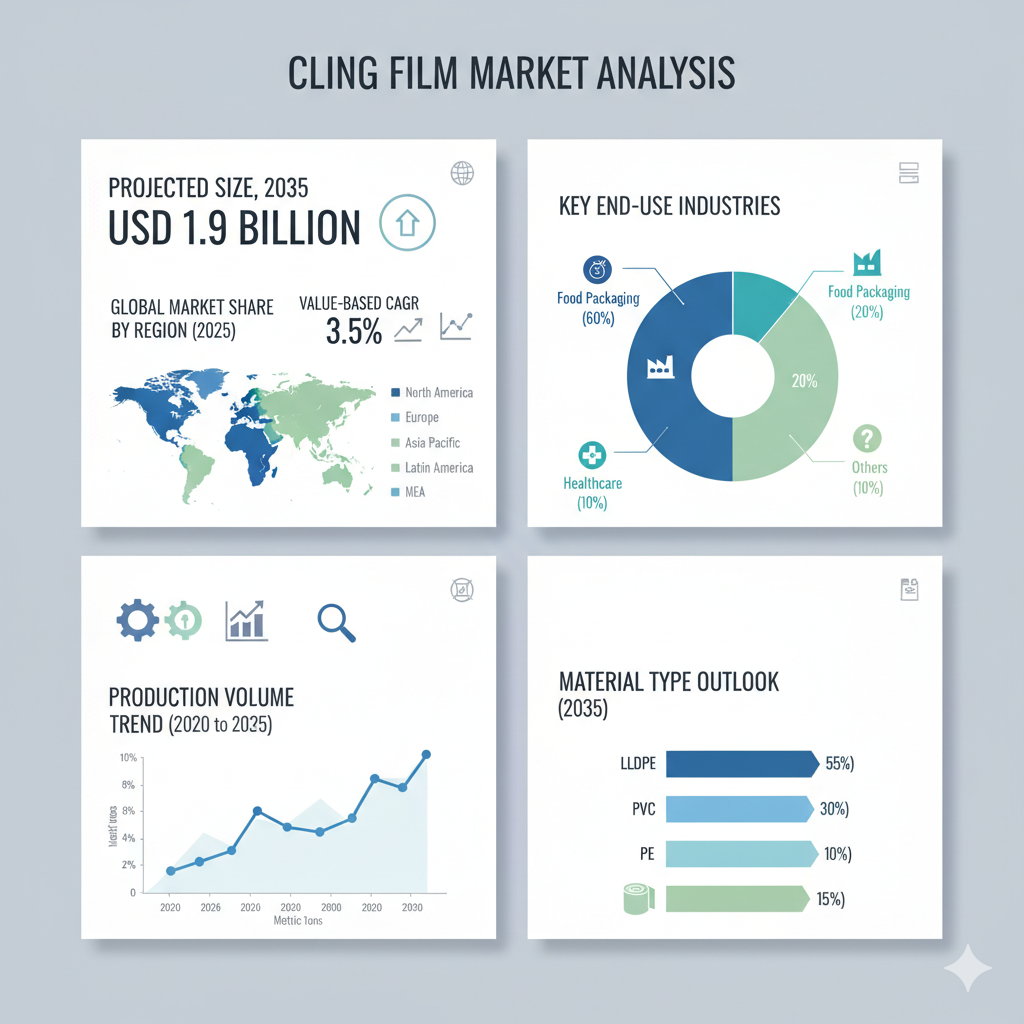
The global cling film market is projected to reach USD 1.9 billion by 2035, expanding at a compound annual growth rate (CAGR) of 3.5 percent between 2025 and 2035. This growth presents a rich opportunity for both well-established manufacturers and new entrants alike, as the industry pursues innovation in materials, sustainability, and production technologies.
Growth Drivers and Market Dynamics
Demand for cling film is being shaped by several key forces: stricter food-safety requirements, rising consumer preference for convenience and freshness, and an increasing emphasis on recyclable and biodegradable packaging. At the same time, emerging technologies—such as biodegradable materials, high-barrier films that protect against moisture and oxygen ingress, and advanced coating innovations—are redefining how companies compete and create value.
For incumbent manufacturers, these developments signal a pivotal moment. Leaders such as Amcor Plc, Berry Global, Inc., and Sealed Air Corporation are advancing next-generation cling film technologies. Amcor is developing recyclable cling films for both the food and healthcare sectors; Berry Global is focusing on lightweight, high-strength films and compostable designs; and Sealed Air is pushing forward with high-barrier films using enhanced coating processes.
Opportunities for New Entrants and Mid-Tier Manufacturers
The report reveals that while global leaders hold a significant market presence, more than half of the market remains open to smaller and regional players. This creates ample opportunity for newcomers and mid-sized manufacturers to establish themselves through differentiation and technological advancement.
For these emerging players, scaling operations around sustainable materials, mono-material film solutions, energy-efficient production, and partnerships with end-user industries such as food, beverage, and healthcare can serve as key differentiators. By adopting green manufacturing practices and aligning with global sustainability goals, they can capture attention from environmentally conscious consumers and retailers alike.
Technology, Collaboration, and Sustainability as Strategic Imperatives
As the competitive landscape evolves, partnerships between manufacturers, raw-material suppliers, and packaging companies are becoming essential. In-house manufacturing offers greater control over quality and innovation, while contract packaging models provide scalability and faster market access. Both strategies can thrive if anchored in technological innovation and a sustainability-first mindset.
Sustainability is no longer optional—it’s the industry’s guiding principle. The transition toward recyclable or compostable cling films, mono-material designs for circular recycling, and low-energy production processes is already shaping the next decade of growth. Companies that proactively integrate these elements into their production pipelines are expected to gain a lasting competitive edge.
Regional Insights and Expansion Opportunities
North America currently leads the global cling film market, driven by strong food-safety standards and consistent demand from retail and foodservice sectors. Europe follows closely, bolstered by rigorous sustainability regulations and consumer demand for eco-friendly packaging. Meanwhile, the Asia-Pacific region is emerging as the fastest-growing market, supported by rapid industrialization, urbanization, and a thriving packaged food sector.
Growth opportunities are particularly strong in emerging economies across Asia-Pacific, Latin America, and Africa. Manufacturers entering these regions with affordable, high-performance, and sustainable cling film solutions are expected to capture substantial market share in the coming years.
A Call to Action for Expanding Manufacturers
Whether an established global enterprise or a regional manufacturer ready to scale, the direction is clear: embrace sustainability, leverage new technologies, and form strategic partnerships. Companies that innovate with purpose—developing materials that align with both regulatory mandates and consumer values—will define the next generation of cling film products.
As the industry moves toward 2035, the window for leadership in this evolving market is open now. By combining technological progress with environmental responsibility, manufacturers can secure their place at the forefront of global packaging innovation.