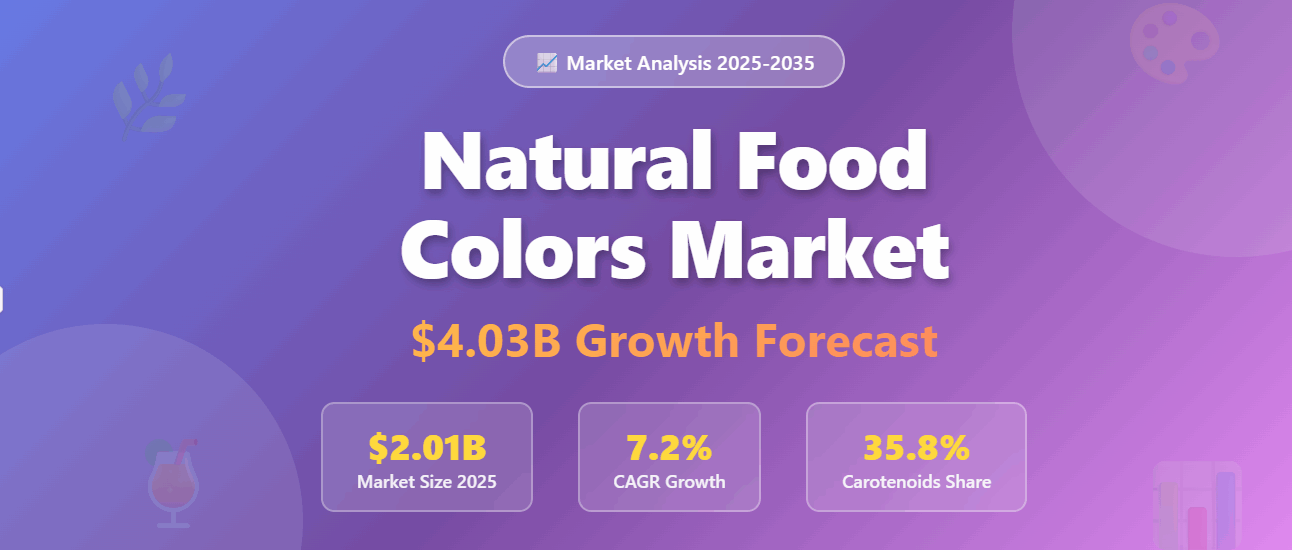
🎨 Natural Food Colors Market
Global Market Analysis, Size, Share & Forecast 2025-2035
Market Overview & Growth Drivers
Market Growth Drivers
- Rising consumer demand for clean-label ingredients
- Increasing adoption of plant-based and organic food products
- Regulatory pressures phasing out synthetic food dyes
- Innovations in extraction technologies
- Growing preference for non-GMO formulations
- Popularity of functional foods with antioxidant-rich colorants
Market Projection 2020-2035
💡 Key Insight
Natural food colors are moving from niche to mainstream with global per-capita consumption expected to reach 21g by 2030, up from 17-20g in 2024.
🌿 Industry Momentum
Growth momentum lies in beverages and plant-based meat, where vivid hues double as “clean label” cues, signaling transparency to health-conscious consumers.
📍 Major Industry Development
June 2025: Kraft Heinz announced elimination of synthetic dyes from all USA products by end of 2027, underscoring the accelerating industry pivot toward safer, natural alternatives driven by FDA initiatives and public health concerns.
Market Segments Analysis
Pigment Type Distribution (2025)
Application Segment Distribution (2025)
🎯 Carotenoid Pigments – Market Leader (35.8% Share)
- Widely used for vibrant colors and proven health benefits
- Includes beta-carotene, lutein, and zeaxanthin sourced from vegetables, fruits, and algae
- Primary applications in dairy, snacks, and bakery items
- Driven by health-conscious consumer preferences for antioxidant-rich ingredients
- Leading companies: DSM, Kalsec, Chr. Hansen
🍹 Beverages – Leading Application Segment (38.8% Share)
- Key consumer of natural food colors in soft drinks, juices, and functional beverages
- Rising demand for clean-label, natural ingredients
- Natural colors from fruits, vegetables, and spices favored for aesthetics and health benefits
- Leading players: Ingredion, Chr. Hansen, Wild Flavors
🔍 Product Forms
Available in liquid, powder, and gel forms to meet diverse manufacturing requirements and specific application needs.
🌱 Source Categories
Plant-based, animal-based (carmine), and microbial sources (spirulina) providing multiple sourcing options.
📊 Market Trends
Segmentation by pigment type, functionality, source, form, and region covering 60+ countries.
Regional Market Analysis
CAGR by Country (2025-2035)
🏅 Fastest Growing Market: India
Symrise & ADM investment: Microencapsulation technology for enhanced heat and light stability of anthocyanins and carotenoids
Market Trends & Insights
Key Market Opportunities
🎯 Growth Opportunities
- Plant-based meat and dairy-free beverage segments showing explosive growth
- Functional food categories with enhanced health claims
- Emerging markets (India, Vietnam, Thailand) with rising processed food penetration
- Bio-fermentation technologies for scalable production
- Regulatory tailwinds phasing out synthetic dyes globally
- Premium product segments commanding higher prices for natural ingredients
🔬 Technology Innovations
- Microencapsulation for improved pigment stability
- Nano-dispersion technologies for better application performance
- Advanced extraction using fermentation instead of agriculture
- Solvent-free enzymatic pigment extraction methods
- Real-time stability monitoring and quality assurance
- AI-driven botanical sourcing and supply chain optimization
Market Consumption Trend (2024-2030)
🚀 Get Full Market Insights Today
Unlock comprehensive analysis, interactive dashboards, and strategic recommendations
📋 Purchase Report Packages
👤 Single User License
- PDF Report Format
- Excel Data Files
- Personal Access Only
- 1 Year of Updates
👥 Multi User License
- PDF Report Format
- Excel Data Files
- Team Access (5 Users)
- 1 Year of Updates
- Dashboard Access
📦 DELIVERED AS: PDF • EXCEL • ONLINE
📊 Interactive Forecasting Dashboard
Real-time KPIs and visual insights into market trends with dynamic data updates and custom report generation capabilities.
📈 MarketNgage Data Platform
Real-time data with customizable dashboards, competitive pricing, and seamless integration with your existing workflows.
🎨 Pigment Types Covered
Carotenoids (Beta-carotene, Annatto, Lutein, Lycopene), Curcumin, Anthocyanin, Paprika Extract, Spirulina, Chlorophyll, Carmine
🍽️ Applications Analyzed
Dairy Food Products, Beverages, Packaged/Frozen Foods, Confectionery, Bakery Products, and emerging categories
🌎 Geographic Coverage
8 Regions • 60+ Countries • USA, Canada, Germany, UK, France, China, India, Japan, Brazil, Australia, South Africa
📊 Data Coverage
Historical data (2020-2024) • Projections (2025-2035) • 350+ pages of comprehensive insights
🔄 Updates & Support
12 months of continuous data updates • Quarterly market reports • Dedicated analyst support
🎯 Key Players
15+ major suppliers with competitive profiles, market share analysis, and strategic positioning
Have Questions? Let’s Connect
Our research team is ready to help you unlock market opportunities
❓ Frequently Asked Questions
🎯 Ready to Make Informed Decisions?
Download the complete Natural Food Colors Market Report and get ahead of industry trends
📄 Report Last Updated: July 25, 2025 | 350 Pages | Food & Beverage Category
🏆 Recognized Industry Authority • Member of Greater New York Chamber of Commerce
© 2025 Market Research. All rights reserved. | Privacy Policy | Terms of Service
CAGR: 8.3%
- Leveraging botanical biodiversity and low-cost extraction advantage
- Dominated by turmeric-curcumin, annatto, and marigold derivatives
- Government-backed curcumin cluster zones for pigment exports
- Make in India accelerating SME-scale natural color manufacturing hubs
- Strong export demand from EU buyers for synthetic-free alternatives
💰 Largest Market: USA
CAGR: 7.9%
- Dominance of functional foods and personalized nutrition
- R&D hubs across California and Midwest
- Integration into plant-based meats and dairy-free beverages
- Strict FDA scrutiny shifting formulation away from FD&C colors
- Heavy retail push from Whole Foods and Trader Joe’s
🇩🇪 Germany (7.5% CAGR)
Strong alignment between consumer activism and sustainable supply chains. Bio-fermentation to reduce agricultural volatility. Local innovation clusters in Bavaria and Hamburg.
🇫🇷 France (7.2% CAGR)
Unique focus on gourmet and artisanal food sector. Natural colors heavily used in pâtisserie, craft cheeses, and wine-based marinades. High interest in gastronomic aesthetics.
🇨🇳 China (8.1% CAGR)
Thriving functional beverage sector and rapid food processing modernization. Government-mandated reformulations in school meals. Leading innovation in safflower and gardenia-derived pigments.
Per Capita Consumption by Region (grams/person)
🌍 Global Consumption Insights
- Netherlands: 400g per capita (Europe’s blending and re-export hub)
- Germany & Denmark: ~380g per capita (bakery, confectionery, dairy)
- USA: 230g per capita (premium spirulina, carmine, carotene dispersions)
- Global Average: 20g per capita (projected to reach 21g by 2030)
- Emerging Markets: Vietnam (14g), Thailand (14g) showing rapid growth
Market Leaders & Players
👑 Market Leader: Chr. Hansen Holding A/S
Global Market Share: 16%
- Leading position with advanced extraction technologies
- Recent innovation: FruitMax® Yellow 1000 (turmeric-derived)
- Robust global distribution networks
- Strong presence across multiple application sectors
Competitive Landscape by Tier
🏆 Tier 1 – Global Leaders
Players: Sensient Technologies, Archer Daniels Midland, Chr. Hansen
Advanced extraction technologies, global supply chains, continuous innovation
🎯 Tier 2 – Innovators
Players: Döhler, GNT, Symrise
Focus on clean-label solutions and sustainable sourcing practices
📍 Tier 3 – Regional Players
Players: Aakash Chemicals, AFIS
Operating regionally with specialized niche portfolios