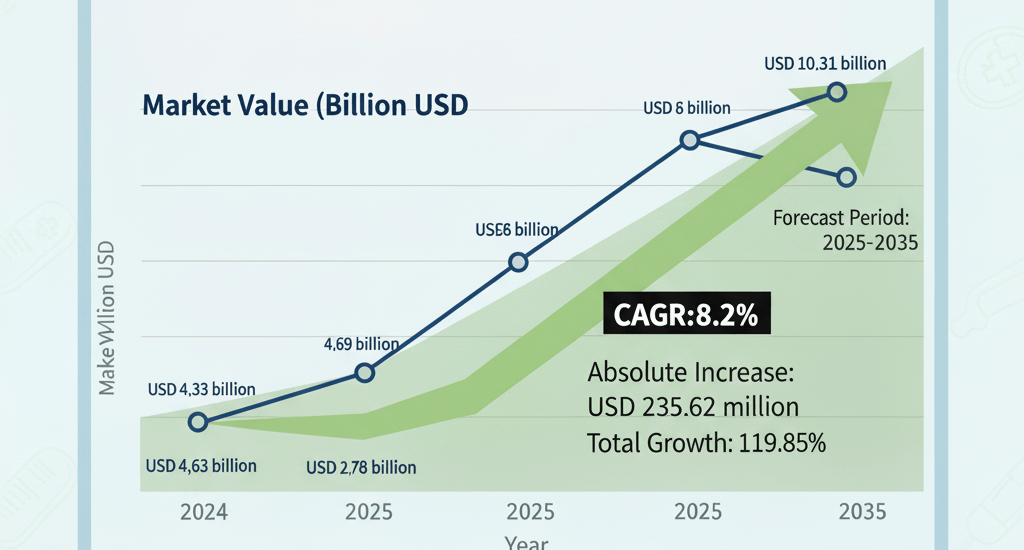
The global sales of microbial identification are estimated to be worth USD 4.69 billion in 2025 and anticipated to reach a value of USD 10.31 billion by 2035. Sales are projected to rise at a CAGR of 8.2% over the forecast period between 2025 and 2035. The revenue generated by microbial identification in 2024 was USD 4.33 billion.is driven by the surging global burden of infectious diseases such as tuberculosis, meningitis, sepsis, and foodborne illnesses. The need for rapid, accurate microbial identification has become more crucial than ever, especially as drug-resistant pathogens threaten global health.
Microbial Identification Market Overview and Key Drivers:
Infectious diseases continue to pose one of the biggest challenges to global health. According to the World Health Organization (WHO), tuberculosis (TB) alone caused 1.25 million deaths in 2023, including 161,000 people with HIV. The increasing incidence of antimicrobial resistance (AMR) and drug-resistant strains has heightened the need for advanced microbial identification systems capable of differentiating between sensitive and resistant microorganisms.
Moreover, foodborne infections caused by pathogens such as E. coli, Salmonella, and Listeria contribute significantly to healthcare costs and public health challenges. Rapid microbial testing is critical for managing such outbreaks, ensuring food safety, and preventing large-scale contamination events. The rising frequency of pandemics, urbanization, and climate change further underscore the importance of robust diagnostic tools for pathogen surveillance and outbreak management.
Microbial Identification Market Highlights and Technological Advancements:
The microbial identification industry has undergone a technological revolution, led by next-generation sequencing (NGS), MALDI-TOF mass spectrometry, microfluidics, and multiplex PCR systems. These innovations enable faster, more accurate identification and characterization of pathogens, improving both clinical outcomes and industrial safety standards.
- Next-Generation Sequencing (NGS): NGS allows detailed genetic analysis of pathogens, enabling researchers to detect resistance genes and track disease transmission patterns in real time.
- MALDI-TOF Mass Spectrometry: This technique provides rapid identification of bacteria, fungi, and yeasts based on unique protein fingerprints. It can process hundreds of samples in minutes, offering significant efficiency for high-throughput labs.
- Microfluidics and Lab-on-a-Chip: Portable identification tools powered by microfluidic systems enable real-time detection of microbes at the point of care or in field environments, expanding diagnostic accessibility.
- Multiplex PCR: The ability to detect multiple pathogens in a single assay enhances testing efficiency, especially in clinical and food safety applications.
Microbial Identification Market Genomic Databases Fueling Industry Growth:
Expanding genomic databases have transformed microbial identification, enabling faster and more accurate detection of pathogens. Initiatives such as the Global Microbial Identifier (GMI) and Pathogenwatch facilitate global sharing of sequencing data, aiding in disease surveillance and resistance tracking. These databases support global public health by helping laboratories compare microbial data against vast repositories, improving diagnostic precision and response times.
Microbial Identification Market Opportunities and Challenges:
Emerging Opportunities: Growing awareness of food safety and quality presents major opportunities for market expansion. Stringent regulations from organizations such as the FDA, EFSA, and ISO 22000 demand advanced microbial testing for compliance. Food and beverage manufacturers are increasingly investing in rapid microbial identification tools to ensure brand reputation, minimize recall risks, and improve process transparency.
The integration of automation and AI into microbial identification workflows is another key opportunity. AI-driven pattern recognition and automated analysis systems can enhance accuracy and speed, improving decision-making in laboratories and production lines.
Market Challenges: Despite its promise, the microbial identification market faces challenges in non-clinical sectors due to limited awareness and adoption of advanced systems. Many small and medium-sized enterprises (SMEs) in food safety, water management, and environmental testing still rely on traditional culture-based methods. Misconceptions about high costs and operational complexity restrict technology uptake, especially in developing regions. Increased outreach, training, and government support will be essential to bridge this knowledge gap and drive broader adoption.
Microbial Identification Market Performance and Growth Trends (2020–2035):
From 2020 to 2024, the market grew at a CAGR of 6.1%, driven by increased healthcare investment and advances in diagnostic technologies such as PCR and MALDI-TOF. Automation, AI integration, and personalized medicine trends further supported industry expansion.
Between 2025 and 2035, the CAGR is expected to remain strong at 8.2%, supported by government initiatives in AMR control, technological breakthroughs, and rising global disease surveillance programs. Portable and field-deployable microbial identification tools are anticipated to extend applications beyond laboratories, especially in remote or resource-limited settings.
Microbial Identification Market Concentration and Competitive Landscape:
The microbial identification market is moderately concentrated, with Tier 1 companies holding approximately 58.9% of the global market share. These leading players dominate through innovation, strategic acquisitions, and global distribution networks.
- Tier 1 Companies: Danaher Corporation, Bruker Corporation, Thermo Fisher Scientific, Siemens Healthineers – These players invest heavily in R&D, expanding their microbial identification portfolios through cutting-edge technologies and clinical validation.
- Tier 2 Companies: Shimadzu Corporation, Wickham Laboratories, VWR International LLC – These firms focus on regional markets, offering agile solutions and competitive pricing through collaborations with hospitals and research institutes.
- Tier 3 Companies: MIDI Inc., Charles River Laboratories – Niche players specializing in specific microbial identification products and services, contributing to market diversity and innovation.
Recent Industry Developments
- Thermo Fisher Scientific (2024): Introduced advanced genomic technologies for microbial genomics and infectious disease research.
- Wickham Laboratories (2023): Expanded MALDI-ToF testing capabilities to meet rising demand in pharmaceutical and medical device sectors.
- Bruker Corporation (2023): Enhanced its MALDI Biotyper platform for faster identification of mycobacteria and fungi, increasing throughput to 600 samples per hour.
Microbial Identification Market Regional Insights:
United States: The U.S. dominates the North American microbial identification market, projected to grow at a CAGR of 3.1% through 2035. The presence of industry leaders such as Thermo Fisher Scientific, Danaher, and BioMérieux, coupled with strong healthcare infrastructure, supports its leadership. R&D investment, technological innovation, and regulatory compliance fuel market expansion.
Germany: Germany’s market is expected to grow at 5.6% CAGR from 2025 to 2035. As a hub for chemical and manufacturing industries, strict environmental regulations drive the adoption of microbial monitoring technologies for wastewater and industrial effluents. The focus on bioremediation and sustainability further strengthens demand.
Japan: Japan is forecasted to grow at 5.9% CAGR, underpinned by its stringent food safety regulations. Advanced microbial identification tools are critical for detecting contamination in seafood and beverages, ensuring compliance with export quality standards.
India and China: Emerging economies such as India (7.1% CAGR) and China (6.7% CAGR) are witnessing rapid adoption of microbial diagnostics due to rising healthcare infrastructure investments, growing pharmaceutical sectors, and heightened awareness of food and water safety.
Full Market Report available for delivery. For purchase or customization, please request here: https://www.futuremarketinsights.com/checkout/5077
Request for Discount: https://www.futuremarketinsights.com/reports/sample/rep-gb-5077
Microbial Identification Market Future Outlook:
The microbial identification market is set for significant expansion, fueled by the convergence of genomics, AI, and automation. Continuous advancements in portable diagnostic tools and global disease surveillance systems will redefine how infections are detected, tracked, and controlled.
With increasing public health awareness, stringent safety regulations, and technological breakthroughs, the microbial identification industry is evolving into a cornerstone of healthcare, food safety, and environmental sustainability worldwide.
Explore More Related Studies Published by Fact.MR Research:
Global Cardiac Assist Devices market is expected to be valued at USD 1.4 billion in 2025. And is projected to reach valuation of USD 2.5 billion by 2035, with CAGR of 5.8% over the forecast period.
Global Automated Cell Shakers market is expected to be valued at USD 649.3 million in 2025. And is projected to reach valuation of USD 920.8 million by 2035, with CAGR of 3.5% over the forecast period.
Global Digital Wound Measurement Devices market is expected to be valued at USD 1,136.9 million in 2025. And is projected to reach valuation of USD 1,887.5 million by 2035, with CAGR of 5.2% over the forecast period.
About Future Market Insights (FMI)
Future Market Insights, Inc. (ESOMAR certified, recipient of the Stevie Award, and a member of the Greater New York Chamber of Commerce) offers profound insights into the driving factors that are boosting demand in the market. FMI stands as the leading global provider of market intelligence, advisory services, consulting, and events for the Packaging, Food and Beverage, Consumer Technology, Healthcare, Industrial, and Chemicals markets. With a vast team of over 400 analysts worldwide, FMI provides global, regional, and local expertise on diverse domains and industry trends across more than 110 countries.
Contact Us:
Future Market Insights Inc.
Christiana Corporate, 200 Continental Drive,
Suite 401, Newark, Delaware – 19713, USA
T: +1-347-918-3531
For Sales Enquiries: sales@futuremarketinsights.com
Website: https://www.futuremarketinsights.com
LinkedIn| Twitter| Blogs | YouTube