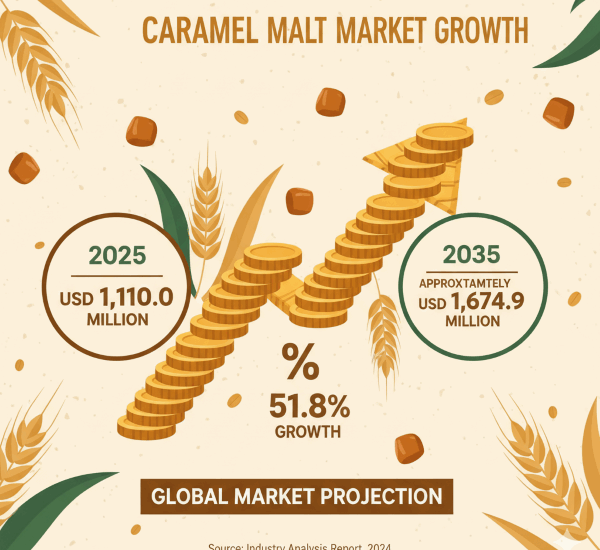
The global Caramel Malt Market is entering a new era of expansion, backed by rising demand for premium brewing ingredients, evolving consumer taste preferences, and the rapid growth of craft beer ecosystems across high-potential markets. According to the latest industry outlook titled “Caramel Malt Market Forecast and Outlook (2025-2035),” the market is projected to grow from USD 1,110.0 million in 2025 to USD 1,674.9 million by 2035, achieving an impressive 50.9% absolute increase and a 4.2% CAGR over the forecast period.
Caramel malt—a specialty malt renowned for its flavor depth, color complexity, and aroma contribution—is increasingly becoming a core ingredient not only in brewing but also in specialty food, confectionery, dairy, and bakery applications. Market growth is being shaped by an emerging trend: manufacturers are innovating to develop malt types with premium sensory performance, cleaner labels, and customized flavor profiles.
Get this Report at $3500 | Grab Your Market Insights Today: https://www.futuremarketinsights.com/reports/sample/rep-gb-8042
Established Maltsters Lead, but New Entrants Are Disrupting the Market
Market leaders like Bairds Malt Limited, Weyermann, and Castle Malting continue to dominate based on capacity, malting legacy, and advanced kilning technologies. Their expertise in precision roasting and proprietary malting techniques enables them to deliver highly consistent caramel malt varieties at scale.
At the same time, new and emerging malt houses—particularly in Asia-Pacific and Eastern Europe—are entering the market to serve local craft breweries with:
- Regionally sourced grains
- Custom roasting profiles
- Sustainability-focused production techniques
These new entrants are reshaping the competitive landscape by offering flexibility, small-batch specialty malts, and affordable pricing—factors that attract startups, home brewers, and nano-breweries.
Premium Malt Innovation is Rising Across Segments
Kilned caramel malt, representing 60% of production in 2025, remains the most widely used thanks to controlled color development and predictable brewing performance. Meanwhile, roasted caramel malt—used for intense, darker beer profiles—is gaining ground among craft producers pursuing bold flavors.
Caramel malt also exhibits strong growth in non-alcoholic applications, including:
- Natural food coloring for confectionery
- Flavor enhancement in bakery products
- Malted ingredients in dairy and frozen desserts
The shift toward clean-label and natural ingredients is accelerating caramel malt adoption in food and beverage manufacturing, giving the market an additional growth path beyond brewing.
Asia Pacific: The Fastest-Growing Growth Hub
Countries like China (5.7% CAGR) and India (5.3% CAGR) are leading global expansion as microbrewery ecosystems surge and consumer interest in premium and flavored beers increases.
- In China, the rise of premium beers and local brewing infrastructure boosts demand for caramel malts with diverse flavor profiles.
- In India, policy liberalization and rapid expansion of microbreweries drive increased investment in malt storage and supply chain partnerships.
- Japan and South Korea continue to invest in premium-quality brewing technologies, favoring malt suppliers capable of meeting strict flavor and performance standards.
Europe Remains the Quality Benchmark for Caramel Malt
Germany—renowned for precision malting and heritage brewing—holds the strongest market share in Europe. Belgium and the United Kingdom follow closely due to their unique specialty brewing cultures and growing interest in premium and traditional malt varieties.
Access Premium Reports – Get Your Copy Today: https://www.futuremarketinsights.com/checkout/8042
Opportunities Ahead for Manufacturers
Manufacturers—especially new entrants—have strategic opportunities to capitalize on:
- Custom malt specifications for craft breweries
- Collaboration with farm-to-malt traceability programs
- Adoption of energy-efficient and sustainable malting systems
- Expansion into food and dairy applications where caramel malt serves as a natural alternative to artificial flavorings
About Future Market Insights (FMI)
Future Market Insights, Inc. (ESOMAR certified, recipient of the Stevie Award, and a member of the Greater New York Chamber of Commerce) offers profound insights into the driving factors that are boosting demand in the market. FMI stands as the leading global provider of market intelligence, advisory services, consulting, and events for the Packaging, Food and Beverage, Consumer Technology, Healthcare, Industrial, and Chemicals markets. With a vast team of over 400 analysts worldwide, FMI provides global, regional, and local expertise on diverse domains and industry trends across more than 110 countries.
Contact Us:
Future Market Insights Inc.
Christiana Corporate, 200 Continental Drive,
Suite 401, Newark, Delaware – 19713, USA
T: +1-347-918-3531
For Sales Enquiries: sales@futuremarketinsights.com
Website: https://www.futuremarketinsights.com
LinkedIn| Twitter| Blogs | YouTube