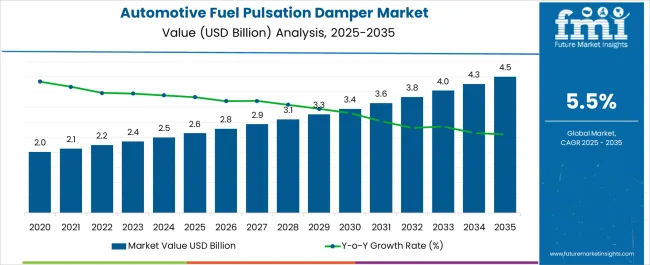
The Automotive Fuel Pulsation Damper Market is witnessing growing demand as automakers prioritize engine efficiency, fuel economy, and reduced emissions. A fuel pulsation damper plays a critical role in stabilizing pressure fluctuations in the fuel system, ensuring consistent delivery of fuel to the injectors and enhancing overall engine performance. With the continuous advancements in fuel injection systems and the shift toward cleaner and more efficient vehicles, fuel pulsation dampers have become indispensable components in modern automotive designs.
Market Overview
The automotive fuel pulsation damper market is expanding steadily, supported by the increasing production of internal combustion engine (ICE) vehicles and the adoption of high-pressure fuel injection systems. As global emission norms become stricter, automakers are integrating precise fuel management technologies to meet environmental standards while maintaining vehicle performance. Moreover, hybrid and turbocharged engines—known for their sensitivity to fuel pressure variations—are further driving demand for efficient pulsation dampers.
Key Market Drivers
The growth of the automotive fuel pulsation damper market is fueled by multiple factors:
- Rising Demand for Fuel-Efficient Vehicles: Automakers are increasingly using fuel pulsation dampers to ensure smooth fuel flow and reduce wastage.
- Stringent Emission Regulations: Governments worldwide are enforcing emission standards that require cleaner and more stable combustion, increasing damper usage.
- Growth in Direct Fuel Injection Systems: The shift toward direct injection engines, which operate under higher pressures, drives the demand for precision damping components.
- Increased Vehicle Production: Expanding automotive manufacturing in regions such as Asia-Pacific and Europe supports steady market growth.
- Adoption in Hybrid and Performance Vehicles: Advanced vehicles require stable fuel systems to achieve optimal performance and lower vibration noise.
Market Segmentation
The market for automotive fuel pulsation dampers can be segmented as follows:
- By Vehicle Type:
- Passenger Cars
- Light Commercial Vehicles (LCVs)
- Heavy Commercial Vehicles (HCVs)
- By Engine Type:
- Gasoline Engines
- Diesel Engines
- Hybrid Engines
- By Material:
- Steel
- Aluminum
- Composite Materials
- By Distribution Channel:
- OEM (Original Equipment Manufacturers)
- Aftermarket
Technological Advancements
Innovation in automotive fuel systems has paved the way for new designs and improved performance of fuel pulsation dampers:
- Integration with Electronic Fuel Injection (EFI) Systems: Enhances control of fuel delivery and pressure stabilization.
- Lightweight Materials: Use of high-performance composites reduces overall vehicle weight and improves fuel efficiency.
- High-Temperature Resistance Designs: Enable dampers to operate effectively under the extreme thermal conditions of turbocharged and hybrid engines.
- Noise and Vibration Reduction Technology: Advanced dampers reduce noise, vibration, and harshness (NVH), improving the driving experience.
Regional Insights
- Asia-Pacific: Dominates the market due to large-scale automotive production in China, India, and Japan, coupled with growing demand for fuel-efficient vehicles.
- Europe: Emphasizes strict emission standards and adoption of advanced fuel systems in luxury and performance cars.
- North America: Strong presence of high-performance vehicles and ongoing R&D in hybrid technologies drive market growth.
- Latin America & Middle East: Emerging markets focusing on improving fuel system efficiency and durability.
Future Outlook
The Automotive Fuel Pulsation Damper Market is expected to grow significantly as the automotive industry continues to evolve toward high-efficiency combustion and hybridization. Manufacturers are investing in innovative damper materials, integrated sensor systems, and compact designs to meet the changing needs of vehicle architectures. As fuel delivery systems become more complex and performance-driven, the role of fuel pulsation dampers will remain vital in ensuring engine reliability, smoother operation, and compliance with emission standards.
Get Instant Access for Only $5000 | Don’t Miss This Exclusive Offer!
https://www.futuremarketinsights.com/reports/sample/rep-gb-5393
Checkout Now to Access Industry Insights:
https://www.futuremarketinsights.com/checkout/5393
About Future Market Insights (FMI)
Future Market Insights, Inc. (ESOMAR certified, recipient of the Stevie Award, and a member of the Greater New York Chamber of Commerce) offers profound insights into the driving factors that are boosting demand in the market. FMI stands as the leading global provider of market intelligence, advisory services, consulting, and events for the Packaging, Food and Beverage, Consumer Technology, Healthcare, Industrial, and Chemicals markets. With a vast team of 400 analysts worldwide, FMI provides global, regional, and local expertise on diverse domains and industry trends across more than 110 countries.
Contact Us:
Future Market Insights Inc.
Christiana Corporate, 200 Continental Drive,
Suite 401, Newark, Delaware – 19713, USA
T: +1-845-579-5705
For Sales Enquiries: sales@futuremarketinsights.com
Website: https://www.futuremarketinsights.com
LinkedIn| Twitter| Blogs | YouTube