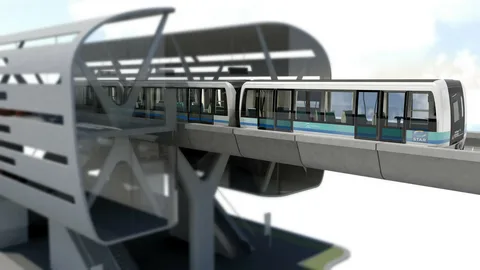
The global automated people mover (APM) market is projected to grow from USD 581.3 million in 2025 to USD 1,050.9 million by 2035, advancing at a CAGR of 6.1%. The Airport application segment is expected to lead the market with a 67% share in 2025, while the Duo Rail system type is anticipated to account for 82% of the system type classification segment.
The Global Automated People Mover (APM) Market is experiencing steady growth as cities, airports, and transit authorities increasingly adopt driverless mobility systems to enhance passenger convenience, reduce congestion, and improve operational efficiency. APM systems—once limited to major airports—are now expanding into urban transportation networks, driven by technological advancements and the rising need for sustainable public transit solutions.
As governments focus on developing smart infrastructure and zero-emission mobility, the market for automated people movers is positioned for robust expansion in the coming decade.
Market Overview
Automated People Movers (APMs) are fully automated, driverless transport systems designed for short- to medium-distance passenger movement. They are primarily used in airports, urban centers, business districts, and theme parks to provide quick, reliable, and efficient transportation.
These systems use automated guideway transit (AGT) technology, featuring electric propulsion, rubber tires, or steel wheels, and operate on dedicated guideways, ensuring safety, reliability, and energy efficiency.
Key Market Drivers
- Growing Demand for Seamless Airport Connectivity
With global air traffic increasing, airports are expanding terminal capacities and adopting automated passenger transfer systems to improve mobility. APMs help streamline airport logistics, reducing congestion and ensuring on-time connectivity between terminals. - Rapid Urbanization and Smart City Development
Rising urban populations and the need for efficient, low-emission urban transit are fueling APM installations in metropolitan areas. Governments are integrating these systems into smart city mobility plans for improved accessibility and traffic management. - Technological Advancements in Automation and Control Systems
Integration of AI-based control systems, IoT-enabled monitoring, and predictive maintenance is transforming the operational efficiency of APMs. Modern systems offer enhanced safety, real-time data analytics, and optimized energy use. - Sustainability and Environmental Regulations
Increasing focus on electric and low-carbon mobility solutions is encouraging investments in automated systems powered by renewable energy sources. APMs support carbon-neutral goals by reducing reliance on fossil-fuel-based shuttle services. - Expanding Applications Beyond Airports
While airports remain the largest end-users, APM adoption is rising in theme parks, urban centers, universities, and commercial zones, driven by the need for high-capacity, short-distance mobility solutions.
Market Segmentation
- By System Type:
- Monorail-based APMs
- Cable-propelled APMs
- Electric Automated Guideway Systems
- Magnetic Levitation (Maglev) Systems
- By Application:
- Airports
- Urban Transit Systems
- Amusement Parks
- Business Districts & Campuses
- By Operation Mode:
- Fully Automated
- Semi-Automated
- By Region:
- North America
- Europe
- Asia-Pacific
- Middle East & Africa
- Latin America
Regional Insights
- North America:
The region leads the global market, supported by significant investments in airport expansion projects and smart mobility initiatives. The U.S. has been a pioneer in adopting APM systems for major airports like Orlando, Dallas/Fort Worth, and Atlanta. - Europe:
Strong emphasis on sustainable mobility and low-emission transport drives APM growth in cities like London, Frankfurt, and Paris. EU policies promoting green public transit further enhance adoption. - Asia-Pacific:
Expected to record the fastest growth rate, fueled by rapid urbanization, airport upgrades, and large-scale projects in China, Japan, India, and South Korea. Governments are deploying APMs in major smart city and airport initiatives. - Middle East:
Mega infrastructure developments in UAE, Saudi Arabia, and Qatar, including airport and tourism hub expansions, are boosting APM installations in the region.
Competitive Landscape
Leading companies in the Automated People Mover Market include:
Bombardier Transportation (Alstom), Mitsubishi Heavy Industries, Siemens Mobility, Doppelmayr Group, Poma Group, Hitachi Rail, and Intamin Transportation.
These companies focus on technological innovation, modular system design, and integration of AI-based control platforms. Collaborations with governments and airport authorities are common strategies to expand their global footprint.
Technological Advancements
- Development of energy-efficient propulsion systems and lightweight materials to reduce operational costs.
- Integration of AI and predictive maintenance software for enhanced system uptime.
- Use of IoT sensors for real-time diagnostics, passenger monitoring, and safety assurance.
- Implementation of driverless control systems that improve speed precision and scheduling accuracy.
Market Challenges
- High Capital Investment:
APM systems require significant upfront costs in infrastructure, design, and installation. - Space Constraints in Urban Areas:
Integrating APM tracks within existing city layouts can be challenging. - Maintenance and Safety Regulations:
Strict standards for automated transit systems require continuous maintenance and safety validation.
Future Outlook
The Automated People Mover Market is set for sustained growth, driven by airport expansion, urban transit modernization, and smart mobility adoption. By 2035, APMs are expected to become integral components of multimodal transportation networks, seamlessly connecting airports, business hubs, and public transit systems.
With ongoing innovations in AI, automation, and sustainable energy integration, APMs will play a pivotal role in shaping the future of connected, carbon-free urban mobility.
Get Instant Access for Only $5000 | Don’t Miss This Exclusive Offer!
https://www.futuremarketinsights.com/reports/sample/rep-gb-7115
Checkout Now to Access Industry Insights:
https://www.futuremarketinsights.com/checkout/7115
About Future Market Insights (FMI)
Future Market Insights, Inc. (ESOMAR certified, recipient of the Stevie Award, and a member of the Greater New York Chamber of Commerce) offers profound insights into the driving factors that are boosting demand in the market. FMI stands as the leading global provider of market intelligence, advisory services, consulting, and events for the Packaging, Food and Beverage, Consumer Technology, Healthcare, Industrial, and Chemicals markets. With a vast team of 400 analysts worldwide, FMI provides global, regional, and local expertise on diverse domains and industry trends across more than 110 countries.
Contact Us:
Future Market Insights Inc.
Christiana Corporate, 200 Continental Drive,
Suite 401, Newark, Delaware – 19713, USA
T: +1-845-579-5705
For Sales Enquiries: sales@futuremarketinsights.com
Website: https://www.futuremarketinsights.com
LinkedIn| Twitter| Blogs | YouTube