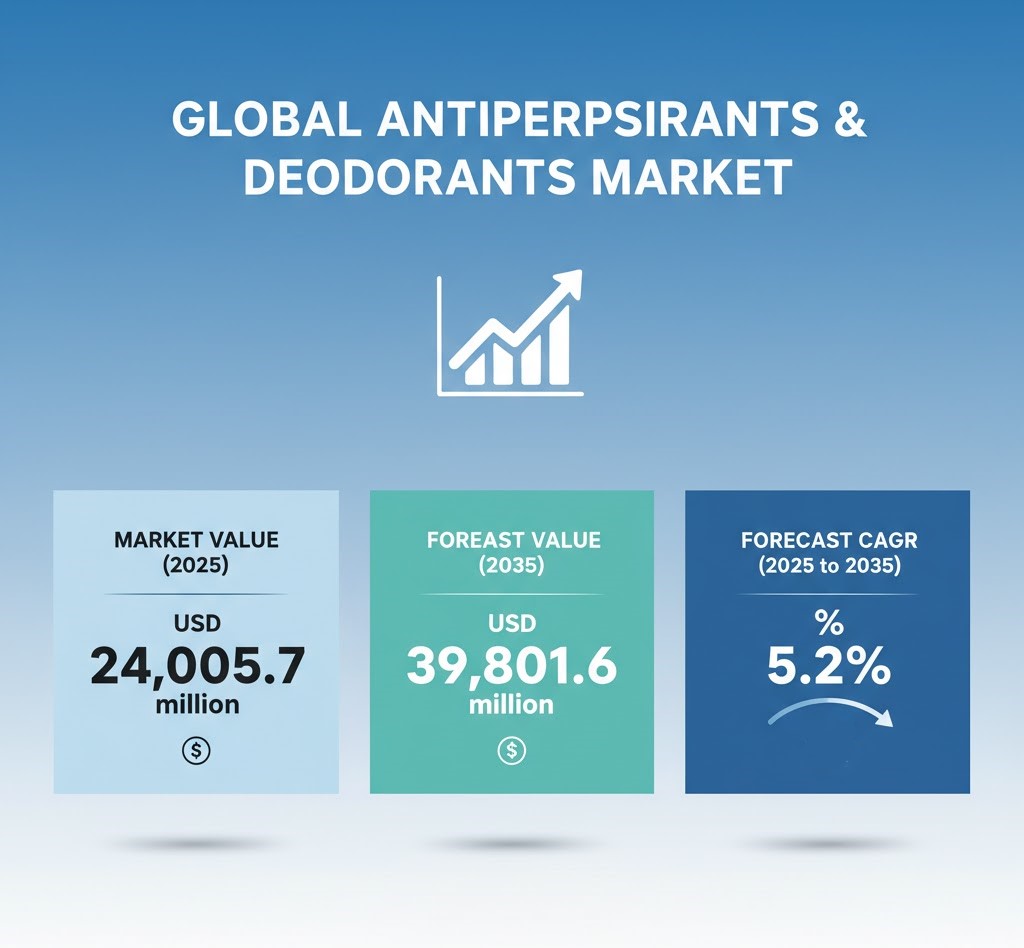
The global Antiperspirants and Deodorants Market is projected to witness remarkable growth over the next decade, recording a valuation of USD 24,005.7 million in 2025 and reaching USD 39,801.6 million by 2035, marking an increase of USD 15,795.9 million—a growth of nearly 193%. This expansion reflects a steady CAGR of 5.2%, underscoring the industry’s continued evolution toward sustainability, personalization, and digital transformation.
Quick Market Insights
- Market Value (2025): USD 24,005.7 Million
- Market Forecast (2035): USD 39,801.6 Million
- CAGR (2025–2035): 5.2%
- Leading Product Segment (2025): Sticks – accounting for over 60% of retail deodorant sales
- Top Growth Regions: North America, Asia-Pacific, Europe
- Key Players: Unilever (Dove, Rexona), Procter & Gamble (Secret, Old Spice), Beiersdorf (Nivea), Colgate-Palmolive, Henkel, Church & Dwight, L’Oréal, Kao, Lion Corporation, Revlon
Market Overview
From 2025 to 2035, the Antiperspirants and Deodorants Market will nearly double in size, propelled by rising hygiene awareness, eco-conscious product development, and digital-first retailing. Consumer demand is shifting toward natural, aluminum-free, and unisex deodorants, redefining competitive dynamics across global and regional markets.
Between 2025 and 2030, the market will expand from USD 24.0 billion to USD 30.9 billion, accounting for 44% of the decade’s growth. During this period, stick formats dominate due to their long-lasting protection and convenience. The latter half (2030–2035) will see stronger acceleration, adding USD 8.89 billion, driven by AI-enabled personalization, eco-packaging, and subscription-based retail models that will make up more than 50% of online sales by 2035.
Why the Market is Growing
- Rising Hygiene Awareness and Lifestyle Shifts
Urbanization, rising disposable incomes, and lifestyle changes are boosting daily deodorant use. Consumers are seeking dermatologically safe, sweat-resistant, and long-lasting products, encouraging brands to expand clean-label portfolios.
- Surge in Natural and Aluminum-Free Deodorants
Health-conscious consumers are increasingly avoiding aluminum and alcohol-based products. This trend fuels innovation in mineral salts, baking soda, and magnesium formulations, paving the way for sustainable and skin-friendly alternatives.
- Digital Commerce and Personalization
AI-powered product recommendations and subscription delivery models are transforming retail strategies. E-commerce and social media-driven brands are expanding rapidly in Asia, Europe, and North America, increasing accessibility and engagement.
- Gender-Neutral and Unisex Products on the Rise
Inclusivity has become a key growth driver. Brands are moving beyond gender-specific marketing to launch unisex deodorants that align with evolving consumer values and promote shared wellness.
Segmental Overview – Key Segments of the Market Report
By Product Type
- Sticks: Leading segment with over 60% of 2025 retail sales; valued for convenience and long-lasting protection.
- Roll-ons: Gaining popularity in Asia and Europe due to skin-friendly application and compact design.
- Sprays & Aerosols: Preferred in humid climates; expected to account for 40% combined share by 2035.
- Creams & Gels: Niche but growing segment offering gentle, premium formulations for sensitive skin.
By Active Ingredient
- Aluminum Compounds (56.1% share, 2025): Retains dominance due to proven sweat-control performance.
- Mineral Salts: Rising as natural substitutes with antibacterial and mild deodorizing properties.
- Natural Actives (Baking Soda, Magnesium): Fastest-growing category catering to health-conscious consumers.
By Function
- Odor Prevention (58.6% share, 2025): Core segment driven by demand for freshness and antibacterial efficacy.
- Sweat Control: Continues to evolve through hybrid and clinical-strength formulations.
- Sensitive-Skin Formulas: Expanding rapidly as consumers prefer hypoallergenic and alcohol-free options.
By Distribution Channel
- Supermarkets & Hypermarkets: Continue to dominate in volume sales.
- Pharmacies & Drugstores: Key outlets for premium and dermatologically tested deodorants.
- E-commerce: Expected to exceed 50% market share by 2035 through digital subscriptions.
- Convenience Stores: Strong foothold in developing nations driven by impulse and affordability purchases.
By End User
- Men (52.5% share, 2025): Leading category, driven by growing grooming awareness and performance-based products.
- Women: Increasing adoption of natural and skin-safe variants.
- Unisex: Rapidly emerging as the most inclusive and sustainable market segment.
By Region
- North America: Mature yet innovative market focusing on eco-packaging and clinical-strength solutions.
- Europe: Strong momentum in aluminum-free, vegan, and cruelty-free formulations.
- Asia-Pacific: Fastest-growing region, led by India (21.8% CAGR) and China (18.9% CAGR).
- Latin America & Middle East/Africa: Rising urban populations and hygiene awareness fuel steady adoption.
Country Highlights
United States
- Market size: USD 4.79 billion in 2025, projected to reach USD 7.42 billion by 2035 (CAGR 5.2%).
- Growth driven by aluminum-free, unisex, and refillable deodorants.
- Subscription and online models dominate digital engagement strategies.
United Kingdom
- 12.4% CAGR (2025–2035) led by demand for sustainable, cruelty-free, and gender-neutral formulations.
- Refillable packaging and eco-labeled products drive premiumization.
India
- Fastest-growing market at 21.8% CAGR, supported by youth-driven demand and e-commerce growth.
- Affordable roll-ons and tropical sweat-control innovations are key success factors.
China
- 18.9% CAGR, dominated by aluminum-based deodorants (55.2% share).
- Strong influence of digital retail, influencer marketing, and hybrid natural formulations.
Germany
- 9.5% CAGR, reflecting the country’s sustainability-first approach.
- Aluminum-free, vegan, and biodegradable deodorants dominate retail expansion.
Competitive Landscape
The global Antiperspirants and Deodorants Market is moderately consolidated, featuring a blend of established multinationals and fast-growing innovators:
- Unilever and Procter & Gamble continue to lead with iconic brands like Dove, Rexona, Secret, and Old Spice, investing in AI-based personalization and refillable packaging.
- Beiersdorf, Colgate-Palmolive, Henkel, Church & Dwight, and L’Oréal are expanding through natural, sensitive-skin, and eco-certified product lines.
- Emerging brands such as Kao, Lion Corporation, and Revlon are leveraging localized scents, eco-formulations, and digital-first strategies to challenge traditional leaders.
This Report Now at Just $2000 | Limited-Time Discount Offer! https://www.futuremarketinsights.com/reports/sample/rep-gb-27093
Checkout Now to Access Industry Insights: https://www.futuremarketinsights.com/checkout/27093
About Future Market Insights (FMI)
Future Market Insights, Inc. (ESOMAR certified, recipient of the Stevie Award, and a member of the Greater New York Chamber of Commerce) offers profound insights into the driving factors that are boosting demand in the market. FMI stands as the leading global provider of market intelligence, advisory services, consulting, and events for the Packaging, Food and Beverage, Consumer Technology, Healthcare, Industrial, and Chemicals markets. With a vast team of over 400 analysts worldwide, FMI provides global, regional, and local expertise on diverse domains and industry trends across more than 110 countries.
Contact Us:
Future Market Insights Inc.
Christiana Corporate, 200 Continental Drive,
Suite 401, Newark, Delaware – 19713, USA
T: +1-347-918-3531
For Sales Enquiries: sales@futuremarketinsights.com
Website: https://www.futuremarketinsights.com
LinkedIn| Twitter| Blogs | YouTube