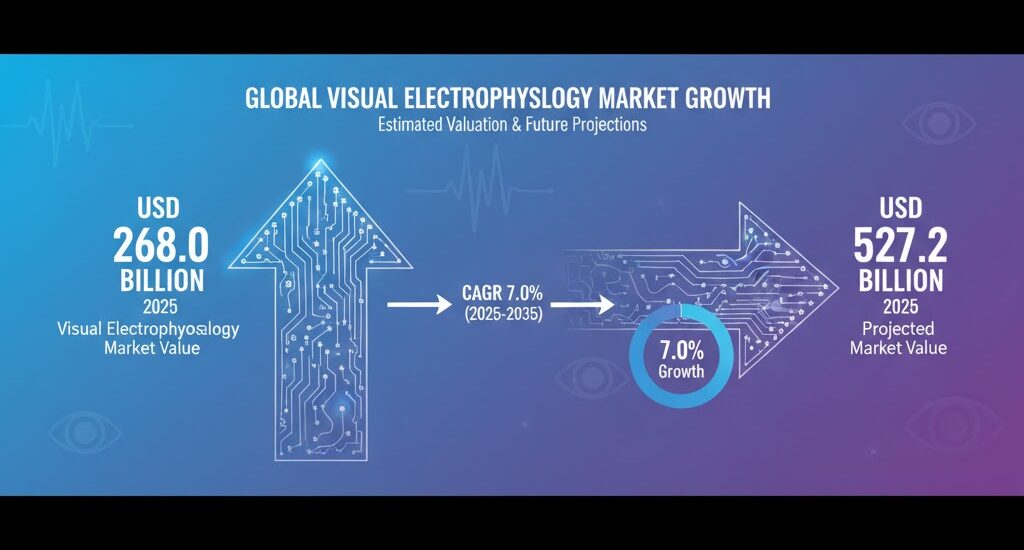
The global Visual Electrophysiology Market is poised for substantial expansion, projected to grow from USD 268.0 billion in 2025 to USD 527.2 billion by 2035, marking a 7.0% compound annual growth rate (CAGR) over the forecast period. This strong upward trajectory underscores a growing global commitment to improving ophthalmic diagnostics, addressing vision-related disorders early, and supporting the next generation of healthcare technologies for manufacturers and care providers.
Driving Forces Behind Market Expansion
The rapid rise in the prevalence of age-related macular degeneration, glaucoma, and diabetic retinopathy continues to be a central catalyst for growth. Increasing awareness of early detection and preventive eye care is spurring the adoption of non-invasive diagnostic methods across hospitals, specialty clinics, and research institutions.
Manufacturers are now uniquely positioned to innovate at the intersection of digital signal processing, AI-assisted diagnostic platforms, and portable electrophysiology systems, ensuring faster, more accurate visual testing. The integration of these technologies into existing healthcare infrastructures offers substantial opportunities to streamline workflows and deliver higher clinical accuracy—an area where equipment manufacturers can lead the charge.
Electroretinogram (ERG): Powering the Diagnostic Revolution
Among test types, the Electroretinogram (ERG) segment stands out as the clear leader, commanding 48.6% of the market by 2025. ERG provides critical insights into retinal function, enabling early diagnosis of inherited and acquired retinal disorders.
For manufacturers, ERG represents a lucrative innovation field—especially as handheld and portable systems become more prevalent in clinical practice. These solutions not only improve accessibility but also expand usage across emerging healthcare markets. The growing emphasis on precision diagnostics ensures that ERG remains the preferred and most commercially viable segment of the visual electrophysiology landscape.
Fixed Modality Systems Strengthen Clinical Foundations
By 2025, the fixed modality segment is projected to secure 57.3% of total market revenue, establishing itself as the cornerstone of ophthalmic diagnostics. These systems are celebrated for their stability, accuracy, and integration capabilities—features that resonate strongly with hospital environments requiring high patient throughput.
Manufacturers that focus on reliability, advanced imaging capabilities, and interoperability with digital medical systems are expected to capture the largest share of institutional contracts. Hospitals and clinics, now prioritizing end-to-end diagnostic solutions, are actively seeking technology partners who can deliver robust, compliant, and scalable visual electrophysiology platforms.
Hospitals Dominate End User Demand
Hospitals are projected to represent 44.8% of total market revenue by 2025, affirming their position as the largest end-user segment. Their dominance is driven by advanced diagnostic infrastructure, skilled personnel, and the ability to conduct comprehensive eye care programs.
For equipment manufacturers, hospitals provide consistent, long-term revenue streams and opportunities for product standardization. The demand for integrated electrophysiology testing within hospital-based care programs reflects a growing commitment to early intervention, multidisciplinary treatment, and improved patient outcomes.
Technology and Innovation: The Next Competitive Frontier
The future of the visual electrophysiology market lies squarely in technological innovation. From enhanced signal processing to AI-enabled data analytics, manufacturers are developing smarter, faster, and more intuitive systems that empower clinicians with deeper insights.
The convergence of ophthalmology with digital health ecosystems—including telemedicine, cloud-based reporting, and portable screening devices—is opening new possibilities for remote diagnostics. This trend is particularly crucial for regions with limited access to specialized eye care, offering manufacturers a chance to expand their global footprint through accessible and scalable solutions.
Challenges and Opportunities for Manufacturers
While growth prospects are strong, high diagnostic costs and stringent regulatory requirements continue to pose challenges. Developing economies often face shortages of trained professionals and adequate infrastructure, restricting widespread adoption.
Manufacturers have an opportunity to bridge these gaps through training programs, affordable system designs, and collaboration with healthcare providers to enhance accessibility. By focusing on cost-effective innovation and compliance, companies can transform these barriers into avenues for market expansion and long-term sustainability.
Buy Now & Save: Premium Market Report at $5,000 | Discount Details Inside:- https://www.futuremarketinsights.com/reports/sample/rep-gb-5268
Regional Insights: Where Growth Will Accelerate
- North America leads the global market with 36.1% share, fueled by substantial research investments and a high prevalence of vision disorders.
- Europe, holding 25.9% of market share, benefits from proactive government health initiatives and widespread adoption of advanced technologies.
- Asia-Pacific is emerging as a key growth engine, driven by healthcare modernization and rising awareness about eye health, with Japan playing a pivotal role through its strong technological infrastructure.
These regions collectively represent fertile ground for manufacturers to localize production, form strategic partnerships, and align with public health initiatives to advance global vision care.
Emerging Startups and Collaborative Innovation
The start-up ecosystem in visual electrophysiology is vibrant, emphasizing early diagnosis and training. Companies like LumiThera Inc. are pioneering photo-biomodulation (PBM) treatments to combat age-related macular degeneration. Their focus on research-driven, non-invasive technologies signals a broader shift toward innovation-driven competition—an environment where manufacturers can collaborate, co-develop, and accelerate product pipelines.
Competitive Landscape: Strengthening Through R&D
Key industry leaders—MetroVision, Konan Medical USA, LKC Technologies Inc., Boston Scientific Corporation, Siemens Healthcare GmbH, and Koninklijke Philips N.V.—are investing heavily in R&D to expand their diagnostic portfolios. Recent product introductions, such as Konan Medical’s CellChek 20 and LKC Technologies’ RETeval software update, demonstrate how product innovation continues to reshape diagnostic accuracy and workflow efficiency.
For manufacturers, this competitive environment highlights the growing importance of data integration, AI-based performance enhancement, and regulatory adaptability in shaping next-generation electrophysiology systems.
Outlook: A Decade of Growth and Transformation
As the market heads toward USD 527.2 billion by 2035, visual electrophysiology stands at the crossroads of technological advancement and clinical necessity. The ongoing convergence of digital innovation, patient-centered diagnostics, and healthcare modernization presents manufacturers with unprecedented growth opportunities.
By focusing on accessibility, precision, and partnership, companies can lead the transformation of global vision diagnostics—empowering clinicians, improving patient outcomes, and securing a pivotal role in the future of ophthalmic care.
Click Here to Purchase the Report:- https://www.futuremarketinsights.com/checkout/5268
About Future Market Insights (FMI)
Future Market Insights, Inc. (ESOMAR certified, recipient of the Stevie Award, and a member of the Greater New York Chamber of Commerce) offers profound insights into the driving factors that are boosting demand in the market. FMI stands as the leading global provider of market intelligence, advisory services, consulting, and events for the Packaging, Food and Beverage, Consumer Technology, Healthcare, Industrial, and Chemicals markets. With a vast team of over 400 analysts worldwide, FMI provides global, regional, and local expertise on diverse domains and industry trends across more than 110 countries.
Contact Us:
Future Market Insights Inc.
Christiana Corporate, 200 Continental Drive,
Suite 401, Newark, Delaware – 19713, USA
T: +1-347-918-3531
For Sales Enquiries: sales@futuremarketinsights.com
Website: https://www.futuremarketinsights.com
LinkedIn| Twitter| Blogs | YouTube