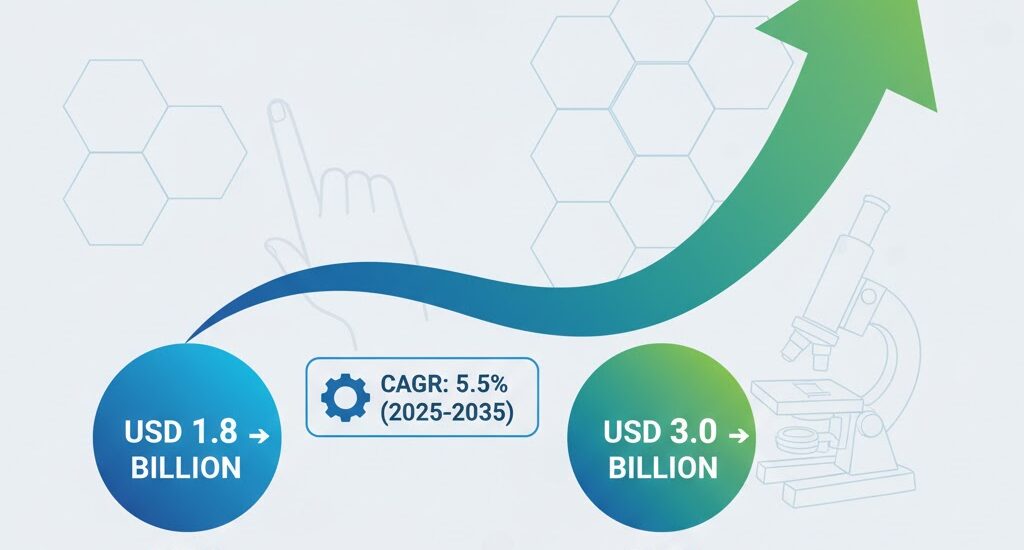
The Scleroderma Treatment Market is on track to experience transformative growth, rising from USD 1.8 billion in 2025 to USD 3.0 billion by 2035, reflecting a compound annual growth rate (CAGR) of 5.5%. This expansion highlights the sector’s critical role in addressing one of the most challenging autoimmune conditions while driving innovation, accessibility, and manufacturing excellence across global healthcare systems.
Rising Prevalence and Innovation Power Market Expansion
The growth of the Scleroderma Treatment Market is being propelled by the increasing prevalence of autoimmune disorders and heightened awareness of scleroderma among clinicians and patients. With the disease’s complex pathology affecting vascular systems, skin, and internal organs, demand for advanced therapies has intensified.
Manufacturers and research leaders are responding through innovations targeting inflammatory pathways, vascular abnormalities, and fibrosis—key factors in the disease’s progression. These therapeutic advancements, coupled with investment in healthcare infrastructure and early diagnostic capabilities, are fostering a new era of patient-centric treatment.
The ongoing development of personalized therapies and novel drug combinations reflects a market-wide commitment to safety, efficacy, and improved quality of life. For manufacturers, this represents not only a clinical breakthrough but also a strategic growth opportunity anchored in long-term demand and cross-regional scalability.
Leading Segments Pave the Way for Clinical and Commercial Success
Anti-Inflammatory Agents: Driving the Core of Market Leadership
In 2025, Anti-Inflammatory Scleroderma Treatment Agents will command an estimated 30% share of the market, marking them as the leading drug class. These therapies have gained prominence for their ability to control inflammation, mitigate symptom progression, and support both localized and systemic treatment approaches.
For manufacturers, this segment represents an attractive growth avenue supported by flexible formulations, enhanced safety profiles, and rising clinician adoption. With education initiatives emphasizing early intervention, anti-inflammatory agents are positioned to sustain leadership well into the next decade, delivering measurable improvements in patient outcomes.
Systemic Treatments: Addressing Multi-Organ Complications
The Systemic Scleroderma Treatment segment is projected to account for 60% of market share in 2025. This growth is attributed to the increasing demand for comprehensive therapies capable of managing the multi-organ complications associated with systemic scleroderma.
Advancements in drug design targeting vascular dysfunction, fibrosis, and immune dysregulation are enabling broader clinical applications and long-term disease control. As healthcare providers continue to favor systemic therapies for their proven efficacy and quality-of-life benefits, manufacturers are expected to see sustained demand for advanced formulations and combination therapies designed for integrated disease management.
Institutional Sales: Strengthening Supply Chain and Access
Institutional Sales will emerge as the dominant distribution channel, representing 40% of market share in 2025. Hospitals, specialty clinics, and research institutions rely heavily on institutional procurement to ensure consistent drug availability, regulatory compliance, and quality assurance.
For manufacturers, this segment provides a stable and scalable commercial model, allowing for predictable demand forecasting and efficient supply chain management. The growth of hospital-based specialty centers and disease management programs is further amplifying opportunities for collaboration, reinforcing the institutional channel as a cornerstone of global market expansion.
Regional Insights: Opportunities for Manufacturing and Innovation
Regional dynamics reveal diverse growth trajectories that are shaping the future of the Scleroderma Treatment Market:
- China leads with a 7.4% CAGR, driven by expanding healthcare access and rapid pharmaceutical development.
- India follows at 6.8%, reflecting the region’s accelerating investment in specialty drug manufacturing and patient care infrastructure.
- In Europe, markets such as Germany (6.3%), France (5.7%), and the UK (5.2%) continue to demonstrate steady expansion backed by research innovation and healthcare reimbursement frameworks.
- The United States, with an estimated market value of USD 610.5 million in 2025, is projected to reach USD 960.2 million by 2035, registering a consistent 4.6% CAGR.
These figures underline the potential for manufacturers to diversify production and supply operations, with Asia-Pacific and Europe offering high-growth opportunities for both established and emerging pharmaceutical producers.
Buy Now & Save: Premium Market Report at $5,000 | Discount Details Inside:- https://www.futuremarketinsights.com/reports/sample/rep-gb-8315
Driving Growth Through Research, Partnerships, and Clinical Advancements
The competitive landscape of the Scleroderma Treatment Market is defined by leading global players, including Actelion (Johnson & Johnson), Astellas Pharma, Bayer AG, Boehringer Ingelheim, Bristol-Myers Squibb, GSK plc, Pfizer, Inc., and F. Hoffmann La Roche Ltd. Alongside these leaders, companies such as Akashi Therapeutics, Galderma Laboratories, Genkyotex, Gilead Sciences, and Prometic Life Sciences are driving targeted innovations and clinical advancements.
Collaborations between pharmaceutical companies, clinical researchers, and healthcare institutions are fostering an ecosystem of innovation, with new drug combinations and novel anti-fibrotic and vascular therapies emerging as future growth catalysts.
Outlook for Manufacturers: Scaling for the Future
For manufacturers, the expanding Scleroderma Treatment Market presents an opportunity to align production capabilities with long-term therapeutic demand. The emphasis on personalized medicine, supply chain efficiency, and institutional partnerships positions manufacturers at the center of a rapidly evolving treatment landscape.
Investments in biologics production, advanced formulation technologies, and quality manufacturing standards will be key to meeting rising global demand. With the market’s trajectory defined by sustained innovation and increasing patient access, stakeholders across the value chain—from R&D to distribution—are positioned to play a vital role in shaping the next decade of autoimmune care.
Click Here to Purchase the Report:- https://www.futuremarketinsights.com/checkout/8315
About Future Market Insights (FMI)
Future Market Insights, Inc. (ESOMAR certified, recipient of the Stevie Award, and a member of the Greater New York Chamber of Commerce) offers profound insights into the driving factors that are boosting demand in the market. FMI stands as the leading global provider of market intelligence, advisory services, consulting, and events for the Packaging, Food and Beverage, Consumer Technology, Healthcare, Industrial, and Chemicals markets. With a vast team of over 400 analysts worldwide, FMI provides global, regional, and local expertise on diverse domains and industry trends across more than 110 countries.
Contact Us:
Future Market Insights Inc.
Christiana Corporate, 200 Continental Drive,
Suite 401, Newark, Delaware – 19713, USA
T: +1-347-918-3531
For Sales Enquiries: sales@futuremarketinsights.com
Website: https://www.futuremarketinsights.com
LinkedIn| Twitter| Blogs | YouTube