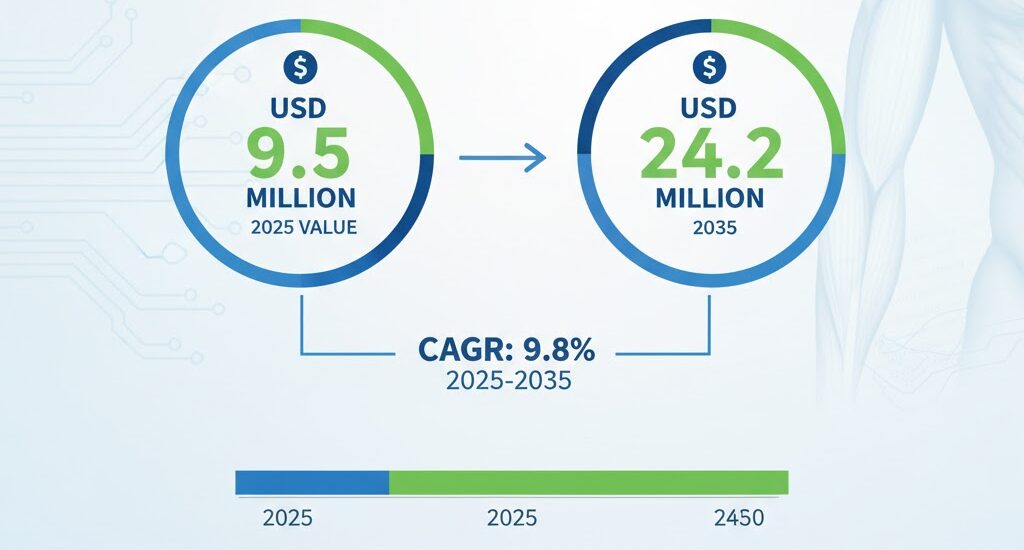
The global Muscle Oxygen Monitors Market is entering a transformative decade of innovation and expansion. Valued at USD 9.5 million in 2025, the market is projected to reach USD 24.2 million by 2035, reflecting an impressive compound annual growth rate (CAGR) of 9.8%. With increasing demand from athletes, fitness professionals, and rehabilitation specialists, manufacturers are poised to play a pivotal role in shaping the next generation of intelligent, data-centric monitoring solutions.
This surge is not merely a function of consumer interest—it represents a structural shift in how performance, recovery, and wellness are measured. As wearable technologies evolve, manufacturers face a growing opportunity to engineer devices that integrate seamlessly with digital ecosystems, deliver actionable physiological insights, and support long-term health optimization.
Empowering a New Era of Precision Health and Performance
The momentum behind muscle oxygen monitoring technology is rooted in one simple but powerful objective: to understand and optimize human performance. Using Near-Infrared Spectroscopy (NIRS), these monitors measure oxygen saturation in muscle tissue by transmitting infrared light between 680 nm and 800 nm—a range capable of penetrating skin, fat, and muscle layers without invasive procedures.
By quantifying how much oxygen is being carried by haemoglobin and myoglobin, muscle oxygen monitors enable real-time measurement of muscular efficiency. This technology is increasingly recognized as a vital tool for improving endurance, preventing fatigue, and guiding recovery strategies.
For manufacturers, the implications are clear: the demand for precision-engineered, portable, and connected monitoring systems is accelerating. The growing emphasis on non-invasive, continuous data collection opens new opportunities to expand beyond traditional sports markets into healthcare, rehabilitation, and industrial wellness programs.
Technology Integration: The Competitive Edge for Manufacturers
The next frontier in this market is software integration and intelligent analytics. The Peripedal Software segment, accounting for 51.2% of total market share in 2025, represents a defining trend—manufacturers are no longer building devices in isolation. Instead, they are creating interconnected systems capable of syncing with mobile applications, cloud-based analytics, and adaptive training platforms.
For manufacturers, this trend underscores the need to design hardware that complements sophisticated software ecosystems. By embedding sensors compatible with real-time data visualization, predictive feedback, and AI-driven performance modeling, companies can provide solutions that go far beyond measurement—they deliver insight, personalization, and competitive advantage.
These software-enabled devices are increasingly used not only by elite athletes but also by physiotherapists and clinicians seeking to monitor patient recovery. As global health systems prioritize preventive healthcare and personalized treatment, manufacturers have the chance to extend the value chain—from sports to clinical diagnostics.
Dominant Segments: Where the Growth Lies
Among various application segments, the Muscle Oxygen Profile category stands out as the market leader, expected to capture 46.8% of total revenue in 2025. This dominance stems from the increasing adoption of real-time muscle oxygen tracking during high-intensity and endurance training.
As sports science gains prominence, this segment is driving demand for wearable devices that integrate seamlessly into performance routines. The shift toward data-driven training means that athletes and fitness enthusiasts now expect devices that not only monitor their activity but also provide interpretable insights that guide decisions.
For manufacturers, this is a defining moment to deliver products that merge usability with precision. Compact form factors, durable designs, and long-lasting sensors are now fundamental expectations. The opportunity lies in delivering devices that balance technical sophistication with everyday practicality, making advanced monitoring accessible to a wider range of users.
Regional Outlook: Global Potential, Local Opportunities
The Muscle Oxygen Monitors Market demonstrates a diverse regional growth pattern. China leads with a remarkable CAGR of 13.2%, followed by India at 12.3%, driven by expanding fitness industries and the rapid digitalization of health tracking systems. Europe, led by Germany (11.3%), continues to show strong momentum, while the United States remains a steady and lucrative market with an 8.3% CAGR.
For manufacturers, this global variation highlights the importance of regional adaptability. The ability to localize product design—whether through multilingual software interfaces, customizable data dashboards, or integration with region-specific mobile ecosystems—will be key to capturing new market share.
Emerging markets in Asia-Pacific and Central Asia also present long-term opportunities, as growing investments in sports infrastructure and public health initiatives drive demand for advanced performance monitoring solutions.
Buy Now & Save: Premium Market Report at $5,000 | Discount Details Inside:- https://www.futuremarketinsights.com/reports/sample/rep-gb-8026
Key Industry Players Leading Innovation
Leading companies such as Garmin Ltd., Polar Electro, Casio, Fitbit, FitBiomics, BSX Athletics, Wahoo Fitness, Respiration Technology Inc., Icon Health & Fitness Inc., Acumen Research and Consulting, Firstbeat Technologies, and Xiaomi are defining the competitive landscape.
These brands have established themselves through a combination of technological innovation, user-centric design, and ecosystem integration. However, with the market still in an early growth phase, new entrants have the opportunity to differentiate through specialized hardware, data analytics capabilities, and cross-platform compatibility.
A Future Built on Smart Manufacturing and Connected Innovation
As the Muscle Oxygen Monitors Market evolves, manufacturers stand at the intersection of technology, wellness, and data intelligence. The convergence of sensor innovation, cloud analytics, and mobile integration is redefining how performance data is captured and applied.
The road ahead promises not only market growth but also transformation in how manufacturers collaborate across industries—from sports and fitness to healthcare and rehabilitation. By embracing smart manufacturing practices, sustainable design, and continuous innovation, manufacturers can ensure their products remain indispensable in a world that values measurable, personalized health outcomes.
Click Here to Purchase the Report:- https://www.futuremarketinsights.com/checkout/8026
About Future Market Insights (FMI)
Future Market Insights, Inc. (ESOMAR certified, recipient of the Stevie Award, and a member of the Greater New York Chamber of Commerce) offers profound insights into the driving factors that are boosting demand in the market. FMI stands as the leading global provider of market intelligence, advisory services, consulting, and events for the Packaging, Food and Beverage, Consumer Technology, Healthcare, Industrial, and Chemicals markets. With a vast team of over 400 analysts worldwide, FMI provides global, regional, and local expertise on diverse domains and industry trends across more than 110 countries.
Contact Us:
Future Market Insights Inc.
Christiana Corporate, 200 Continental Drive,
Suite 401, Newark, Delaware – 19713, USA
T: +1-347-918-3531
For Sales Enquiries: sales@futuremarketinsights.com
Website: https://www.futuremarketinsights.com
LinkedIn| Twitter| Blogs | YouTube