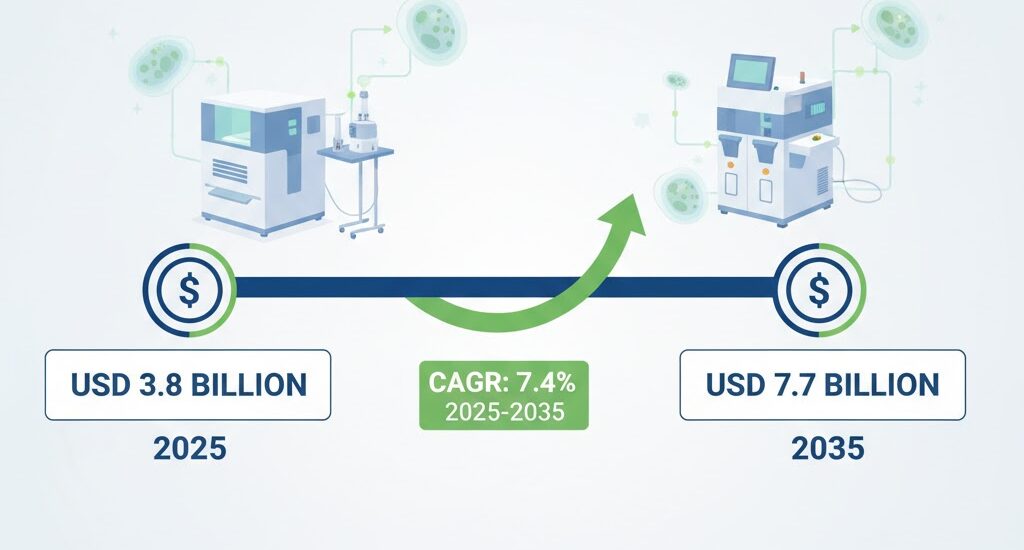
The global Fluorescence-Activated Cell Sorting (FACS) market is on the brink of a major growth phase, projected to nearly double from USD 3.8 billion in 2025 to USD 7.7 billion by 2035, representing a robust compound annual growth rate (CAGR) of 7.4%. This expansion signals a defining decade for manufacturers, researchers, and healthcare innovators committed to advancing cell-based technologies and precision medicine.
A Future Driven by Precision, Automation, and Collaboration
At its core, fluorescence-activated cell sorting has evolved from a laboratory technique into a cornerstone technology of modern biomedical research. By enabling the rapid and accurate sorting of live cells based on fluorescence patterns, FACS empowers scientists to isolate and analyze complex cell populations with unmatched precision.
The global market’s acceleration is being driven by several converging factors: the growing demand for personalized medicine, expanding investments in cell and gene therapy, and rising adoption across immunology and cancer research. The result is a more connected ecosystem of academic, clinical, and industrial stakeholders, each leveraging cell sorting to improve diagnostic accuracy, therapeutic development, and patient outcomes.
For manufacturers, this trend represents both a challenge and an opportunity. As research intensity grows, the need for automated, high-throughput, and miniaturized sorting platforms will reshape production priorities, urging manufacturers to integrate innovation, reliability, and scalability at every stage of product development.
Immunology and Cancer Research: The Largest Growth Driver
In 2025, Immunology and Cancer Research will dominate the FACS market, capturing 44.6% of total revenue. This leadership reflects the crucial role of cell sorting in identifying rare immune cells, tumor subpopulations, and functional biomarkers critical to next-generation therapies.
Rising global investments in immunotherapy and precision oncology are fueling this segment’s momentum. Researchers depend on fluorescence-based systems to uncover how immune cells interact with cancer cells, paving the way for breakthrough treatments. As biomarker discovery continues to accelerate, manufacturers supplying FACS equipment are positioned to serve an expanding scientific base that requires more sensitive, reproducible, and multi-parameter analysis tools.
For technology developers, this means greater demand for advanced fluorescence optics, real-time analysis software, and AI-assisted data interpretation—areas ripe for competitive differentiation and strategic partnerships.
Research Institutes Lead End-User Demand with 52.8% Market Share
Research institutes remain at the forefront of FACS adoption, projected to account for 52.8% of market revenue in 2025. This dominance is driven by the increasing need for sophisticated cell analysis systems across academic laboratories and government-funded research facilities focused on disease mechanisms, regenerative medicine, and translational science.
As research projects become more interdisciplinary, FACS technologies are being integrated into multi-omics workflows, enabling combined genomic, proteomic, and metabolomic analysis. Manufacturers are responding by designing systems that are modular, automated, and data-integrated, aligning with the new era of connected research ecosystems.
Strategic collaborations between research institutions and biopharmaceutical manufacturers are further accelerating adoption. These partnerships are fostering innovation pipelines for drug discovery, vaccine development, and biological validation, underscoring the transformative potential of fluorescence-activated cell sorting in modern R&D.
Regional Insights: Asia-Pacific Leads Global Momentum
While North America and Europe continue to anchor the FACS market, the Asia-Pacific region is emerging as the fastest-growing hub, led by China (CAGR 10.0%) and India (CAGR 9.3%). Rapid expansion of biotechnology clusters, supportive government initiatives, and rising healthcare infrastructure investments are fueling market penetration across these regions.
Developed markets such as Germany (8.5%), France (7.8%), and the UK (7.0%) maintain steady growth, while the United States, valued at USD 1.4 billion in 2025, is expected to reach USD 2.6 billion by 2035. Even emerging markets such as Brazil (5.6% CAGR) indicate solid growth trajectories, reflecting a global consensus on the importance of advanced cell sorting in healthcare innovation.
For manufacturers, this geographic diversity highlights the importance of localized production strategies, cost-efficient designs, and flexible service networks to meet distinct regional research and regulatory demands.
Technology at the Core of Market Expansion
At the heart of the FACS market lies the flow cytometry principle, where cells in a liquid stream are analyzed and sorted based on their fluorescent properties as they pass through laser beams. The continued miniaturization and automation of this process have made modern FACS systems faster, more precise, and more user-friendly.
Emerging trends such as microfluidic integration, AI-enhanced cell detection, and biomarker-specific fluorescence tagging are driving innovation across manufacturing and application fronts. These technologies enable smaller labs with limited infrastructure to adopt high-performance systems—expanding market reach and supporting inclusive scientific growth.
As automation advances, FACS systems are transitioning from specialized tools to centralized analytical platforms that connect diagnostics, research, and production pipelines. This convergence creates a new frontier for manufacturers to deliver systems that are not only technically advanced but also scalable, data-driven, and interoperable across diverse research environments.
Buy Now & Save: Premium Market Report at $5,000 | Discount Details Inside:- https://www.futuremarketinsights.com/reports/sample/rep-gb-8025
Competitive Landscape: Innovation and Integration Lead the Way
The global market remains competitive, with leading players including Becton Dickinson and Company, Danaher Corporation, Thermo Fisher Scientific Inc., Agilent Technologies Inc., Bio-Rad Laboratories Inc., and Merck KGaA spearheading innovation. Other significant contributors such as Miltenyi Biotec, Sysmex Corporation, Luminex Corporation, Sony Biotechnology Inc., and Enzo Life Sciences Inc. are focusing on enhancing throughput, sensitivity, and user experience through design advancements.
The industry’s competitive advantage will increasingly depend on system interoperability, customizable analytical software, and strategic alliances that bring research and manufacturing closer together. Manufacturers that prioritize end-user collaboration and application-specific innovation are expected to lead the next wave of market growth.
Empowering the Future of Cell Science
The decade ahead marks a pivotal period for the Fluorescence-Activated Cell Sorting market. As the world pivots toward precision healthcare and cell-based innovation, FACS stands as a vital enabler of discovery, diagnostics, and therapeutic development.
For manufacturers, this is more than a growth opportunity—it is a call to shape the scientific infrastructure of tomorrow, driving performance, reliability, and innovation to meet the evolving needs of global research and medicine. With its projected doubling in value by 2035, the FACS market is not just expanding—it’s redefining the future of how science sees, sorts, and understands life itself.
Click Here to Purchase the Report:- https://www.futuremarketinsights.com/checkout/8025
About Future Market Insights (FMI)
Future Market Insights, Inc. (ESOMAR certified, recipient of the Stevie Award, and a member of the Greater New York Chamber of Commerce) offers profound insights into the driving factors that are boosting demand in the market. FMI stands as the leading global provider of market intelligence, advisory services, consulting, and events for the Packaging, Food and Beverage, Consumer Technology, Healthcare, Industrial, and Chemicals markets. With a vast team of over 400 analysts worldwide, FMI provides global, regional, and local expertise on diverse domains and industry trends across more than 110 countries.
Contact Us:
Future Market Insights Inc.
Christiana Corporate, 200 Continental Drive,
Suite 401, Newark, Delaware – 19713, USA
T: +1-347-918-3531
For Sales Enquiries: sales@futuremarketinsights.com
Website: https://www.futuremarketinsights.com
LinkedIn| Twitter| Blogs | YouTube