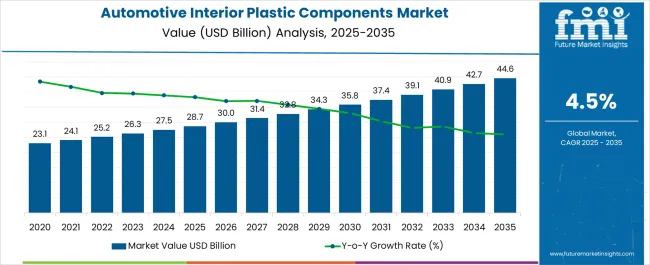
The Automotive Interior Plastic Components Market is estimated to be valued at USD 28.7 billion in 2025 and is projected to reach USD 44.6 billion by 2035, registering a compound annual growth rate (CAGR) of 4.5% over the forecast period.
The Automotive Interior Plastic Components Market is undergoing rapid transformation driven by the increasing demand for lightweight materials, sustainable manufacturing, and enhanced vehicle aesthetics. Interior plastic components—ranging from dashboards, door panels, and consoles to seat backs and trims—are essential for improving comfort, safety, and functionality in modern vehicles. As automakers pursue energy efficiency and premium cabin design, innovative plastic solutions are redefining interior manufacturing standards.
- Market Overview
The global Automotive Interior Plastic Components Market is projected to reach USD 52.7 billion by 2033, growing at a CAGR of 5.8% from 2025 to 2033.
Growth is primarily driven by the shift toward lightweight design, the integration of advanced polymers, and the adoption of eco-friendly materials in response to stricter emission standards. Automotive OEMs are increasingly using plastics as substitutes for metals, offering cost advantages, design flexibility, and recyclability.
- Market Drivers
- Lightweighting for Fuel Efficiency and Emission Reduction
Lightweight plastic components contribute to vehicle weight reduction, improving fuel economy and reducing CO₂ emissions. This trend is accelerating, especially in electric and hybrid vehicles, where weight directly affects range and efficiency.
- Rising Demand for Enhanced Cabin Aesthetics
Consumers increasingly prioritize comfort and premium aesthetics. High-grade plastics with leather-like finishes, soft-touch surfaces, and customizable textures are gaining traction among OEMs to deliver luxury experiences across all vehicle segments.
- Advancements in Material Technology
New polymer blends and composites such as polypropylene (PP), ABS, polycarbonate (PC), and polyurethane (PU) offer superior mechanical strength, heat resistance, and formability. The integration of bio-based plastics is also emerging as a sustainable alternative.
- Increasing Adoption of Smart and Functional Interiors
As vehicles evolve into digital hubs, plastic components now integrate smart surfaces, embedded lighting, and touch-sensitive controls, enhancing both aesthetics and user interaction.
- Key Market Segments
- By Component Type
- Dashboard and Instrument Panel: Incorporating lightweight plastics for structural integrity and improved ergonomics.
- Door Panels: Featuring noise insulation, soft-touch finishes, and integrated electronics.
- Center Consoles and Armrests: Combining functionality with modern design flexibility.
- Seat Components: Using reinforced thermoplastics for strength and reduced weight.
- Pillars and Trims: Enhancing safety, durability, and overall cabin appearance.
- By Material Type
- Polypropylene (PP): Widely used for trims, consoles, and panels due to high durability and cost efficiency.
- ABS (Acrylonitrile Butadiene Styrene): Preferred for dashboards and decorative parts due to its glossy finish.
- Polycarbonate (PC): Ideal for transparent and high-strength applications.
- Polyurethane (PU): Extensively used in cushioning and foamed seat structures.
- Bio-based Plastics: Gaining prominence for sustainable interior development.
- By Vehicle Type
- Passenger Cars: Dominant segment, focusing on aesthetics, comfort, and lightweight performance.
- Commercial Vehicles: Increasing use of durable and cost-effective plastic interiors to improve cabin ergonomics.
- Electric Vehicles (EVs): Emphasis on sustainable, noise-reducing, and recyclable plastic materials.
- Technological Innovations
- Sustainable and Recycled Plastics
Manufacturers are adopting recycled polymers and plant-based composites to meet environmental goals and align with circular economy practices.
- In-Mold Electronics (IME)
The integration of electronics directly into molded plastic surfaces allows touch controls, lighting, and sensors without additional wiring, reducing component weight and complexity.
- 3D Printing and Additive Manufacturing
3D printing enables rapid prototyping and low-volume production of customized interior components, improving design flexibility and reducing lead time.
- Antimicrobial and Scratch-Resistant Coatings
New surface treatments enhance hygiene and durability, particularly important in shared mobility and fleet vehicles.
- Regional Insights
North America
Home to major OEMs and suppliers, the region focuses on technological innovation and integration of recycled plastics in automotive interiors.
Europe
Leading in sustainability, European automakers are using eco-friendly materials to comply with stringent EU emission and recycling directives.
Asia-Pacific
The fastest-growing region, driven by vehicle production in China, India, Japan, and South Korea. OEM collaborations with local suppliers support affordable and sustainable plastic component development.
Latin America and Middle East & Africa
Emerging automotive hubs with gradual adoption of lightweight and cost-efficient plastic components, supported by government initiatives promoting local manufacturing.
- Market Challenges
- Fluctuating Raw Material Prices: Volatility in polymer supply affects overall production costs.
- Recycling and Waste Management Issues: Lack of efficient recycling infrastructure for composite plastics poses environmental challenges.
- Heat Sensitivity and Material Degradation: Plastic components must withstand UV radiation and high cabin temperatures.
- Design Complexity: Balancing aesthetics, strength, and manufacturability remains a technical challenge for OEMs.
- Future Outlook
The Automotive Interior Plastic Components Market is evolving toward sustainability, smart functionality, and digital integration. The use of biodegradable plastics, lightweight composites, and in-mold electronics will redefine interior design and manufacturing. Furthermore, as the automotive industry transitions to electric and autonomous vehicles, interior plastics will play a key role in enabling modular, connected, and eco-friendly cabin experiences.
Conclusion
The Automotive Interior Plastic Components Market stands at the forefront of innovation, blending material science with advanced design and sustainability. With ongoing advancements in lightweight polymers, digital surfaces, and circular manufacturing, the industry is paving the way for next-generation vehicle interiors that are smarter, greener, and more comfortable.
Get Instant Access for Only $5000 | Don’t Miss This Exclusive Offer!
https://www.futuremarketinsights.com/reports/sample/rep-gb-5200
Checkout Now to Access Industry Insights:
https://www.futuremarketinsights.com/checkout/5200
About Future Market Insights (FMI)
Future Market Insights, Inc. (ESOMAR certified, recipient of the Stevie Award, and a member of the Greater New York Chamber of Commerce) offers profound insights into the driving factors that are boosting demand in the market. FMI stands as the leading global provider of market intelligence, advisory services, consulting, and events for the Packaging, Food and Beverage, Consumer Technology, Healthcare, Industrial, and Chemicals markets. With a vast team of 400 analysts worldwide, FMI provides global, regional, and local expertise on diverse domains and industry trends across more than 110 countries.
Contact Us:
Future Market Insights Inc.
Christiana Corporate, 200 Continental Drive,
Suite 401, Newark, Delaware – 19713, USA
T: +1-845-579-5705
For Sales Enquiries: sales@futuremarketinsights.com
Website: https://www.futuremarketinsights.com
LinkedIn| Twitter| Blogs | YouTube