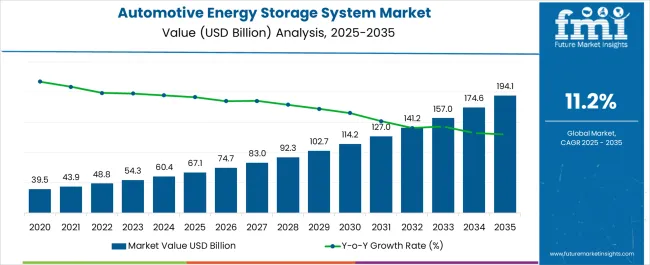
The Automotive Energy Storage System Market is estimated to be valued at USD 67.1 billion in 2025 and is projected to reach USD 194.1 billion by 2035, registering a compound annual growth rate (CAGR) of 11.2% over the forecast period.
The Automotive Energy Storage System Market is rapidly expanding as the global automotive industry transitions toward electrification and sustainable energy solutions. Energy storage systems (ESS) play a pivotal role in improving vehicle efficiency, performance, and environmental sustainability by managing and storing electrical energy effectively. From hybrid and electric vehicles to smart grid integration, automotive energy storage systems are becoming the backbone of the mobility revolution.
Market Overview
The automotive energy storage system market is experiencing strong momentum due to the rising demand for electric mobility and renewable energy integration. These systems are used to capture and reuse braking energy, support auxiliary functions, and enhance vehicle performance. The growing adoption of electric vehicles (EVs), plug-in hybrids (PHEVs), and fuel cell vehicles (FCVs) is fueling market expansion across all major regions.
Key Market Drivers
Several critical factors are propelling the growth of the automotive energy storage system market:
- Rising Adoption of Electric and Hybrid Vehicles: Growing consumer preference for zero-emission and fuel-efficient vehicles boosts the demand for efficient energy storage systems.
- Technological Advancements: Innovations in lithium-ion batteries, solid-state batteries, and supercapacitors enhance energy density, safety, and lifecycle performance.
- Government Regulations and Incentives: Supportive policies and subsidies promoting EV adoption accelerate market growth globally.
- Sustainability and Carbon Neutrality Goals: Automakers are investing in energy-efficient solutions to meet decarbonization targets and regulatory standards.
- Smart Energy Management: Integration of battery management systems (BMS) for optimized energy flow and extended battery life.
Advantages of Automotive Energy Storage Systems
Automotive energy storage systems offer numerous benefits that make them indispensable in modern vehicle design:
- Improved Energy Efficiency: Recovers and reuses energy during braking and acceleration.
- Enhanced Vehicle Performance: Provides additional power for acceleration and improves driving range.
- Reduced Fuel Consumption: Decreases dependency on fossil fuels, leading to lower operating costs.
- Lower Emissions: Supports the global shift toward sustainable and eco-friendly transportation.
- Support for Electrified Powertrains: Essential for the efficient operation of hybrid and electric vehicles.
Applications Across Vehicle Segments
Automotive energy storage systems are used across various types of vehicles:
- Battery Electric Vehicles (BEVs): Serve as the primary power source, storing and delivering electrical energy for propulsion.
- Hybrid Electric Vehicles (HEVs): Store recovered braking energy and supply additional power during peak demand.
- Plug-in Hybrid Electric Vehicles (PHEVs): Offer extended electric-only driving range and fuel efficiency.
- Commercial Electric Vehicles: Support logistics and fleet electrification initiatives by enabling longer operation times and faster charging cycles.
Emerging Trends and Innovations
The market is witnessing several technological advancements that are reshaping its future:
- Solid-State Batteries: Offering higher energy density, faster charging, and improved safety over traditional lithium-ion batteries.
- Second-Life Battery Applications: Reusing EV batteries for stationary energy storage to enhance sustainability.
- Wireless Charging and Smart Grid Integration: Creating new opportunities for vehicle-to-grid (V2G) energy management systems.
- Advanced Thermal Management Systems: Ensuring optimal temperature control for extended battery lifespan.
Future Outlook
The Automotive Energy Storage System Market is poised for transformative growth as global automotive manufacturers accelerate the shift toward electrification. Strategic collaborations between battery manufacturers, automakers, and energy technology providers are driving innovation in efficiency, safety, and sustainability. As governments push for zero-emission mobility and renewable energy integration, the demand for advanced energy storage solutions will continue to rise, powering the vehicles of tomorrow.
Get Instant Access for Only $5000 | Don’t Miss This Exclusive Offer!
https://www.futuremarketinsights.com/reports/sample/rep-gb-5123
Checkout Now to Access Industry Insights:
https://www.futuremarketinsights.com/checkout/5123
About Future Market Insights (FMI)
Future Market Insights, Inc. (ESOMAR certified, recipient of the Stevie Award, and a member of the Greater New York Chamber of Commerce) offers profound insights into the driving factors that are boosting demand in the market. FMI stands as the leading global provider of market intelligence, advisory services, consulting, and events for the Packaging, Food and Beverage, Consumer Technology, Healthcare, Industrial, and Chemicals markets. With a vast team of 400 analysts worldwide, FMI provides global, regional, and local expertise on diverse domains and industry trends across more than 110 countries.
Contact Us:
Future Market Insights Inc.
Christiana Corporate, 200 Continental Drive,
Suite 401, Newark, Delaware – 19713, USA
T: +1-845-579-5705
For Sales Enquiries: sales@futuremarketinsights.com
Website: https://www.futuremarketinsights.com
LinkedIn| Twitter| Blogs | YouTube