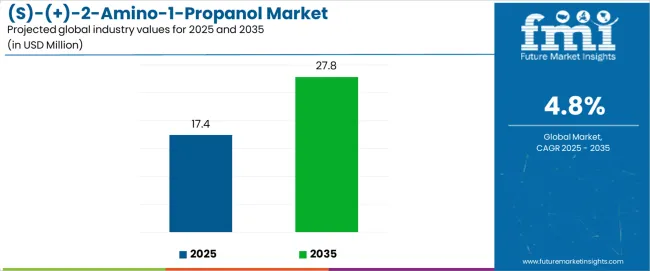
The global (S)-(+)-2-Amino-1-Propanol market is set to experience consistent growth over the next decade, reflecting the expanding role of chiral intermediates in pharmaceutical and chemical manufacturing. According to Future Market Insights (FMI), the market is projected to grow from USD 17.4 million in 2025 to USD 27.8 million by 2035, advancing at a compound annual growth rate (CAGR) of 4.8%. The growing use of enantiomerically pure compounds in drug development, combined with technological advancements in asymmetric synthesis and biocatalytic production, continues to shape the market’s upward trajectory.
Rising Demand for Chiral Building Blocks Fuels Market Expansion
(S)-(+)-2-Amino-1-Propanol is a vital chiral intermediate used extensively in the synthesis of active pharmaceutical ingredients (APIs), surfactants, and fine chemicals. Its increasing relevance in producing β-blockers, anti-HIV drugs, and other high-value pharmaceutical compounds has significantly contributed to global demand.
The chemical’s asymmetric configuration allows manufacturers to achieve superior enantiomeric purity — a key factor in modern drug formulation. As the pharmaceutical industry accelerates the transition toward enantioselective synthesis, the need for reliable chiral intermediates like (S)-(+)-2-Amino-1-Propanol continues to grow, driving investments from both established players and new entrants eager to leverage precision chemistry and green synthesis pathways.
Emerging Producers Join Established Leaders in Technological Evolution
Major global manufacturers, including Merck KGaA, TCI Chemicals, Sigma-Aldrich, and Jiangxi Yuneng Pharmaceutical Co., Ltd., continue to dominate the (S)-(+)-2-Amino-1-Propanol landscape with strong research and production capabilities. These companies are focusing on refining their purification and chiral resolution techniques to meet the stringent requirements of pharmaceutical-grade intermediates.
Meanwhile, a new generation of manufacturers in China, India, and South Korea is rapidly expanding capacity, targeting exports to the United States and European markets. Firms such as Nantong Chem-Tech and Anhui Sealong Biotech are investing in continuous flow chemistry and catalytic hydrogenation technologies, enabling high-yield, low-waste production. This blend of innovation and scale is redefining market competition, opening opportunities for technology licensing and strategic collaborations between multinational and regional producers.
Technological Innovations Driving Quality and Efficiency
Over the forecast period, the market will be shaped by the growing adoption of biocatalytic synthesis and enzymatic resolution techniques, which promise to replace traditional chemical synthesis routes that rely on harsh reagents. These methods not only improve yield and purity but also align with global sustainability goals.
Advanced manufacturing systems are helping producers reduce solvent waste and energy consumption. New developments in immobilized enzyme technology and continuous stirred-tank reactors are also enhancing scalability and cost-efficiency in production. These advancements are particularly beneficial for startups and smaller producers, who can now compete with established players by offering customized, high-purity grades of (S)-(+)-2-Amino-1-Propanol for research and specialty applications.
Pharmaceutical Applications Continue to Lead Market Growth
The pharmaceutical sector remains the largest end-use segment, accounting for the majority of global demand in 2025 and expected to maintain its dominance through 2035. The compound’s use as a precursor for various chiral drugs — particularly beta-blockers like propranolol and central nervous system agents — has made it indispensable in the synthesis of both new chemical entities and generics.
Furthermore, the growth in biologics and biosimilars manufacturing has expanded the scope of chiral intermediates, where (S)-(+)-2-Amino-1-Propanol plays a critical role in the formulation of excipients and stabilizing agents. The steady evolution of drug synthesis toward more efficient and environmentally responsible processes underscores the growing reliance on compounds that deliver performance, stability, and biocompatibility.
Purchase this Report for USD 5,000 Only | Get an Exclusive Discount Instantly! https://www.futuremarketinsights.com/checkout/27268
Everything You Need—within Your Budget. Request a Special Price Now! https://www.futuremarketinsights.com/reports/sample/rep-gb-27268
Regional Insights: Asia-Pacific and North America at the Forefront
Geographically, Asia-Pacific continues to lead the global market, driven by the expanding pharmaceutical and specialty chemical industries in China and India. With their growing production capabilities and access to skilled chemists, these countries are emerging as primary suppliers of chiral intermediates to Western markets. FMI’s analysis highlights that China’s market is expected to post a robust growth rate of over 6% CAGR, supported by ongoing capacity expansions and favorable government initiatives promoting fine chemical exports.
North America and Europe follow as mature but innovation-driven regions. In the United States, the push for advanced manufacturing and the rise of CDMOs (Contract Development and Manufacturing Organizations) are fostering demand for high-purity intermediates. European nations, particularly Germany and Switzerland, continue to lead in R&D-driven production, with companies investing in clean synthesis technologies that meet stringent REACH and EPA regulations.
Sustainability and Green Chemistry: The New Competitive Edge
The chemical manufacturing industry’s ongoing shift toward green chemistry principles is emerging as a defining factor for long-term success in the (S)-(+)-2-Amino-1-Propanol market. Companies are increasingly adopting bio-based feedstocks and recyclable catalysts to minimize waste generation and carbon emissions. The integration of renewable raw materials into production processes aligns with global regulatory frameworks promoting eco-friendly synthesis.
Manufacturers focusing on sustainability are also gaining strategic partnerships with pharmaceutical giants seeking to reduce the environmental footprint of their supply chains. This trend is expected to continue shaping corporate priorities through 2035, making green chemistry a key differentiator for both established and emerging players.
About Future Market Insights (FMI)
Future Market Insights, Inc. (ESOMAR certified, recipient of the Stevie Award, and a member of the Greater New York Chamber of Commerce) offers profound insights into the driving factors that are boosting demand in the market. FMI stands as the leading global provider of market intelligence, advisory services, consulting, and events for the Packaging, Food and Beverage, Consumer Technology, Healthcare, Industrial, and Chemicals markets. With a vast team of over 400 analysts worldwide, FMI provides global, regional, and local expertise on diverse domains and industry trends across more than 110 countries.
Contact Us:
Future Market Insights Inc.
Christiana Corporate, 200 Continental Drive,
Suite 401, Newark, Delaware – 19713, USA
T: +1-347-918-3531
For Sales Enquiries: sales@futuremarketinsights.com
Website: https://www.futuremarketinsights.com
LinkedIn| Twitter| Blogs | YouTube