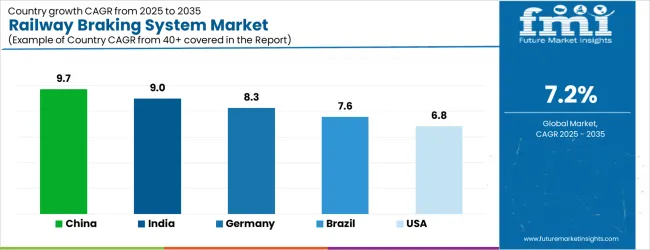
The Railway Braking System Market is estimated to be valued at USD 2.9 billion in 2025 and is projected to reach USD 5.8 billion by 2035, registering a compound annual growth rate (CAGR) of 7.2% over the forecast period.
The global Railway Braking System Market is witnessing significant growth, driven by the modernization of rail networks, rising demand for high-speed trains, and advancements in braking technologies that enhance safety and performance. Braking systems play a vital role in ensuring efficient train operations by managing speed, reducing stopping distances, and preventing derailments under varying load and environmental conditions.
Market Overview
In 2025, the Railway Braking System Market is valued at USD 11.5 billion and is projected to reach USD 18.2 billion by 2033, expanding at a CAGR of 6.0%. The growth is primarily attributed to increasing investments in urban metro networks, high-speed rail corridors, and freight transportation modernization across developing and developed economies.
- Market Drivers
- Expansion of Global Rail Infrastructure
Countries are investing heavily in railway modernization to enhance passenger connectivity and freight efficiency. Projects such as India’s Dedicated Freight Corridors, Europe’s Trans-European Transport Network (TEN-T), and China’s Belt and Road rail initiatives are creating substantial demand for advanced braking systems.
- Emphasis on Passenger Safety and Operational Efficiency
Railway operators are prioritizing safety through the integration of intelligent braking systems that automatically adjust braking force based on train speed, track gradient, and load conditions. These systems enhance reliability and minimize human error in emergency scenarios.
- Shift Toward Electrified and High-Speed Trains
The increasing adoption of high-speed and electric trains demands efficient braking systems capable of dissipating large amounts of kinetic energy. Regenerative braking technologies are gaining traction as they recover energy during braking to improve overall train efficiency.
- Technology Advancements
- Development of Regenerative and Electro-Pneumatic Brakes
The introduction of regenerative braking systems allows energy generated during braking to be fed back into the power grid, improving energy efficiency and sustainability. Electro-pneumatic braking systems, on the other hand, offer faster response times and better synchronization compared to conventional air brakes.
- Integration of IoT and Predictive Maintenance
Modern braking systems are now equipped with sensors and data analytics platforms that monitor system health in real-time. Predictive maintenance helps reduce downtime, optimize component lifespan, and ensure consistent braking performance.
- Lightweight and Noise-Reduction Materials
Advances in composite materials and friction technologies are resulting in lighter braking components that reduce wear, improve heat dissipation, and minimize noise — especially in urban metro environments.
- Market Segmentation
- By Train Type
- Passenger Trains – Account for a major market share due to the increasing deployment of metro, suburban, and intercity trains.
- Freight Trains – Adoption is rising to ensure controlled braking for heavy loads and long-haul operations.
- High-Speed Trains – Require advanced electro-dynamic braking systems to maintain stability at high velocities.
- By Brake Type
- Air Brakes – Widely used for their simplicity and cost-effectiveness.
- Vacuum Brakes – Predominant in older train models, now gradually being phased out.
- Electro-Pneumatic Brakes – Offer precision control and faster braking response in modern trains.
- Regenerative Brakes – Support sustainable energy management by converting kinetic energy into electrical energy.
- By Component
- Brake Pads and Discs – Core components ensuring friction and stopping power.
- Brake Control Units – Manage communication between sensors and actuators for efficient braking control.
- Actuators and Valves – Enable mechanical movement for braking application and release.
- Regional Insights
Europe
Europe leads the railway braking system market, supported by high-speed rail networks in France, Germany, and Spain. The European Union’s strict safety standards and focus on energy efficiency are driving the adoption of advanced braking systems.
Asia-Pacific
Asia-Pacific is emerging as the fastest-growing region due to large-scale investments in metro and intercity rail projects. Countries like China, India, and Japan are heavily focusing on integrating regenerative and electro-pneumatic braking technologies in new trains.
North America
The North American market is growing steadily with modernization of freight networks, particularly in the U.S. and Canada, and increasing adoption of automated braking systems for commuter and freight rail safety compliance.
- Key Challenges
- High Installation and Maintenance Costs: Advanced braking technologies require substantial upfront investment and technical expertise.
- Integration Complexity: Compatibility with existing rolling stock can be a challenge, particularly for older trains.
- Environmental and Weather Constraints: Extreme temperatures and humidity can affect braking performance and system durability.
- Future Outlook
The future of the Railway Braking System Market lies in intelligent, energy-efficient, and connected solutions. With rapid digitalization, manufacturers are focusing on smart braking systems integrated with IoT, AI-based predictive analytics, and lightweight materials. These innovations are expected to enhance train safety, operational reliability, and sustainability across global networks.
Conclusion
The Railway Braking System Market is on a trajectory of steady growth, driven by infrastructure expansion, safety mandates, and technological evolution. As global rail operators embrace automation and energy efficiency, advanced braking technologies will remain central to improving rail performance, passenger safety, and environmental sustainability.
Get Instant Access for Only $5000 | Don’t Miss This Exclusive Offer!
https://www.futuremarketinsights.com/reports/sample/rep-gb-5244
Checkout Now to Access Industry Insights:
https://www.futuremarketinsights.com/checkout/5244
About Future Market Insights (FMI)
Future Market Insights, Inc. (ESOMAR certified, recipient of the Stevie Award, and a member of the Greater New York Chamber of Commerce) offers profound insights into the driving factors that are boosting demand in the market. FMI stands as the leading global provider of market intelligence, advisory services, consulting, and events for the Packaging, Food and Beverage, Consumer Technology, Healthcare, Industrial, and Chemicals markets. With a vast team of 400 analysts worldwide, FMI provides global, regional, and local expertise on diverse domains and industry trends across more than 110 countries.
Contact Us:
Future Market Insights Inc.
Christiana Corporate, 200 Continental Drive,
Suite 401, Newark, Delaware – 19713, USA
T: +1-845-579-5705
For Sales Enquiries: sales@futuremarketinsights.com
Website: https://www.futuremarketinsights.com
LinkedIn| Twitter| Blogs | YouTube