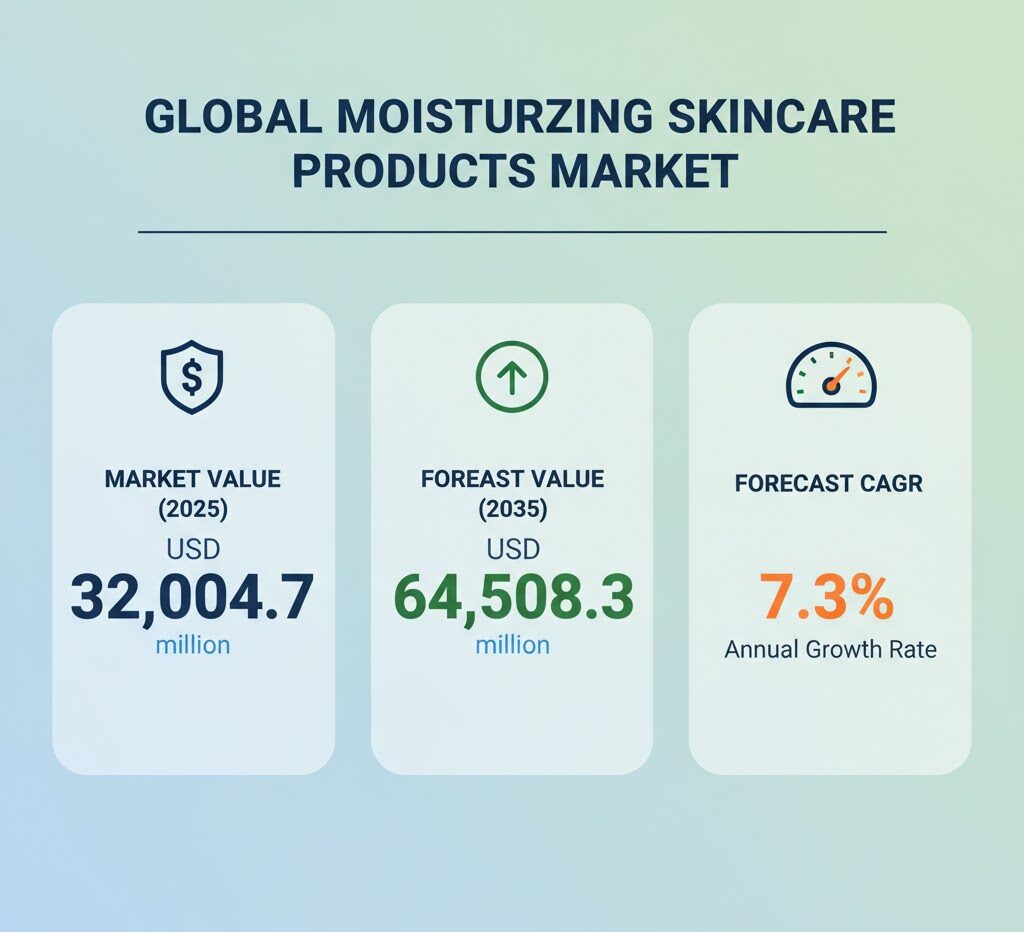
The Moisturizing Skincare Products Market is on track for a transformative decade, poised to double in value from USD 32,004.7 million in 2025 to USD 64,508.3 million by 2035, reflecting a robust CAGR of 7.3%. The industry’s 202.8% surge underscores a global shift toward advanced hydration technologies, digital skincare personalization, and sustainable innovation.
From dermatologist-endorsed brands to new-age digital-first entrants, skincare manufacturers are redefining moisture science and expanding product accessibility through e-commerce and hybrid retail models.
Market Growth Highlights
- Market Valuation (2025): USD 32,004.7 million
- Forecast Valuation (2035): USD 64,508.3 million
- CAGR (2025–2035): 7.3%
- Top Growth Segments: Hydrating serums, AI-personalized moisturizers, sleeping masks
- Leading Regions: North America, Asia-Pacific, Europe
- Prominent Players: CeraVe, Neutrogena, Nivea, La Roche-Posay, Eucerin, Cetaphil, Kiehl’s, Olay, The Ordinary, Clinique
A Decade of Transformation: Key Market Phases
Between 2025 and 2030, the market expands by USD 13,432.8 million, with demand largely led by daily face moisturizers that account for over 41.2% of applications. Consumers are gravitating toward emollient-rich products that reinforce the skin barrier and prevent moisture loss.
In the following five years (2030–2035), the market accelerates by USD 19,070.8 million, representing 58.7% of total growth. This surge is powered by multi-molecular hyaluronic acid, ceramide-infused creams, and AI-driven personalized skincare solutions. Digital skincare diagnostics, cloud-linked analysis tools, and subscription models are expected to contribute over 20% of total revenue, transforming skincare from a product-based to a service-driven ecosystem.
Why the Moisturizing Skincare Products Market Is Growing
Consumer consciousness around skin barrier health and hydration science is reshaping product innovation. Ingredients such as hyaluronic acid, ceramides, glycerin, and fatty acids are now considered essential for maintaining balanced, healthy skin.
This rise in demand aligns with three major drivers:
- Scientific Skincare Awareness: Increased dermatologist recommendations for clinically tested, hydration-centric products.
- Digital Skincare Revolution: The adoption of AI and AR tools to create personalized routines and accurate skin diagnostics.
- Sustainable Beauty Trends: A global push toward eco-friendly packaging, refillable jars, and clean-label formulations.
As digital-first beauty platforms and influencer marketing converge with scientific skincare, the global market is experiencing a fusion of technology, sustainability, and efficacy.
Key Segments of the Moisturizing Skincare Products Market
By Product Type
- Daily Face Moisturizers (41.2%) – Essential for all skin types, emphasizing emollient retention and barrier repair.
- Hydrating Serums (58.8%) – The fastest-growing segment, favored for lightweight, high-absorption textures and visible hydration results.
- Rich Creams & Balms – Designed for intensive care, particularly for dry and mature skin.
- Sleeping Masks – Rising in popularity for overnight hydration and rejuvenation.
By Key Ingredients
- Hyaluronic Acid (Multi-MW) – Dominating 58.8% of the share in 2025, valued for its superior moisture-binding capacity.
- Glycerin & Polyols (40.1%) – Classic humectants ensuring long-lasting hydration.
- Ceramides & Fatty Acids – Strengthen barrier function and reduce trans-epidermal water loss.
- Squalane/Esters – Lightweight emollients offering smooth texture and enhanced absorption.
By Skin Type
- Normal & Combination Skin (59.9%) – Most in-demand category due to climate adaptability and balanced hydration needs.
- Dry Skin (41.7%) – Driven by demand for intensive creams and barrier-repair formulations.
- Sensitive Skin – Growing rapidly as consumers seek hypoallergenic, fragrance-free products.
By Distribution Channel
- E-Commerce – Fastest-growing sales channel with AI-driven personalization and virtual skin consultations.
- Pharmacies/Drugstores – Trusted point of sale for dermatologist-endorsed and clinical skincare.
- Specialty Beauty Retail – Focused on premium and sustainable brands.
- Supermarkets & Hypermarkets – Expanding reach to mass consumers through affordable, effective moisturizers.
By End User
- Women – Continue to dominate demand with diverse hydration needs across age groups.
- Men – Rapidly growing category with oil-free and quick-absorb formulations.
- Unisex Family Care & Senior Skin – Gaining traction through inclusive and anti-aging hydration lines.
By Region
- North America – Steady growth driven by clinical validation and e-commerce integration.
- Asia-Pacific – Fastest-growing region, led by India (9.1% CAGR) and China (8.1% CAGR).
- Europe – Moderate growth underpinned by regulatory standards, clean formulations, and pharmacy-driven retail.
Regional Insights
- United States: Valued at USD 7.42 billion in 2025, expanding at 3.4% CAGR through 2035. AI-based skin diagnostics and dermatologist-backed brands like CeraVe and Neutrogena dominate online sales.
- United Kingdom: Growing at 5.3% CAGR, fueled by clean beauty and sustainable packaging initiatives.
- India: Leading at 9.1% CAGR, with rising demand for herbal-hybrid moisturizers and e-commerce-driven penetration into tier-2 and tier-3 cities.
- China: Forecasted 8.1% CAGR, driven by K-beauty-inspired serums, social commerce, and domestic innovation.
- Germany: At 3.9% CAGR, emphasizing fragrance-free, dermatologically tested skincare.
Competitive Landscape
The Moisturizing Skincare Products Market remains moderately fragmented, featuring a dynamic mix of established global brands and emerging innovators.
- Leading Global Brands: CeraVe, Neutrogena, Nivea, Eucerin, and La Roche-Posay continue to dominate through clinically validated, ceramide-rich formulas and mass-premium accessibility.
- Emerging Innovators: Kiehl’s, Olay, The Ordinary, and new digital-first brands are gaining traction through personalized routines, refillable packaging, and hybrid serum-moisturizer offerings.
- Tech Integration: The market is witnessing a shift toward AI-powered skin analysis, AR-based virtual try-ons, and data-driven personalization, redefining how consumers interact with skincare.
Key Industry Developments:
- 2025: CeraVe launched an AI-powered Barrier Health Scan in collaboration with Google Cloud for real-time hydration tracking.
- 2025: Beiersdorf (Nivea) introduced a sustainable refillable jar system in Europe, reducing plastic usage by 70% per refill cycle.
Conclusion
The global Moisturizing Skincare Products Market is entering a golden era defined by technological convergence, ingredient innovation, and sustainability. With demand expected to surpass USD 64 billion by 2035, both established skincare leaders and emerging brands are investing in AI-driven personalization, multi-functional hydration systems, and environmentally responsible production.
As consumers increasingly equate skin hydration with long-term health and confidence, the next decade promises to redefine not just skincare — but the very meaning of self-care.
This Report Now at Just $2000 | Limited-Time Discount Offer! https://www.futuremarketinsights.com/reports/sample/rep-gb-27253
Checkout Now to Access Industry Insights: https://www.futuremarketinsights.com/checkout/27253
About Future Market Insights (FMI)
Future Market Insights, Inc. (ESOMAR certified, recipient of the Stevie Award, and a member of the Greater New York Chamber of Commerce) offers profound insights into the driving factors that are boosting demand in the market. FMI stands as the leading global provider of market intelligence, advisory services, consulting, and events for the Packaging, Food and Beverage, Consumer Technology, Healthcare, Industrial, and Chemicals markets. With a vast team of over 400 analysts worldwide, FMI provides global, regional, and local expertise on diverse domains and industry trends across more than 110 countries.
Contact Us:
Future Market Insights Inc.
Christiana Corporate, 200 Continental Drive,
Suite 401, Newark, Delaware – 19713, USA
T: +1-347-918-3531
For Sales Enquiries: sales@futuremarketinsights.com
Website: https://www.futuremarketinsights.com
LinkedIn| Twitter| Blogs | YouTube