The global Di-n-octyl Sulfide (DNOS) market is set for a decade of consistent expansion, growing from USD 76.6 million in 2025 to USD 128.4 million by 2035 at a CAGR of 5.3%. The growth reflects the rising importance of sulfur-based intermediates in pharmaceutical manufacturing, precision chemical synthesis, and specialty industrial processes. Over this ten-year period, the market will add approximately USD 51.8 million in new value, underlining its evolution from a niche intermediate to a strategically relevant performance chemical.
Market Overview: A Niche Chemical Becomes a Core Building Block
After years of specialized use, Di-n-octyl Sulfide has entered mainstream chemical operations thanks to its high stability, controllable reactivity, and compatibility with catalytic processes. Between 2025 and 2030, the market is projected to rise to USD 98.7 million, representing 42.7% of total decade growth. By 2035, advanced purification methods and wider regulatory acceptance will lift it beyond USD 128 million, confirming its position as a key enabler in high-purity synthesis and process reliability.
The product’s strength lies in its functional versatility. It serves both as a sulfur donor and as a stabilizing agent in complex reactions, ensuring reproducibility and precision in pharmaceutical chemistry. As industries prioritize cleaner, more efficient reactions, Di-n-octyl Sulfide’s unique chemical attributes are gaining renewed attention from manufacturers and research laboratories worldwide.
Growth Drivers: Pharmaceutical Research and Advanced Manufacturing Lead the Way
The surge in pharmaceutical innovation remains the single biggest driver of DNOS demand. The compound’s compatibility with stringent purity standards makes it ideal for active ingredient synthesis and process development. Simultaneously, growth in specialty chemical manufacturing—especially in catalysts and lubricant additives—is amplifying adoption.
Automation in laboratories and industrial plants has further increased the demand for consistent and high-purity reagents. As advanced analytical and digital quality-control systems are integrated into chemical production, manufacturers are emphasizing traceable and standardized sulfur intermediates.
Emerging technological advancements—such as AI-assisted synthesis design and digital purity tracking—are expected to optimize both yield and sustainability, allowing producers to maintain cost competitiveness even amid raw-material fluctuations.
Regional Insights: Asia Pacific Takes the Lead
Asia Pacific dominates the global DNOS market, accounting for the highest growth rate across regions. China leads the charge with an impressive 7.2% CAGR, backed by an expanding pharmaceutical base and strong government support for specialty chemical innovation. Major local producers are scaling production capacity while forming partnerships with Western distributors to meet export demand.
India follows with 6.6% CAGR, fueled by a rapidly maturing pharmaceutical industry and increasing R&D investment. Domestic firms are adopting advanced purification systems and automated synthesis processes to improve yield and meet international quality benchmarks.
In Europe, Germany anchors the market with a 6.1% CAGR, leveraging its chemical engineering strength and strong research infrastructure. Other European countries—like France, Italy, and the United Kingdom—continue to contribute to stable regional demand through their established pharmaceutical and fine-chemical industries.
The United States maintains steady progress with 5.0% CAGR, benefiting from high adoption of digital monitoring and advanced automation in chemical manufacturing. Meanwhile, Brazil and Japan contribute region-specific momentum through pharmaceutical growth and precision manufacturing, respectively.
Segmental Highlights: High-Purity Grades Dominate
The high-purity grade (≥ 97%) segment represents 62.3% of total market value in 2025 and remains the cornerstone of global demand. Its dominance stems from stringent purity requirements across pharmaceutical and research applications, where even trace impurities can alter reaction outcomes.
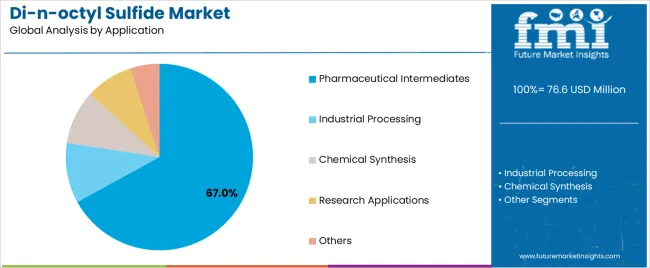
Pharmaceutical applications themselves represent about 67% of total consumption, underscoring the compound’s essential role in consistent, reliable synthesis. The industrial processing and chemical R&D segments also show increasing traction as advanced laboratories pursue process optimization and reaction efficiency.
As digital monitoring and automated purification systems become standard in manufacturing facilities, the technical and research grades of Di-n-octyl Sulfide are expected to gain share, especially in precision synthesis and academic research institutions.
Purchase this Report for USD 5,000 Only | Get an Exclusive Discount Instantly! https://www.futuremarketinsights.com/checkout/27271
Everything You Need—within Your Budget. Request a Special Price Now! https://www.futuremarketinsights.com/reports/sample/rep-gb-27271
Competitive Landscape: Established Leaders Meet Innovative Entrants
The Di-n-octyl Sulfide market is highly specialized yet increasingly dynamic. Established leaders such as Endeavour, Robinson Brothers, and Hangzhou Keying Chem dominate with robust technical expertise, global networks, and vertically integrated production capabilities. Their continued investments in purity enhancement, regulatory compliance, and eco-efficient synthesis ensure dependable supply to the pharmaceutical and specialty chemical sectors.
New and emerging players—including Arkema Group, Tokyo Chemical Industry, Sigma-Aldrich (Merck KGaA), TCI Chemicals, Alfa Aesar (Thermo Fisher Scientific), and Oakwood Products—are carving niches through customized formulations and automation-ready product lines. These entrants emphasize agile manufacturing and flexible delivery models tailored to small-batch research or pilot-scale production.
The growing participation of distributors such as Acros Organics, Fisher Scientific, and Matrix Scientific also strengthens the ecosystem by improving accessibility, expanding regional reach, and promoting technical awareness across new markets.
Innovation Outlook: Digital Quality and Sustainable Chemistry
Future growth in the DNOS market hinges on innovation in synthesis control and environmental sustainability. Manufacturers are investing in digital purity verification systems, enabling real-time monitoring of product consistency. Automation and sensor-based tracking are streamlining production workflows, improving safety, and reducing waste.
Sustainability is another defining factor. Leading producers are pursuing greener synthesis routes, minimizing solvent use, and integrating circular-economy principles to reduce emissions. These initiatives not only comply with environmental regulations but also appeal to pharmaceutical partners pursuing low-impact supply chains.
With research institutions increasingly demanding traceable and reproducible chemical materials, Di-n-octyl Sulfide suppliers are aligning technological innovation with scientific credibility—making the compound a benchmark for precision-grade sulfur intermediates by 2035.
About Future Market Insights (FMI)
Future Market Insights, Inc. (ESOMAR certified, recipient of the Stevie Award, and a member of the Greater New York Chamber of Commerce) offers profound insights into the driving factors that are boosting demand in the market. FMI stands as the leading global provider of market intelligence, advisory services, consulting, and events for the Packaging, Food and Beverage, Consumer Technology, Healthcare, Industrial, and Chemicals markets. With a vast team of over 400 analysts worldwide, FMI provides global, regional, and local expertise on diverse domains and industry trends across more than 110 countries.
Contact Us:
Future Market Insights Inc.
Christiana Corporate, 200 Continental Drive,
Suite 401, Newark, Delaware – 19713, USA
T: +1-347-918-3531
For Sales Enquiries: sales@futuremarketinsights.com
Website: https://www.futuremarketinsights.com
LinkedIn| Twitter| Blogs | YouTube