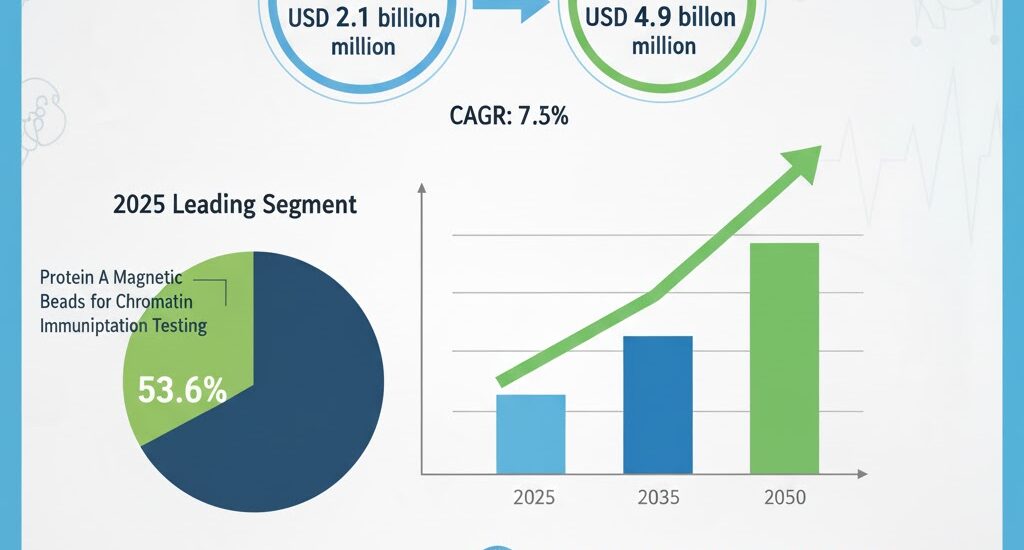
The global Chromatin Immunoprecipitation Testing (ChIP) Market is entering a new era of precision-driven expansion, reflecting a steady demand for advanced molecular tools that unlock deeper insights into gene regulation and epigenetic mechanisms. Estimated at USD 2.1 billion in 2025, the market is projected to reach USD 4.3 billion by 2035, growing at a compound annual growth rate (CAGR) of 7.3% over the forecast period.
As the life sciences sector moves toward data-rich and precision-based research, ChIP testing stands out as a critical enabler of discovery — one that is reshaping how manufacturers, laboratories, and research institutions approach disease analysis, drug development, and biomarker discovery.
Powering a New Phase of Molecular Precision
Chromatin Immunoprecipitation testing lies at the heart of understanding protein–DNA interactions, processes fundamental to gene transcription, DNA repair, and chromosomal stability. For manufacturers supplying reagents, consumables, and assay kits, this market’s trajectory signals not only growth but transformation.
The increasing prevalence of cancer, neurodegenerative, and autoimmune diseases, all linked with epigenetic alterations, has accelerated the global demand for reproducible and accurate testing systems. ChIP-based technologies, particularly when integrated with next-generation sequencing (ChIP-Seq), are enabling comprehensive mapping of chromatin binding sites with unmatched accuracy.
This trend positions ChIP testing as an essential platform for manufacturers supporting epigenetics, proteomics, and personalized medicine — three domains set to define the next decade of life science innovation.
Manufacturers at the Forefront of Innovation
Leading companies such as Thermo Fisher Scientific Inc., Illumina Inc., F. Hoffmann-La Roche Ltd., Merck KGaA, Agilent Technologies Inc., Bio-Rad Laboratories Inc., Qiagen N.V., and BGI Genomics Co. Ltd. are driving forward the adoption of scalable, automation-friendly, and high-throughput ChIP solutions.
Their focus on workflow efficiency, sample integrity, and cross-platform compatibility is enabling laboratories to handle large sample volumes with precision and speed — a key demand from academic and clinical research centers. Manufacturers able to provide streamlined, cost-effective kits and magnetic bead systems stand to capture significant market share as researchers increasingly prioritize accuracy and throughput.
Buy Now & Save: Premium Market Report at $5,000 | Discount Details Inside:- https://www.futuremarketinsights.com/reports/sample/rep-gb-7959
Protein A Magnetic Beads: The Market’s Dominant Product Segment
Among product types, Protein A Magnetic Beads for Chromatin Immunoprecipitation Testing are set to dominate with a commanding 53.6% market share in 2025. Their superior binding affinity, low contamination risk, and compatibility with automated systems make them the preferred choice for high-precision molecular studies.
For manufacturers, this segment presents a compelling opportunity. Demand for reproducible, scalable, and automation-ready solutions is growing rapidly, particularly as laboratories seek to streamline workflows in oncology and epigenetics research. By investing in next-generation bead technologies and user-friendly kit formats, suppliers can strengthen their competitive positioning in an expanding global market.
XChIP: Leading the Charge in Chip Type Adoption
The XChIP segment, capturing 57.1% of market revenue in 2025, remains the most widely used method due to its exceptional ability to preserve protein–DNA interactions during crosslinking. This ensures unparalleled accuracy in identifying chromatin binding sites, a key requirement for research in transcription factor mapping, histone modification profiling, and gene expression studies.
Its dominance stems from compatibility with next-generation sequencing workflows, allowing for both small- and large-scale genomic investigations. As manufacturers continue to refine reagents and automation tools that enhance reproducibility, the XChIP segment’s performance-driven reputation is expected to further solidify its leadership.
Cancer Research Driving Demand and Innovation
In terms of application, the cancer research segment is projected to account for 48.5% of market revenue in 2025, underscoring its central role in advancing demand for ChIP testing. The technology’s ability to identify epigenetic biomarkers, therapeutic targets, and mechanisms of drug resistance has made it indispensable in oncology research and precision drug development.
Manufacturers catering to this segment are focusing on assay standardization, reagent optimization, and sequencing integration to help pharmaceutical and biotech partners accelerate discoveries in cancer diagnostics and treatment development.
Regional Momentum: Asia-Pacific Leading Growth
While North America and Europe continue to hold substantial shares, Asia-Pacific markets — particularly China and India — are demonstrating the fastest growth rates. China leads globally with a 9.9% CAGR, followed by India at 9.1%, driven by strong research investments, expanding life science infrastructure, and local manufacturing capacity.
Developed regions such as Germany (8.4%), France (7.7%), and the UK (6.9%) maintain stable momentum, supported by government funding and academic collaboration networks. The U.S. market, estimated at USD 810.3 million in 2025, is projected to reach USD 1.5 billion by 2035, reflecting a 6.2% CAGR.
For manufacturers, this global spread translates into a diversified opportunity landscape — from supplying reagents and consumables to establishing partnerships with regional research hubs focused on precision medicine.
A Platform for Future Growth
As the market evolves, manufacturers who align with key industry priorities — automation, precision, and scalability — will be best positioned for long-term success. The convergence of ChIP testing with high-throughput sequencing, combined with growing interest in epigenomic biomarker discovery, presents a fertile ground for innovation.
By developing flexible kits and integrated analytical platforms, suppliers can help researchers decode the complexities of gene regulation while meeting the demand for reproducible, high-quality data.
With the Chromatin Immunoprecipitation Testing market projected to double by 2035, the message for manufacturers is clear: the era of precision-driven molecular testing is here, and those who innovate now will define the future of genomic research and diagnostics.
Click Here to Purchase the Report:- https://www.futuremarketinsights.com/checkout/7959
Market Snapshot (2025–2035):
- Market Size 2025: USD 2.1 billion
- Forecast 2035: USD 4.3 billion
- CAGR (2025–2035): 7.3%
- Leading Product Segment: Protein A Magnetic Beads (53.6%)
- Leading Application: Cancer Research (48.5%)
- Fastest Growing Region: China (9.9% CAGR)
About Future Market Insights (FMI)
Future Market Insights, Inc. (ESOMAR certified, recipient of the Stevie Award, and a member of the Greater New York Chamber of Commerce) offers profound insights into the driving factors that are boosting demand in the market. FMI stands as the leading global provider of market intelligence, advisory services, consulting, and events for the Packaging, Food and Beverage, Consumer Technology, Healthcare, Industrial, and Chemicals markets. With a vast team of over 400 analysts worldwide, FMI provides global, regional, and local expertise on diverse domains and industry trends across more than 110 countries.
Contact Us:
Future Market Insights Inc.
Christiana Corporate, 200 Continental Drive,
Suite 401, Newark, Delaware – 19713, USA
T: +1-347-918-3531
For Sales Enquiries: sales@futuremarketinsights.com
Website: https://www.futuremarketinsights.com
LinkedIn| Twitter| Blogs | YouTube