The global BNT lead-free piezoelectric ceramics market is set to surge from USD 141 million in 2025 to USD 744.3 million by 2035, expanding at a remarkable CAGR of 18.1%. The growth reflects a pivotal transformation in the materials industry, where environmental compliance, high-performance engineering, and material innovation converge to define the next generation of piezoelectric devices.
At the heart of this expansion is bismuth sodium titanate (BNT), a sustainable alternative to conventional lead zirconate titanate (PZT). The market shift comes amid stricter environmental mandates under RoHS and REACH regulations, which are accelerating the adoption of lead-free materials across medical devices, automotive sensors, consumer electronics, and energy harvesting systems.
From Regulation to Opportunity: The Rise of Green Piezoelectric Ceramics
The global enforcement of hazardous substance restrictions has become a catalyst for innovation. Manufacturers are racing to replace lead-based ceramics with BNT-based solutions that meet both performance and sustainability standards.
The transition is not merely regulatory—it’s strategic. As industries move toward green electronics and sustainable manufacturing, BNT ceramics are emerging as a core component for precision devices requiring environmental integrity without compromising performance.
The technology is rapidly evolving. Solid-state reactions, the most traditional method, continue to dominate large-scale production, while sol-gel and hydrothermal synthesis techniques enable fine-tuned material uniformity and nanostructure control for advanced applications. Meanwhile, spark plasma sintering and microwave-assisted sintering are redefining industrial processing, lowering energy use, and improving crystal stability.
Performance Redefined: Enhancing Material Efficiency
The performance of BNT ceramics is characterized by strong ferroelectric behavior, high electromechanical coupling coefficients, and robust dielectric properties—all essential for actuators, sensors, and transducers.
When doped with barium, strontium, or potassium, BNT ceramics display relaxor ferroelectric properties, offering enhanced fatigue resistance and temperature stability. These improvements are enabling their use in critical medical and automotive applications where reliability is paramount.
From 2025 to 2030, the market is expected to rise from USD 141 million to USD 274.3 million, driven by material optimization and miniaturization. Between 2030 and 2035, another USD 470 million in new opportunities will emerge, propelled by advanced medical imaging, minimally invasive surgical devices, and next-generation automotive systems.
Medical Devices Lead Market Adoption
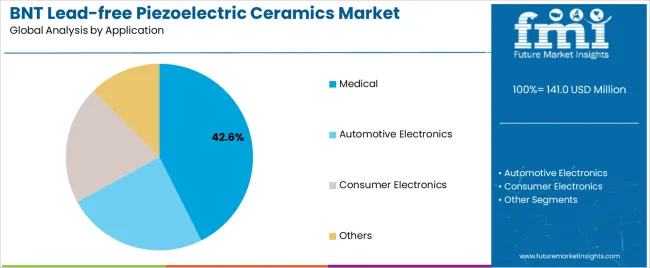
The medical sector continues to be the most significant growth driver, commanding over 42% of total demand in 2025. BNT ceramics are now the material of choice for ultrasound transducers, therapeutic ultrasound systems, and surgical instruments due to their biocompatibility and environmental compliance.
Medical device manufacturers are investing heavily in qualification programs and certification frameworks to ensure safety and reliability, reinforcing the trust in lead-free materials for critical healthcare equipment.
As healthcare technologies become more advanced and portable, the demand for energy-efficient, high-frequency ultrasound imaging systems and miniaturized diagnostic devices is growing rapidly, further amplifying the use of BNT ceramics in medical innovation.
Automotive and Electronics Fuel Diversification
The automotive industry is undergoing an electric transformation, and piezoelectric ceramics play a crucial role in enabling this shift. From pressure sensors and fuel injection actuators to vehicle vibration monitoring systems, BNT-based ceramics are driving the next generation of smart, sustainable automotive electronics.
As automakers pursue zero-emission goals and integrate advanced driver-assistance systems (ADAS), the need for lead-free, high-performance sensors will escalate, positioning BNT ceramics as a key enabler of green mobility.
Meanwhile, consumer electronics manufacturers are incorporating BNT ceramics into haptic feedback systems, smart wearables, and miniature actuators—paving the way for more tactile, energy-efficient, and environmentally compliant devices.
Purchase this Report for USD 5,000 Only | Get an Exclusive Discount Instantly! https://www.futuremarketinsights.com/checkout/27265
Everything You Need—within Your Budget. Request a Special Price Now! https://www.futuremarketinsights.com/reports/sample/rep-gb-27265
Asia-Pacific and Europe Lead Global Expansion
The regional outlook reveals China at the forefront of market expansion, growing at an extraordinary 24.4% CAGR through 2035. The country’s leadership in electronics manufacturing, medical device production, and green technology adoption solidifies its position as the largest market.
India follows closely with a 22.6% CAGR, driven by healthcare modernization and local electronics manufacturing initiatives under the Make in India program.
Germany leads European growth at 20.8%, where engineering excellence and strict environmental regulations accelerate lead-free ceramic innovation. The USA, UK, and Japan also showcase steady advances, backed by strong R&D ecosystems and mature medical and automotive sectors.
By 2035, Europe’s BNT ceramics market is expected to expand from USD 49.9 million to USD 232.3 million, supported by deep integration of sustainable technologies across industrial clusters in Germany, France, and the UK.
Manufacturers Shape the Competitive Frontier
The competitive landscape of the BNT lead-free piezoelectric ceramics market is marked by dynamic innovation and strategic collaboration among leading material producers and technology developers.
CeramTec, a pioneer in advanced ceramics, leads the global market with a comprehensive portfolio catering to medical imaging, automotive sensors, and industrial actuation systems.
PI Ceramic focuses on high-precision actuators and sensors, offering both standard and custom BNT-based solutions for precision mechanics and robotics.
CTS Corporation continues to expand its lead-free piezoelectric component portfolio, targeting automotive and telecommunications applications that demand both performance and compliance.
In parallel, a new generation of emerging manufacturers and startups across East Asia and Europe are advancing dopant engineering, nanostructure control, and thin-film deposition techniques—driving the next phase of material performance improvements and scalability.
About Future Market Insights (FMI)
Future Market Insights, Inc. (ESOMAR certified, recipient of the Stevie Award, and a member of the Greater New York Chamber of Commerce) offers profound insights into the driving factors that are boosting demand in the market. FMI stands as the leading global provider of market intelligence, advisory services, consulting, and events for the Packaging, Food and Beverage, Consumer Technology, Healthcare, Industrial, and Chemicals markets. With a vast team of over 400 analysts worldwide, FMI provides global, regional, and local expertise on diverse domains and industry trends across more than 110 countries.
Contact Us:
Future Market Insights Inc.
Christiana Corporate, 200 Continental Drive,
Suite 401, Newark, Delaware – 19713, USA
T: +1-347-918-3531
For Sales Enquiries: sales@futuremarketinsights.com
Website: https://www.futuremarketinsights.com
LinkedIn| Twitter| Blogs | YouTube