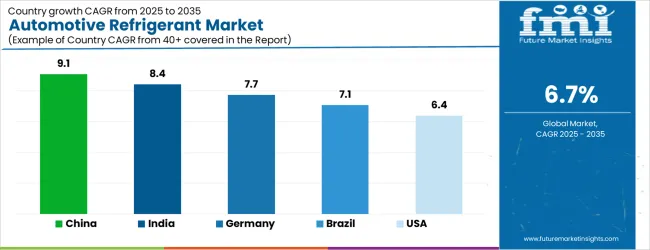
The Automotive Refrigerant Market is estimated to be valued at USD 58.8 billion in 2025 and is projected to reach USD 112.8 billion by 2035, registering a compound annual growth rate (CAGR) of 6.7% over the forecast period.
The Automotive Refrigerant Market is experiencing significant growth as global temperatures rise and the demand for comfortable, climate-controlled vehicle interiors increases. Automotive refrigerants play a vital role in vehicle air conditioning (A/C) systems, enabling efficient heat transfer and temperature regulation.
With the rapid expansion of the automotive industry, increasing vehicle production, and growing adoption of electric vehicles (EVs), the need for environmentally friendly and energy-efficient refrigerants is becoming more critical than ever. The market is witnessing a transition from traditional hydrofluorocarbon (HFC) refrigerants toward low-GWP (Global Warming Potential) alternatives to comply with stringent environmental regulations and sustainability goals.
🔍 Market Overview
The Automotive Refrigerant Market forms a crucial segment of the global automotive chemicals industry, as A/C systems have become standard in most passenger and commercial vehicles. Refrigerants ensure optimal comfort, enhance air quality, and support defogging and defrosting operations in various weather conditions.
The market is characterized by a growing shift toward next-generation refrigerants, such as R-1234yf and CO₂-based alternatives, due to their reduced environmental impact. Automakers are increasingly adopting these advanced refrigerants to align with international climate policies, such as the Montreal Protocol and F-Gas regulations.
As electric and hybrid vehicles become more prevalent, manufacturers are developing thermally efficient refrigerant systems to maintain battery temperature and cabin comfort simultaneously — a key factor in the future growth of this market.
⚙️ Key Market Drivers
- Rising Vehicle Production and Ownership
The increasing production of passenger and commercial vehicles globally continues to drive demand for refrigerants in both OEM and aftermarket applications. - Stringent Environmental Regulations
Regulatory bodies are enforcing limits on high-GWP refrigerants, pushing manufacturers to adopt eco-friendly alternatives such as R-744 (CO₂) and R-1234yf. - Expansion of the Electric Vehicle Market
EVs require specialized thermal management systems to maintain optimal battery performance, boosting the adoption of advanced refrigerants. - Growing Demand for Comfort and Luxury Vehicles
Rising disposable income and consumer preference for vehicles with advanced air conditioning and climate control systems enhance market growth. - Technological Advancements in A/C Systems
The integration of smart sensors, energy-efficient compressors, and low-leakage refrigerant systems supports market expansion.
🚗 Applications of Automotive Refrigerants
Automotive refrigerants are used across several vehicle types and applications, including passenger cars, commercial vehicles, and electric vehicles.
Major applications include:
- Passenger Vehicle Air Conditioning: Ensuring consistent cooling and humidity control for enhanced passenger comfort.
- Commercial Vehicle Climate Systems: Maintaining optimal cabin temperature for long-haul drivers and fleet operations.
- Electric and Hybrid Vehicles: Managing both cabin and battery cooling systems to enhance performance and safety.
- Aftermarket Recharging and Maintenance: Supporting the replacement and refilling of refrigerants in vehicle service centers.
Efficient refrigerant systems improve fuel economy, extend component life, and ensure compliance with global emission standards.
🌍 Market Trends
The Automotive Refrigerant Market is witnessing several key trends that are shaping its evolution toward sustainability and efficiency:
- Shift Toward Eco-Friendly Refrigerants: Adoption of low-GWP and natural refrigerants is becoming an industry standard.
- Rise in Thermal Management Systems for EVs: Advanced refrigerants are being integrated into EV cooling systems to optimize performance.
- Growth of Aftermarket Refrigerant Services: Increasing awareness of A/C maintenance drives the aftermarket segment.
- Innovation in Leak Detection and Recovery Systems: Improving refrigerant recovery and recycling enhances sustainability.
- Development of Lightweight and Compact A/C Components: Enabling higher efficiency and reduced vehicle energy consumption.
💡 Challenges and Opportunities
While the market faces challenges such as high cost of eco-friendly refrigerants and complex retrofitting of old systems, the long-term opportunities are immense.
Manufacturers are investing in R&D to develop high-performance refrigerants that combine low environmental impact with superior cooling efficiency. The growing electric mobility ecosystem and government incentives for green technologies further amplify market potential.
Additionally, collaborations between chemical manufacturers and automotive OEMs are paving the way for sustainable solutions that ensure safety, efficiency, and compliance.
🚀 Future Outlook
The future of the Automotive Refrigerant Market is driven by sustainability, innovation, and efficiency. As the global automotive sector transitions toward electrification, the focus will shift to next-generation refrigerants that support battery thermal management and reduce greenhouse gas emissions.
Advancements in smart HVAC (Heating, Ventilation, and Air Conditioning) systems, combined with IoT-enabled diagnostics and AI-driven climate control, will transform the vehicle comfort experience. Leading players are expected to invest heavily in green refrigerant technologies to meet upcoming environmental standards while maintaining cost-effectiveness and performance.
📌 Key Takeaways
- Rising vehicle production and consumer demand drive refrigerant adoption.
- Environmental regulations accelerate the shift toward low-GWP alternatives.
- EV expansion creates new opportunities in thermal management systems.
- Technological innovation enhances refrigerant efficiency and sustainability.
- Collaboration between OEMs and chemical producers drives market evolution.
Get Instant Access for Only $5000 | Don’t Miss This Exclusive Offer!
https://www.futuremarketinsights.com/reports/sample/rep-gb-5246
Checkout Now to Access Industry Insights:
https://www.futuremarketinsights.com/checkout/5246
About Future Market Insights (FMI)
Future Market Insights, Inc. (ESOMAR certified, recipient of the Stevie Award, and a member of the Greater New York Chamber of Commerce) offers profound insights into the driving factors that are boosting demand in the market. FMI stands as the leading global provider of market intelligence, advisory services, consulting, and events for the Packaging, Food and Beverage, Consumer Technology, Healthcare, Industrial, and Chemicals markets. With a vast team of 400 analysts worldwide, FMI provides global, regional, and local expertise on diverse domains and industry trends across more than 110 countries.
Contact Us:
Future Market Insights Inc.
Christiana Corporate, 200 Continental Drive,
Suite 401, Newark, Delaware – 19713, USA
T: +1-845-579-5705
For Sales Enquiries: sales@futuremarketinsights.com
Website: https://www.futuremarketinsights.com
LinkedIn| Twitter| Blogs | YouTube