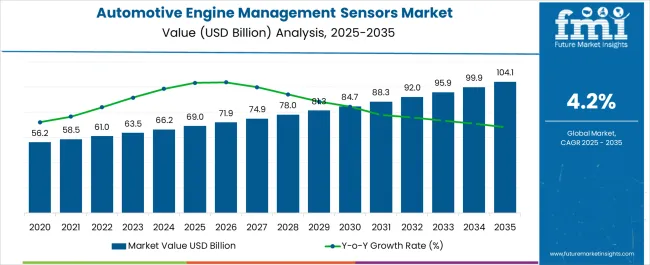
The Automotive Engine Management Sensors Market is estimated to be valued at USD 69.0 billion in 2025 and is projected to reach USD 104.1 billion by 2035, registering a compound annual growth rate (CAGR) of 4.2% over the forecast period.
The Automotive Engine Management Sensors Market is witnessing dynamic growth as modern vehicles increasingly depend on advanced sensor technologies to achieve superior performance, fuel efficiency, and emission control. Engine management sensors are the backbone of smart automotive systems, ensuring real-time monitoring and optimization of combustion, fuel delivery, and air intake.
As automakers shift toward connected, hybrid, and electric powertrains, the demand for intelligent engine management systems has surged. These sensors enable precise control over various engine parameters, helping manufacturers comply with stringent emission norms while improving vehicle reliability and drivability.
🔍 Market Overview
The Automotive Engine Management Sensors Market is expanding rapidly due to rising global automotive production, growing consumer preference for fuel-efficient vehicles, and continuous technological advancements in engine control systems.
Engine management sensors, including oxygen sensors, temperature sensors, pressure sensors, mass airflow sensors, and crankshaft position sensors, play a crucial role in maintaining optimal engine performance. They continuously gather data and transmit it to the Engine Control Unit (ECU), allowing the system to make accurate adjustments in fuel injection, ignition timing, and air-fuel ratios.
As vehicles become more electrified and autonomous, the integration of digital sensors and AI-driven diagnostics is transforming the way engines are managed and maintained, paving the way for smarter mobility solutions.
⚙️ Key Market Drivers
- Stringent Emission Regulations
Global initiatives to reduce carbon emissions are compelling automakers to adopt highly accurate engine sensors that monitor and optimize combustion efficiency. - Rising Demand for Fuel Efficiency
Consumers increasingly prefer vehicles with enhanced mileage and lower emissions, boosting the use of intelligent engine monitoring sensors. - Adoption of Advanced Driver Assistance Systems (ADAS)
Integration of ADAS technologies requires seamless communication between engine sensors and vehicle control systems, promoting sensor innovation. - Growth of Electric and Hybrid Vehicles
The shift toward electrification has led to the development of new sensor categories for battery management, thermal regulation, and motor control. - Technological Advancements in Sensor Design
Miniaturization, MEMS (Micro-Electro-Mechanical Systems), and IoT-enabled sensors are driving next-generation engine performance optimization.
🚘 Applications in Modern Vehicles
Engine management sensors are now integrated across various automotive systems to enhance safety, reliability, and performance.
Major applications include:
- Fuel Management Systems: Ensuring the precise control of fuel injection and combustion for maximum efficiency.
- Emission Control Systems: Monitoring exhaust gases and enabling catalytic converter optimization.
- Temperature and Pressure Monitoring: Regulating coolant, oil, and air temperature for smooth engine operation.
- Ignition Timing and Speed Sensing: Synchronizing spark and crankshaft rotation to prevent misfires and improve performance.
- Battery and Hybrid Powertrain Monitoring: Ensuring optimal voltage, current, and temperature balance in electric and hybrid systems.
These sensors enable real-time diagnostics, reduce maintenance costs, and improve the overall sustainability of vehicle operations.
🌐 Market Trends
The market is undergoing significant transformation with the integration of digital technologies, AI algorithms, and connected automotive systems.
Key trends include:
- Integration of IoT and Cloud-Based Monitoring for predictive maintenance.
- Increased use of MEMS-based miniaturized sensors for lightweight vehicles.
- Growing demand for wireless and contactless sensors for advanced vehicles.
- Expansion of sensor functionality in electric powertrains.
- Focus on data analytics for real-time performance optimization.
These innovations are helping automakers achieve higher levels of automation, efficiency, and environmental compliance.
🔩 Challenges and Opportunities
While the market faces challenges such as high production costs, sensor calibration complexity, and standardization issues, opportunities abound in:
- Integration of self-learning AI sensors for autonomous driving.
- Growth in aftermarket engine sensor replacements due to rising vehicle age.
- Expanding EV and hybrid vehicle segments, demanding new types of sensors.
Manufacturers investing in R&D and collaborating with automotive OEMs are likely to gain a competitive edge in this fast-evolving sector.
🚀 Future Outlook
The future of the Automotive Engine Management Sensors Market is firmly aligned with the evolution of smart mobility and green transportation. The emergence of connected cars, autonomous vehicles, and electrified powertrains is reshaping the engine sensor ecosystem.
Manufacturers are focusing on AI-enabled diagnostic sensors, real-time data analytics, and energy-efficient sensing systems to meet the growing demand for sustainable automotive technologies. As the automotive industry continues to digitize, engine management sensors will remain indispensable to achieving the next generation of cleaner, safer, and smarter vehicles.
📌 Key Takeaways
- Rising demand for fuel-efficient and low-emission vehicles drives market expansion.
- Integration of AI, IoT, and MEMS technology transforms sensor functionality.
- Electric and hybrid vehicles open new opportunities for advanced sensing solutions.
- Stringent emission norms accelerate innovation and adoption of intelligent sensors.
- Predictive maintenance and connected car technologies shape the market’s future.
Get Instant Access for Only $5000 | Don’t Miss This Exclusive Offer!
https://www.futuremarketinsights.com/reports/sample/rep-gb-5094
Checkout Now to Access Industry Insights:
https://www.futuremarketinsights.com/checkout/5094
About Future Market Insights (FMI)
Future Market Insights, Inc. (ESOMAR certified, recipient of the Stevie Award, and a member of the Greater New York Chamber of Commerce) offers profound insights into the driving factors that are boosting demand in the market. FMI stands as the leading global provider of market intelligence, advisory services, consulting, and events for the Packaging, Food and Beverage, Consumer Technology, Healthcare, Industrial, and Chemicals markets. With a vast team of 400 analysts worldwide, FMI provides global, regional, and local expertise on diverse domains and industry trends across more than 110 countries.
Contact Us:
Future Market Insights Inc.
Christiana Corporate, 200 Continental Drive,
Suite 401, Newark, Delaware – 19713, USA
T: +1-845-579-5705
For Sales Enquiries: sales@futuremarketinsights.com
Website: https://www.futuremarketinsights.com
LinkedIn| Twitter| Blogs | YouTube