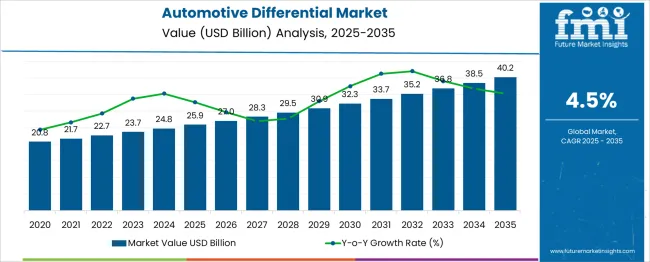
The Automotive Differential Market is witnessing robust growth, fueled by the rising demand for vehicle stability, traction control, and performance efficiency across passenger and commercial vehicles. As automakers embrace electrification and intelligent drivetrain systems, differentials are evolving into high-precision components that ensure smooth torque distribution and improved vehicle handling under diverse driving conditions.
The market’s growth is further supported by innovations in electronic limited-slip differentials (eLSDs), torque vectoring technology, and lightweight materials that enhance efficiency and reduce emissions.
- Rising Vehicle Production and Electrification Trends
The surge in global vehicle production, particularly in emerging economies, has significantly boosted the demand for differentials in both front- and rear-wheel-drive configurations. Moreover, as electric and hybrid vehicles (EVs and HEVs) become mainstream, differential systems are being redesigned to manage instant torque delivery and regenerative braking.
Manufacturers are developing compact and electronically controlled differentials tailored to electric drivetrains, ensuring optimal performance while reducing energy loss.
- Growing Adoption of All-Wheel Drive (AWD) and Four-Wheel Drive (4WD) Systems
The increasing consumer preference for SUVs, crossovers, and high-performance vehicles has accelerated the adoption of AWD and 4WD systems. These vehicles rely heavily on advanced differentials to balance torque between axles and wheels, enhancing traction on slippery or uneven terrains.
Modern AWD systems are now incorporating active differentials, which automatically adjust torque distribution based on driving conditions, improving both vehicle control and fuel efficiency.
- Technological Advancements: From Mechanical to Electronic Differentials
Traditional mechanical differentials are gradually being replaced by electronic and torque-vectoring systems, offering dynamic power management in real time.
Key innovations include:
- Electronic Limited Slip Differentials (eLSD): Enhance cornering stability and acceleration performance.
- Torque Vectoring Differentials: Improve traction by distributing power independently to each wheel.
- Lightweight and Compact Designs: Reduce energy consumption and improve overall vehicle efficiency.
These advancements are paving the way for smart drivetrain systems that integrate seamlessly with ADAS and vehicle stability control modules.
- Increasing Use of Lightweight and Durable Materials
The industry is moving toward lightweight aluminum and composite materials to improve differential efficiency and durability. These materials help reduce vehicle weight and fuel consumption while maintaining strength and reliability.
Suppliers are also incorporating heat-resistant alloys and advanced lubrication systems to extend product lifespan and minimize maintenance requirements.
- Regional Insights
- Asia-Pacific: Dominates the global market, driven by high vehicle production in China, India, Japan, and South Korea.
- Europe: Home to major premium automakers and advanced drivetrain innovators focusing on performance and electric mobility.
- North America: Sees strong growth in the SUV and pickup truck segments, supported by technological advancements in AWD and off-road capabilities.
These regions are expected to witness steady growth as automotive OEMs continue investing in drivetrain modernization and sustainability initiatives.
- Key Market Players
Leading manufacturers in the Automotive Differential Market include:
- Dana Incorporated
- BorgWarner Inc.
- ZF Friedrichshafen AG
- Eaton Corporation
- GKN Automotive Limited
- AAM (American Axle & Manufacturing Holdings Inc.)
- Linamar Corporation
- JTEKT Corporation
These companies are investing in electronic differential technologies, lightweight component manufacturing, and strategic collaborations with EV makers to stay competitive in a rapidly evolving market.
- Future Outlook
The Automotive Differential Market is expected to expand steadily through 2035, supported by:
- The shift toward electric powertrains with smart torque management systems.
- Continuous integration of electronic control units (ECUs) in drivetrain systems.
- Expansion of connected and autonomous vehicle platforms, requiring advanced differential synchronization.
As mobility transitions toward intelligent and sustainable solutions, differentials will remain a key component in ensuring smooth, efficient, and high-performance driving experiences across all vehicle categories.
Get Instant Access for Only $5000 | Don’t Miss This Exclusive Offer!
https://www.futuremarketinsights.com/reports/sample/rep-gb-3061
Checkout Now to Access Industry Insights:
https://www.futuremarketinsights.com/checkout/3061
About Future Market Insights (FMI)
Future Market Insights, Inc. (ESOMAR certified, recipient of the Stevie Award, and a member of the Greater New York Chamber of Commerce) offers profound insights into the driving factors that are boosting demand in the market. FMI stands as the leading global provider of market intelligence, advisory services, consulting, and events for the Packaging, Food and Beverage, Consumer Technology, Healthcare, Industrial, and Chemicals markets. With a vast team of 400 analysts worldwide, FMI provides global, regional, and local expertise on diverse domains and industry trends across more than 110 countries.
Contact Us:
Future Market Insights Inc.
Christiana Corporate, 200 Continental Drive,
Suite 401, Newark, Delaware – 19713, USA
T: +1-845-579-5705
For Sales Enquiries: sales@futuremarketinsights.com
Website: https://www.futuremarketinsights.com
LinkedIn| Twitter| Blogs | YouTube