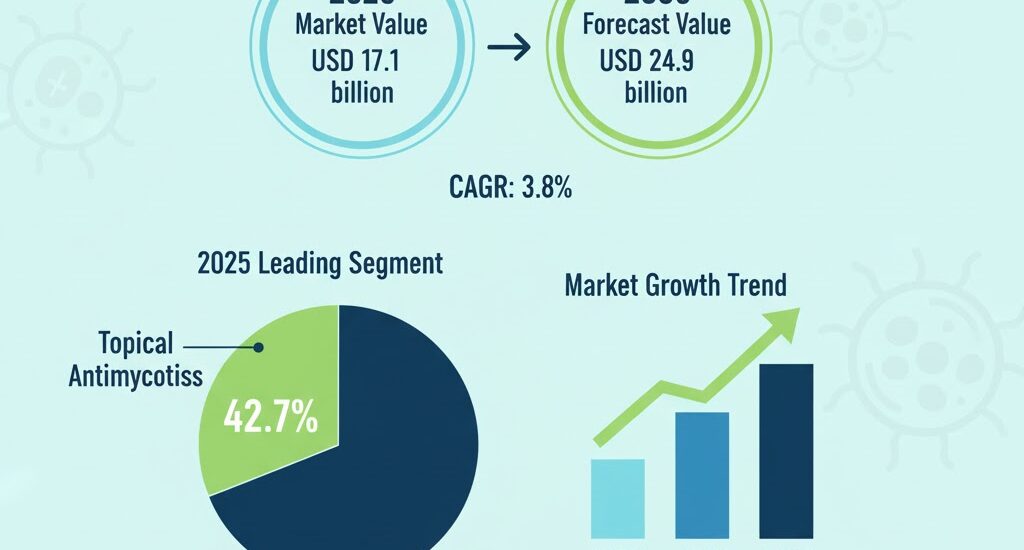
The global Antimycotics Market is set to experience robust expansion over the next decade, advancing from USD 17.1 billion in 2025 to USD 24.9 billion by 2035, with a compound annual growth rate (CAGR) of 3.8%. This growth reflects the rising prevalence of fungal infections worldwide and a strengthened global commitment to infection management, innovation, and healthcare access.
For manufacturers and healthcare partners, the antimycotics sector presents a compelling opportunity—one defined by technological evolution, expanding clinical applications, and the need for sustainable, efficient production strategies to meet global demand.
Rising Prevalence of Fungal Infections Driving Market Demand
Over the past two decades, the global healthcare landscape has seen a notable rise in fungal infections, particularly among immunocompromised individuals, cancer patients, AIDS patients, and transplant recipients. The need for effective antifungal therapies has become a central focus in hospital settings and community care alike.
Manufacturers are responding to these trends by developing advanced formulations that target both superficial and systemic fungal infections. The growing preference for rapid, safe, and targeted treatments has fueled innovation in topical and systemic antimycotic products. Moreover, enhanced awareness of fungal disease management and earlier diagnosis has strengthened patient outcomes, encouraging broader adoption of antifungal therapies.
As the population ages and the number of patients with chronic conditions continues to rise, the global antimycotics market is positioned to benefit from sustained and diverse demand across therapeutic settings.
Topical Antimycotics Lead the Market with 42.7% Share in 2025
Among formulation types, Topical Antimycotics stand out as the dominant category, commanding 42.7% of total market share in 2025. This segment’s leadership is attributed to its convenience, targeted delivery, and favorable safety profile.
Topical therapies are increasingly preferred by both healthcare professionals and patients for treating superficial fungal infections, including dermatophytosis, candidiasis, and ringworm. Their localized mode of action minimizes systemic side effects, improving patient compliance and satisfaction.
Continuous advancements in formulation technologies—particularly those enhancing skin penetration and therapeutic speed—are further reinforcing the role of topical antimycotics in modern healthcare. With increasing retail availability and over-the-counter accessibility, this segment is expected to maintain its momentum through 2035.
For manufacturers, this represents a prime area for product differentiation and market entry, particularly in the development of improved topical formulations that combine efficacy, affordability, and user-friendly design.
Buy Now & Save: Premium Market Report at $5,000 | Discount Details Inside:- https://www.futuremarketinsights.com/reports/sample/rep-gb-8063
Hospitals Remain the Cornerstone of Antimycotic Utilization
In 2025, Hospitals are expected to hold a commanding 57.3% of market revenue, making them the largest end-user segment. Their leadership reflects the high incidence of systemic and invasive fungal infections in critical care settings and the need for advanced formulations—ranging from oral to intravenous antimycotics—to manage these conditions.
Hospitals not only serve as key administration centers but also as distribution hubs through in-house pharmacies and treatment units. The presence of trained personnel and adherence to evidence-based clinical protocols make hospitals pivotal in the antifungal treatment continuum.
The ongoing expansion of hospital networks, particularly in emerging regions, is expected to enhance access to antifungal therapies. For manufacturers, collaboration with hospital systems represents a strategic pathway to long-term partnerships, consistent demand, and enhanced market visibility.
Regional Growth Insights: Asia-Pacific and Europe Lead in Innovation
Geographically, the Antimycotics Market is segmented across North America, Latin America, Europe, Asia-Pacific, and the Middle East & Africa.
While North America and Europe continue to represent established markets, Asia-Pacific is emerging as the most dynamic region.
Country-wise analysis highlights:
- China leading with a 2% CAGR,
- India following closely at 8%,
- Germany at 4%, and
- France and the UK showing stable growth at 0% and 3.6%, respectively.
The USA market, valued at USD 6.3 billion in 2025, is projected to reach USD 8.7 billion by 2035, reflecting steady and sustained expansion. Meanwhile, Japan and South Korea, valued at USD 811.4 million and USD 536.1 million respectively in 2025, continue to reinforce Asia’s growing influence in antifungal therapy innovation and production.
Manufacturers seeking regional expansion will find significant opportunities in Asia-Pacific, where investments in R&D and healthcare infrastructure are accelerating, and patient access to advanced therapeutics is expanding rapidly.
Key Industry Players Shaping the Future of Antimycotics
The competitive landscape of the Antimycotics Market is marked by the presence of leading pharmaceutical innovators, including:
Pfizer Inc., Merck & Co., Inc., Bayer AG, Astellas Pharma Inc., Gilead Sciences, Inc., Novartis AG, Sanofi S.A., and Glenmark Pharmaceuticals Ltd.
These companies are driving R&D advancements, developing novel antifungal agents, and exploring next-generation formulations to overcome resistance and enhance efficacy. Strategic collaborations, licensing partnerships, and investments in biotechnology are central to their market success.
For manufacturers entering or expanding in this field, opportunities exist in formulation innovation, supply chain optimization, and generic manufacturing partnerships—all of which support the long-term sustainability of antifungal treatment availability.
Building a Healthier Future: Opportunities for Manufacturers
As global demand for antifungal therapies continues to grow, manufacturers are uniquely positioned to play a transformative role in advancing public health.
The need for cost-effective, high-quality antimycotic formulations—coupled with improved accessibility across hospitals, laboratories, and pharmacies—creates room for both established players and new entrants. The market’s moderate but consistent growth trajectory underscores its resilience, scalability, and long-term profitability.
By focusing on innovation, regulatory compliance, and strategic regional expansion, manufacturers can help shape the future of fungal infection management—delivering solutions that are not only effective but also sustainable and accessible to all.
Click Here to Purchase the Report:- https://www.futuremarketinsights.com/checkout/8063
About Future Market Insights (FMI)
Future Market Insights, Inc. (ESOMAR certified, recipient of the Stevie Award, and a member of the Greater New York Chamber of Commerce) offers profound insights into the driving factors that are boosting demand in the market. FMI stands as the leading global provider of market intelligence, advisory services, consulting, and events for the Packaging, Food and Beverage, Consumer Technology, Healthcare, Industrial, and Chemicals markets. With a vast team of over 400 analysts worldwide, FMI provides global, regional, and local expertise on diverse domains and industry trends across more than 110 countries.
Contact Us:
Future Market Insights Inc.
Christiana Corporate, 200 Continental Drive,
Suite 401, Newark, Delaware – 19713, USA
T: +1-347-918-3531
For Sales Enquiries: sales@futuremarketinsights.com
Website: https://www.futuremarketinsights.com
LinkedIn| Twitter| Blogs | YouTube