The demand for geosynthetics in South Asia is set to rise dramatically from USD 3 billion in 2025 to nearly USD 7 billion by 2035, representing a 136.7% total growth at a CAGR of 8.8%. According to Future Market Insights (FMI), this expansion is being driven by accelerated infrastructure development, the adoption of sustainable construction materials, and increasing requirements for soil stabilization and drainage efficiency across highways, railways, and environmental protection projects.
South Asia’s geosynthetics landscape is evolving rapidly, led by India, Indonesia, and Vietnam, where large-scale government-backed programs are reshaping regional construction standards. With infrastructure modernization and environmental compliance becoming central to national agendas, the role of geosynthetics has expanded from auxiliary materials to essential components of resilient and efficient construction systems.
Market Overview and Key Growth Drivers
Between 2025 and 2030, South Asia’s geosynthetics market is projected to increase from USD 3 billion to USD 4.7 billion, reflecting a 41.5% share of the total decade’s growth. This early expansion phase is defined by massive public investment in highways, urban infrastructure, and rail modernization. From 2030 to 2035, the market will further accelerate to USD 7 billion, contributing another USD 2.4 billion, propelled by advanced drainage systems, bio-based materials, and standardized installation protocols designed to improve safety and performance.
Rising urbanization and environmental resilience programs across India, Indonesia, and the Philippines are pushing developers to adopt high-performance geosynthetic solutions. Modern construction relies on geotextiles for separation and filtration, geomembranes for containment, and geogrids for reinforcement. As governments strengthen infrastructure codes, demand for these materials will continue to expand, enabling cost-efficient, long-lasting, and eco-compliant infrastructure.
India Leads Regional Growth with Infrastructure Modernization
India is projected to grow at an impressive 9.4% CAGR, fueled by the Bharatmala highway development and rail modernization programs. The country’s initiatives in highway expansion, freight corridors, and smart city development are creating widespread adoption of nonwoven geotextiles, geogrids, and drainage composites.
Leading Indian manufacturers such as Garware Technical Fibres, Strata Geosystems, and TechFab India are expanding local production and technical support networks to meet rising demand. Government mandates for certified geosynthetic materials and quality assurance protocols have turned India into a testing ground for high-standard infrastructure practices. As a result, both domestic producers and global companies are investing in Indian manufacturing facilities to serve the fast-growing regional market.
Regional Highlights: Indonesia, Vietnam, and Beyond
In Indonesia, the 9.2% CAGR forecast is backed by the ambitious Nusantara capital city project, which includes extensive land reclamation, drainage, and coastal defense infrastructure. The use of geogrids for soil reinforcement and geomembranes for containment is becoming increasingly prevalent in seismic-prone regions, while coastal erosion control projects are driving demand for high-durability marine-grade materials.
Vietnam follows with 8.7% growth, fueled by expressway construction, coastal protection, and industrial drainage systems supporting rapid manufacturing expansion. Meanwhile, the Philippines, Malaysia, and Thailand are integrating geosynthetics into flood control, transit systems, and irrigation projects—key areas where the materials enhance efficiency and environmental resilience.
Technological Advancements and Emerging Trends
The region is witnessing a surge in innovation and material technology, with manufacturers investing in advanced nonwoven geotextile filtration systems and bio-based composite materials. The introduction of polypropylene and polyester fiber technologies has improved UV stability, chemical resistance, and long-term performance.
TenCate Geosynthetics (Solmax), a global leader with significant manufacturing presence in Malaysia, is pioneering new product lines that integrate barrier protection with drainage efficiency. Similarly, GSE Environmental continues to strengthen its presence in South Asia with geomembrane systems tailored for mining, waste management, and water containment. German-based NAUE GmbH & Co. KG has expanded its supply of drainage geocomposites for climate-resilient water infrastructure, while Fibertex Nonwovens from Denmark is innovating in nonwoven geotextile technology optimized for tropical climates.
Indian and Southeast Asian firms are also making bold strides in technological self-sufficiency. Companies such as Garware Technical Fibres are not only scaling local production but also expanding globally—exemplified by its recent acquisition of Offshore & Trawl Supply (OTS) to enhance its European presence. This convergence of regional innovation and international expertise is positioning South Asia as a manufacturing and application hub for next-generation geosynthetic technologies.
Geotextiles and Polypropylene Dominate Product and Material Segments
Geotextiles remain the leading product type, accounting for 34% of total demand in 2025. Their dominance underscores their vital role in road and rail construction, where they serve critical functions in separation, filtration, and drainage. Innovations in fiber bonding and weaving systems have improved both tensile strength and filtration performance, making geotextiles indispensable in large-scale infrastructure projects.
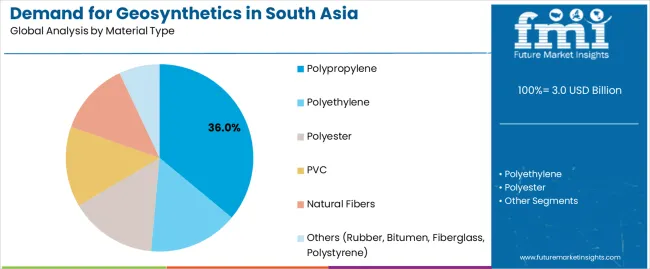
By material, polypropylene holds a commanding 36% market share, driven by its cost-effectiveness, ease of processing, and suitability for diverse environmental conditions. Its UV resistance and chemical stability make it the preferred choice for road construction and environmental containment applications.
The road construction sector continues to account for the largest share—around 42%—as national highway programs across India and Indonesia adopt geosynthetics to improve pavement lifespan and drainage performance.
Purchase this Report for USD 5,000 Only | Get an Exclusive Discount Instantly! https://www.futuremarketinsights.com/checkout/27162
Everything You Need—within Your Budget. Request a Special Price Now! https://www.futuremarketinsights.com/reports/sample/rep-gb-27162
Sustainable and Smart Infrastructure: The Next Decade of Growth
From 2025 to 2035, South Asia’s geosynthetics market will increasingly align with sustainability goals and smart infrastructure technologies. Governments and private developers are prioritizing eco-friendly materials, low-impact manufacturing, and long-life engineering solutions. Advanced geocomposite systems, combining multiple functions such as reinforcement, filtration, and drainage, are being deployed in climate-resilient infrastructure and coastal protection projects.
As climate change challenges intensify, South Asia’s infrastructure strategies are shifting toward resilience. Geosynthetics are emerging as the backbone of sustainable engineering—reducing raw material use, extending structural lifespan, and improving environmental compliance.
Competitive Landscape and Outlook
The competitive environment is defined by a mix of global leaders and emerging regional players. Alongside TenCate (Solmax), GSE Environmental, NAUE, and Fibertex, companies such as Maccaferri Environmental Solutions, SKAPS Industries, and Terram (Berry Global) are deepening their regional footprints through partnerships and production investments.
Local manufacturers are leveraging proximity advantages, cost efficiency, and strong technical expertise to serve national infrastructure programs. New entrants in India and Southeast Asia are investing in automated extrusion systems, AI-based quality monitoring, and custom-engineered composite solutions, ensuring alignment with international performance benchmarks.
As South Asia accelerates its infrastructure transformation, the geosynthetics industry stands at the forefront of this evolution. With its projected growth from USD 3 billion in 2025 to USD 7 billion by 2035, the sector will continue to empower sustainable construction, environmental protection, and resilient development across the region.
About Future Market Insights (FMI)
Future Market Insights, Inc. (ESOMAR certified, recipient of the Stevie Award, and a member of the Greater New York Chamber of Commerce) offers profound insights into the driving factors that are boosting demand in the market. FMI stands as the leading global provider of market intelligence, advisory services, consulting, and events for the Packaging, Food and Beverage, Consumer Technology, Healthcare, Industrial, and Chemicals markets. With a vast team of over 400 analysts worldwide, FMI provides global, regional, and local expertise on diverse domains and industry trends across more than 110 countries.
Contact Us:
Future Market Insights Inc.
Christiana Corporate, 200 Continental Drive,
Suite 401, Newark, Delaware – 19713, USA
T: +1-347-918-3531
For Sales Enquiries: sales@futuremarketinsights.com
Website: https://www.futuremarketinsights.com
LinkedIn| Twitter| Blogs | YouTube