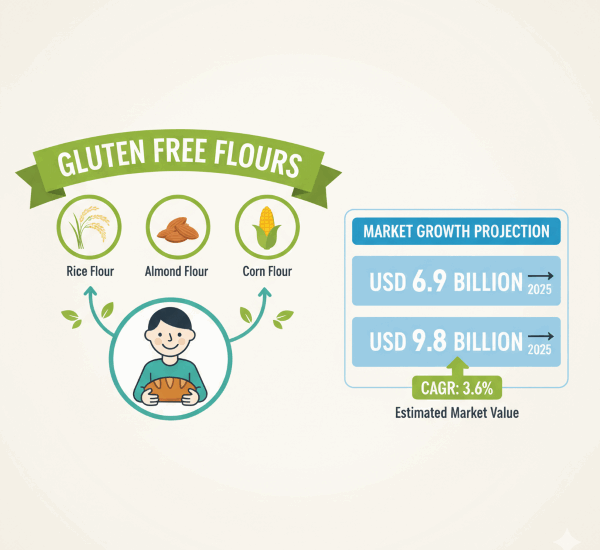
The Global Gluten Free Flours Market is poised for steady growth, projected to rise from USD 6.9 billion in 2025 to USD 9.8 billion by 2035, expanding at a compound annual growth rate (CAGR) of 3.6%. This growth is being fueled by a strong consumer shift toward health-conscious lifestyles, clean-label ingredients, and gluten-free alternatives that offer both nutrition and taste.
Get this Report at $3500 | Grab Your Market Insights Today: https://www.futuremarketinsights.com/reports/sample/rep-gb-2929
Rising Health Awareness Fuels Market Expansion
Growing awareness about celiac disease, gluten intolerance, and lifestyle-driven dietary changes is reshaping food choices globally. Consumers are increasingly opting for gluten-free flours not just for medical reasons, but as part of their wellness-focused eating habits. As a result, both established food manufacturers and emerging brands are expanding their portfolios with innovative gluten-free flour variants to capture this growing market.
Functional foods, sustainability, and plant-based eating are driving demand for natural, nutrient-dense alternatives. The use of advanced flour processing technologies has helped manufacturers enhance texture, flavor, and shelf life—making gluten-free flours more appealing to mainstream consumers.
Market Segmentation and Key Insights
The Gluten Free Flours Market is segmented by Type, Source, End Use Application, and Distribution Channel, with Oat Flour emerging as the dominant type, holding 28.4% of the market share in 2025. Oat flour’s rich fiber content, smooth texture, and versatility make it a preferred ingredient in bakery and home-baking applications. Its use aligns with the rising popularity of plant-based diets and sustainable ingredients.
By Source, the Cereals segment leads the market with a 60% share in 2025, driven by nutritional benefits and improved functional performance in cooking and baking. Continuous advancements in milling technologies have further enhanced the consistency and quality of cereal-based gluten-free flours.
In terms of End Use Applications, the Bread & Bakery Products segment accounts for the largest share at 43.8% in 2025. The popularity of gluten-free bread, cakes, and pastries continues to grow as consumers seek healthier, allergen-free alternatives. Retail-ready bakery products and the rise of home baking have further strengthened this segment’s leadership position.
Regional Growth and Country-Level Insights
Regionally, North America, Europe, and Asia-Pacific dominate the global landscape. The United States remains a key hub, supported by rising awareness of celiac disease and a growing population choosing gluten-free lifestyles. The U.S. market is projected to grow at a CAGR of 3.5%, reaching USD 2,926.2 million by 2035.
Germany continues to lead the European market with a CAGR of 2.9%, maintaining its reputation for high food safety standards and advanced food innovation. German producers have focused heavily on R&D, setting benchmarks for quality and taste in gluten-free alternatives.
Meanwhile, China and Japan are witnessing rapid expansion, with projected CAGRs of 4.7% and 4.1%, respectively. In China, rising health awareness and the localization of gluten-free products have created new growth avenues, with several companies introducing gluten-free versions of traditional Asian foods.
Innovation, Technology, and Product Development
Leading and emerging manufacturers are investing heavily in R&D and technological advancements to enhance product performance. Innovations in gluten-free flour blends are improving texture, consistency, and ease of use, catering to both professional and home bakers. Ready-to-use gluten-free blends are gaining traction for their convenience and ability to mimic traditional wheat flour functionality.
Ancient grains such as quinoa and amaranth are also shaping market trends. Rich in protein and fiber, these grains appeal to consumers seeking nutrient-dense, plant-based ingredients. Similarly, plant-based flours from almonds, chickpeas, and coconuts are becoming increasingly popular for their health and environmental benefits.
Competitive Landscape: Established Giants and Emerging Innovators
The Gluten Free Flours Market is moderately fragmented, featuring a mix of multinational corporations and regional players. Global leaders such as Cargill, Agrana Beteiligungs-AG, Sunopta Inc., The Scoular Company, Archer Daniels Midland Company, Hain Celestial Group Inc., General Mills Inc., and Associated British Foods Plc. are expanding their product lines and exploring mergers and acquisitions to strengthen their global reach.
At the same time, new entrants and regional brands are innovating with local grains and traditional processing methods to appeal to niche markets. These smaller firms are finding success by emphasizing authenticity, transparency, and clean-label formulations.
Recent developments illustrate the dynamic nature of this sector:
- In February 2025, Base Culture launched its “Simply” line of shelf-stable gluten-free breads made with tapioca, flax, hemp, chickpea, and coconut flours.
- In January 2025, Arva Flour Mills, North America’s oldest operating flour mill, acquired Full of Beans Gluten-Free Brand to expand its gluten-free product portfolio.
Such initiatives demonstrate how both heritage brands and new innovators are working toward capturing growing demand by introducing versatile and high-quality gluten-free flours for modern consumers.
Access Premium Reports – Get Your Copy Today: https://www.futuremarketinsights.com/checkout/2929
Future Outlook: Health, Convenience, and Global Accessibility
The Global Gluten Free Flours Market is projected to continue its positive trajectory through 2035, supported by the convergence of health consciousness, product innovation, and increased accessibility through digital retail channels.
As consumers embrace plant-based and allergen-free diets, gluten-free flours will remain central to the evolution of the modern food ecosystem. The next decade will likely see greater diversification across product lines, with a stronger focus on organic, non-GMO, and sustainably sourced ingredients.
Both established manufacturers and emerging players stand to benefit from this transformation, as the gluten-free flours market cements its position as a cornerstone of the global clean-label food movement.
About Future Market Insights (FMI)
Future Market Insights, Inc. (ESOMAR certified, recipient of the Stevie Award, and a member of the Greater New York Chamber of Commerce) offers profound insights into the driving factors that are boosting demand in the market. FMI stands as the leading global provider of market intelligence, advisory services, consulting, and events for the Packaging, Food and Beverage, Consumer Technology, Healthcare, Industrial, and Chemicals markets. With a vast team of over 400 analysts worldwide, FMI provides global, regional, and local expertise on diverse domains and industry trends across more than 110 countries.
Contact Us:
Future Market Insights Inc.
Christiana Corporate, 200 Continental Drive,
Suite 401, Newark, Delaware – 19713, USA
T: +1-347-918-3531
For Sales Enquiries: sales@futuremarketinsights.com
Website: https://www.futuremarketinsights.com
LinkedIn| Twitter| Blogs | YouTube