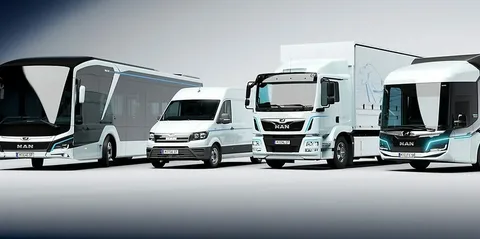
The Electric Light Commercial Vehicle Market is estimated to be valued at USD 332.0 billion in 2025 and is projected to reach USD 822.8 billion by 2035, registering a compound annual growth rate (CAGR) of 9.4% over the forecast period.
The Global Electric Light Commercial Vehicle (e-LCV) Market is witnessing unprecedented growth as the world transitions toward sustainable mobility and low-emission logistics solutions. Driven by the rapid expansion of e-commerce, urban delivery services, and stringent emission regulations, electric light commercial vehicles are becoming essential for last-mile transportation and fleet modernization across key global markets.
Market Overview
Electric light commercial vehicles, which include electric vans, pickups, and small trucks, are emerging as vital components in the global shift toward carbon-neutral logistics. These vehicles combine operational efficiency with reduced fuel costs and zero tailpipe emissions, making them ideal for both urban and regional transport operations.
Governments across regions are supporting e-LCV adoption through tax incentives, charging infrastructure investments, and emission reduction policies, driving fleet operators and logistics providers to transition from diesel to electric models.
Key Market Drivers
- Rapid Growth of E-Commerce and Last-Mile Delivery
The exponential rise in online retailing and food delivery services is fueling demand for electric delivery vans that can operate efficiently in cities with low-emission zones. - Government Incentives and Emission Regulations
National and regional authorities are implementing zero-emission mandates and subsidy programs for electric commercial vehicles, accelerating adoption across logistics and public fleet segments. - Technological Advancements in Battery Systems
Innovations in battery energy density, charging speed, and vehicle range are making e-LCVs more practical and cost-competitive compared to conventional vehicles. - Fleet Electrification and Corporate Sustainability Goals
Major logistics and retail companies are adopting electric fleets to reduce carbon footprints, comply with ESG standards, and enhance brand reputation. - Expanding Charging Infrastructure
The development of fast-charging networks and smart grid integration is improving operational convenience and supporting large-scale e-LCV deployment.
Applications
- E-Commerce and Parcel Delivery – Efficient and clean last-mile logistics
- Public and Municipal Fleets – Waste collection, maintenance, and utility services
- Food and Beverage Distribution – Temperature-controlled electric delivery vans
- Passenger and Shuttle Services – Low-emission urban transport solutions
- Construction and Small Business Operations – Compact, powerful, and eco-friendly work vehicles
Regional Insights
- Europe: Leading the global e-LCV market with strong policy support, including emission-free city zones and subsidies for electric fleets.
- North America: Growing adoption driven by major delivery companies and government electrification initiatives.
- Asia-Pacific: Expected to experience rapid growth due to rising urbanization, manufacturing capacity, and EV policies in China, Japan, and India.
- Rest of the World: Early adoption seen in the Middle East and Latin America through pilot programs and commercial partnerships.
Competitive Landscape
Key players in the Electric Light Commercial Vehicle Market include:
BYD Company Ltd., Nissan Motor Co., Ltd., Renault Group, Ford Motor Company, Mercedes-Benz Group AG, Tata Motors Limited, Rivian Automotive, Stellantis N.V., and Hyundai Motor Company.
These companies are focusing on:
- Expanding electric vehicle production capacity.
- Developing next-generation battery and charging technologies.
- Forming strategic partnerships with logistics and fleet operators.
- Launching compact, long-range e-LCV models for urban mobility.
Future Outlook
The Electric Light Commercial Vehicle Market is projected to grow substantially through 2035, supported by increasing fleet electrification, falling battery prices, and expanding infrastructure.
Advancements in solid-state batteries, vehicle connectivity, and AI-based fleet management will further enhance operational efficiency and reduce ownership costs.
As businesses and cities continue to prioritize clean and sustainable logistics, electric LCVs are set to play a pivotal role in redefining the future of commercial transportation.
Key Highlights
- Growing demand for zero-emission urban logistics solutions.
- Rising adoption of electric vans and pickups by fleet operators.
- Technological advancements in battery performance and fast charging.
- Strong government incentives and emission mandates driving market expansion.
- Asia-Pacific and Europe leading in adoption and innovation.
Get Instant Access for Only $5000 | Don’t Miss This Exclusive Offer!
https://www.futuremarketinsights.com/reports/sample/rep-gb-18837
Checkout Now to Access Industry Insights:
https://www.futuremarketinsights.com/checkout/18837
About Future Market Insights (FMI)
Future Market Insights, Inc. (ESOMAR certified, recipient of the Stevie Award, and a member of the Greater New York Chamber of Commerce) offers profound insights into the driving factors that are boosting demand in the market. FMI stands as the leading global provider of market intelligence, advisory services, consulting, and events for the Packaging, Food and Beverage, Consumer Technology, Healthcare, Industrial, and Chemicals markets. With a vast team of 400 analysts worldwide, FMI provides global, regional, and local expertise on diverse domains and industry trends across more than 110 countries.
Contact Us:
Future Market Insights Inc.
Christiana Corporate, 200 Continental Drive,
Suite 401, Newark, Delaware – 19713, USA
T: +1-845-579-5705
For Sales Enquiries: sales@futuremarketinsights.com
Website: https://www.futuremarketinsights.com
LinkedIn| Twitter| Blogs | YouTube