The European Union electroplating chemicals market demand is entering a dynamic growth phase, set to expand from USD 5.2 billion in 2025 to approximately USD 7.6 billion by 2035, marking an overall growth of 46% at a steady CAGR of 3.9%. Verified by Future Market Insights (FMI), this evolution underscores the continent’s pivot toward sustainable manufacturing and the increasing demand for corrosion-resistant coatings across automotive, electronics, and aerospace sectors.
The market’s expansion is fueled by three key forces: the electrification of Europe’s automotive industry, miniaturization in electronics manufacturing, and the rapid adoption of eco-compliant plating chemistries that eliminate toxic compounds such as hexavalent chromium and cyanides. Together, these shifts are transforming traditional surface finishing into a cleaner, more automated, and regulation-aligned industrial ecosystem.
Automotive Electrification Powers Industry Growth
Between 2025 and 2030, EU electroplating chemicals demand is expected to rise from USD 5.2 billion to USD 6.2 billion — a value increase of over USD 1 billion. This growth phase will be dominated by accelerating electric vehicle (EV) production across Germany, France, and Italy, as manufacturers seek reliable plating solutions for high-performance components.
Automotive manufacturers such as Volkswagen Group, BMW, Mercedes-Benz, Renault, and Stellantis are leading adopters of advanced electroplating systems that deliver precise coating control, corrosion resistance, and decorative finishes for both internal and external components. In electric vehicles, copper and nickel plating are essential for battery connectors and high-voltage circuits requiring superior conductivity and heat stability. As European automakers transition toward EV-dominated fleets, their demand for high-performance plating chemicals is expected to rise exponentially.
From 2030 to 2035, the market will gain another USD 1.3 billion in value, reaching USD 7.6 billion. This second growth phase will be shaped by automation, AI-assisted plating control, and the full-scale adoption of trivalent chromium systems as Europe phases out hazardous plating compounds.
Eco-Compliant Chemistries Redefine Industry Standards
Environmental sustainability is now the foundation of Europe’s electroplating transformation. The EU’s REACH and RoHS regulations have compelled chemical manufacturers to invest heavily in safer, compliant alternatives that maintain the high coating quality demanded by European industries.
Leading players like Atotech Deutschland GmbH, Coventya (Element Solutions), Enthone (MacDermid Alpha), and Technic Inc. have made sustainability their central development priority. They are pioneering trivalent chromium systems, cyanide-free gold solutions, and alkaline zinc formulations that reduce waste, protect workers, and meet stringent EU discharge regulations.
Atotech maintains its market dominance with around 13% share, delivering precision-engineered chemistries for automotive, electronics, and decorative applications. Coventya, with nearly 10% share, focuses on developing plating formulations that balance performance with environmental compliance, while Enthone and Technic emphasize specialty coatings for microelectronics and high-value aerospace components.
Emerging regional manufacturers such as TIB Chemicals, Schlötter, and Chemetall (BASF) are expanding production across Central and Eastern Europe, introducing high-efficiency, REACH-compatible product lines tailored for small and mid-scale electroplating operations. This competitive environment encourages innovation, ensuring a steady supply of sustainable products for every industrial need.
Technology Integration and Industry 4.0 Modernization
Modern electroplating facilities across Europe are rapidly integrating Industry 4.0 technologies. Automated plating lines, real-time bath monitoring, and digital process control systems are becoming standard. Manufacturers such as Umicore and DuPont are collaborating with robotics and AI firms to design smart plating environments where every coating variable — from current density to bath pH — is digitally tracked and optimized for maximum consistency and chemical efficiency.
This digitalization wave is particularly visible in Germany and Italy, where electroplating operations serve the high-precision automotive, aerospace, and electronics industries. Automated chemical dosing, inline inspection, and predictive maintenance systems reduce rework rates, cut waste, and deliver flawless surface finishes required by demanding European standards.
Nickel and Copper Plating Dominate Metal Segment
Among plating metals, nickel remains the most widely used, commanding a 20% share of total demand in 2025 due to its unmatched corrosion resistance and durability. Its extensive use across automotive powertrain components and electronic connectors ensures its continued dominance through 2035, even as copper plating grows due to the electrification wave.
Zinc plating, too, is expanding its footprint, driven by its role in automotive galvanization and protective coatings for industrial machinery. Together, these metals represent the technological backbone of Europe’s electroplating industry, supporting both decorative and functional coating needs with proven reliability and scalable performance.
Automotive and Electronics Lead Application Growth
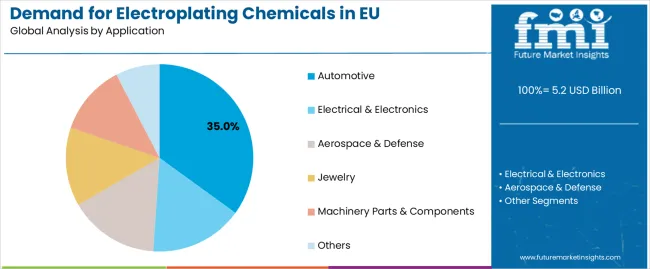
The automotive sector accounts for 35% of market demand in 2025 and is expected to climb slightly to 36% by 2035. Beyond corrosion protection, electroplating chemicals are vital for achieving premium finishes, performance durability, and regulatory compliance across Europe’s manufacturing ecosystem.
The electronics industry is the second major consumer, using ultra-thin coatings for printed circuit boards, semiconductors, and miniaturized devices. The rise of 5G infrastructure, wearable electronics, and renewable energy systems further expands the sector’s reliance on precision plating chemistries designed for fine metallization and low-defect deposition.
Purchase this Report for USD 5,000 Only | Get an Exclusive Discount Instantly! https://www.futuremarketinsights.com/checkout/27159
Everything You Need—within Your Budget. Request a Special Price Now! https://www.futuremarketinsights.com/reports/sample/rep-gb-27159
Germany Leads Europe’s Manufacturing Momentum
Germany will continue to drive regional growth with a projected CAGR of 4.2% through 2035, thanks to its strong automotive and electronics sectors. Italy (3.8%) and France (3.5%) follow closely, fueled by expanding aerospace and precision machinery manufacturing. Spain (3.6%) and the Netherlands (3.5%) are emerging hubs for specialty electroplating, benefiting from increased investment in advanced materials and green manufacturing programs.
Germany’s deep industrial expertise, rigorous quality standards, and established supply chain networks make it the epicenter for electroplating technology innovation. Continuous research in automation and eco-compliant chemistries positions the country as a model for sustainable surface finishing practices globally.
A Competitive Yet Collaborative Market Landscape
The EU electroplating chemicals market is highly competitive but also collaborative, with major suppliers and emerging firms forming partnerships to co-develop sustainable solutions. This synergy between established players like Atotech, BASF Coatings, and Umicore, and newer entrants such as TIB Chemicals and Technic Europe, is accelerating innovation across all segments — from automotive coatings to microelectronics finishing.
Chemical manufacturers are investing in R&D hubs, localized production facilities, and digital monitoring platforms to ensure reliability, cost efficiency, and environmental accountability. Their efforts are helping European industries achieve world-class finishing standards while advancing toward the EU’s 2030 sustainability goals.
About Future Market Insights (FMI)
Future Market Insights, Inc. (ESOMAR certified, recipient of the Stevie Award, and a member of the Greater New York Chamber of Commerce) offers profound insights into the driving factors that are boosting demand in the market. FMI stands as the leading global provider of market intelligence, advisory services, consulting, and events for the Packaging, Food and Beverage, Consumer Technology, Healthcare, Industrial, and Chemicals markets. With a vast team of over 400 analysts worldwide, FMI provides global, regional, and local expertise on diverse domains and industry trends across more than 110 countries.
Contact Us:
Future Market Insights Inc.
Christiana Corporate, 200 Continental Drive,
Suite 401, Newark, Delaware – 19713, USA
T: +1-347-918-3531
For Sales Enquiries: sales@futuremarketinsights.com
Website: https://www.futuremarketinsights.com
LinkedIn| Twitter| Blogs | YouTube