The European black and wood pellets market demand is entering a transformative growth phase, projected to rise from USD 14.1 billion in 2025 to nearly USD 33.4 billion by 2035. This remarkable 135.5% increase reflects the region’s accelerating transition toward renewable energy, sustainable heating systems, and biomass-based power generation. According to Future Market Insights (FMI), demand will expand at a healthy 9% CAGR through the forecast period, with Poland, Italy, Germany, and the United Kingdom leading the surge.
Across Europe, the growing need to decarbonize residential, commercial, and industrial heating systems is fueling demand for certified, efficient biomass fuels. Governments are introducing stringent emission standards, renewable heat incentives, and carbon reduction mandates that are encouraging wide-scale adoption of pellet boilers and district heating systems. This shift marks a critical milestone in Europe’s broader sustainability transition—one where bioenergy plays a central role in achieving net-zero emissions.
Renewable Heating and Decarbonization Mandates Propel Market Momentum
From 2025 to 2030, Europe’s black and wood pellets market is expected to grow from USD 14.1 billion to USD 21.2 billion, adding USD 7.1 billion in value. This expansion is driven primarily by increased residential and commercial heating operations in Poland, Italy, and Germany—regions with strong policy frameworks supporting renewable heat generation.
The pace quickens between 2030 and 2035, with the market forecast to gain another USD 12 billion to reach USD 33.4 billion. This second growth wave will be shaped by technological advancements in torrefied black pellets, the expansion of district heating networks, and the integration of advanced certification standards such as ENplus® A1 across supply chains. As Europe deepens its commitment to sustainable forestry practices and circular bioeconomy principles, pellet manufacturers are investing in traceable raw material sourcing and next-generation production technologies.
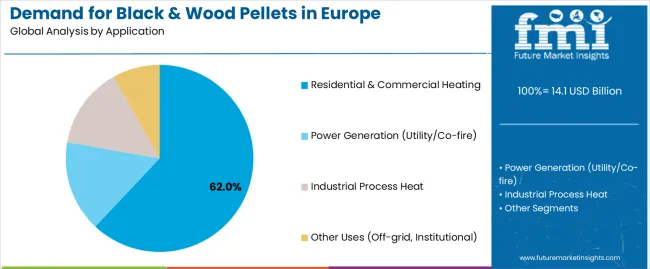
Residential and Commercial Heating Lead Market Demand
Residential and commercial heating applications account for 62% of Europe’s pellet demand, underscoring the region’s reliance on biomass for carbon-neutral heating. Rising natural gas and heating oil prices are pushing households and small businesses toward pellet-based systems that combine cost efficiency with environmental responsibility.
Technological innovation is reshaping the sector, with smart pellet stoves, automated boilers, and remote monitoring systems enhancing user convenience and performance optimization. European consumers are increasingly choosing premium, ENplus® A1-certified pellets to ensure cleaner combustion, reduced emissions, and reliable heating performance in compliance with strict EU energy regulations.
White Wood Pellets Maintain Dominance Amid Rising Black Pellet Innovation
White wood pellets remain the backbone of Europe’s biomass heating sector, commanding an 82% market share in 2025. Their broad compatibility with existing residential and commercial systems, coupled with well-established certification programs like DINplus and ENplus®, sustains their leadership position.
However, black and torrefied pellets are emerging as the next frontier of innovation. Offering higher energy density, superior weather resistance, and lower transport costs, these advanced fuels are gaining traction in industrial and utility-scale power generation. Manufacturers across Europe—particularly in the Baltic and Nordic regions—are accelerating investment in torrefaction and steam explosion technologies to meet this evolving demand.
Poland, Italy, and Germany Spearhead Regional Growth
Poland is poised to lead the European market with a CAGR of 9.3% through 2035. The country’s district heating modernization initiatives and aggressive coal phase-out policies are transforming its energy landscape. Local manufacturers and municipalities are deploying automated pellet handling systems and biomass boilers to meet new efficiency and emission targets.
Italy follows closely with 9.1% CAGR, supported by an extensive network of residential pellet stove installations and government-backed incentives like the Conto Termico program. Italian suppliers are focusing on premium-grade pellet production and improving quality control to serve the growing Southern European heating market.
Germany’s 8.6% growth is anchored in its building decarbonization mandates, which are pushing the adoption of renewable heating solutions. The country’s rigorous enforcement of ENplus® certification has strengthened supply chain integrity and promoted sustainable heating operations across both urban and rural sectors.
Purchase this Report for USD 5,000 Only | Get an Exclusive Discount Instantly! https://www.futuremarketinsights.com/checkout/27143
Everything You Need—within Your Budget. Request a Special Price Now! https://www.futuremarketinsights.com/reports/sample/rep-gb-27143
Established Industry Leaders and New Entrants Reshape the Competitive Landscape
Europe’s pellet industry features a powerful mix of established leaders and emerging innovators striving to expand capacity, strengthen sustainability credentials, and introduce new technologies. Graanul Invest, based in Estonia, leads with an estimated 18% market share and operates 12 production facilities across Europe with a combined capacity of 2.7 million tonnes annually. Its vertically integrated approach—covering forest management, production, and logistics—positions it as a global benchmark for sustainability and reliability.
Drax Group in the United Kingdom continues to drive the industrial and utility pellet market through its large-scale co-firing operations and long-term biomass supply contracts. Enviva, following its 2024 restructuring, is re-entering the market with enhanced capacity from its Epes, Alabama facility, targeting new European clients seeking high-quality industrial pellets. Meanwhile, German Pellets and SBE Latvia maintain a strong foothold in residential and district heating segments through certified pellet production and localized distribution networks.
New entrants and regional producers are also gaining ground, particularly in the Baltic States and Central Europe, where proximity to raw materials and advanced manufacturing facilities supports competitive operations. Companies like Stora Enso, Binderholz, Pfeifer Group, Verdo, and Arbaflame are investing in automation, torrefaction innovation, and digital quality monitoring systems to ensure production efficiency and traceability.
Sustainability and Technology Define the Future of Europe’s Biomass Heating
The coming decade will mark a decisive shift toward high-performance, sustainable pellet production as Europe’s energy and climate policies tighten. Manufacturers are aligning operations with stringent sustainability criteria, including FSC and PEFC certification, lifecycle carbon accounting, and real-time quality monitoring technologies.
Advanced production lines now integrate moisture sensors, ash analyzers, and automated testing protocols that enhance pellet durability and uniformity. Torrefied black pellets are becoming central to Europe’s industrial decarbonization strategies, offering superior storage stability and compatibility with large-scale co-firing power plants.
As urbanization and energy modernization accelerate, Europe’s pellet market will continue to expand across both traditional heating and industrial applications. Collaboration between established producers, new entrants, and government regulators is crucial to achieving scalability, maintaining quality assurance, and ensuring sustainable biomass utilization across the continent.
About Future Market Insights (FMI)
Future Market Insights, Inc. (ESOMAR certified, recipient of the Stevie Award, and a member of the Greater New York Chamber of Commerce) offers profound insights into the driving factors that are boosting demand in the market. FMI stands as the leading global provider of market intelligence, advisory services, consulting, and events for the Packaging, Food and Beverage, Consumer Technology, Healthcare, Industrial, and Chemicals markets. With a vast team of over 400 analysts worldwide, FMI provides global, regional, and local expertise on diverse domains and industry trends across more than 110 countries.
Contact Us:
Future Market Insights Inc.
Christiana Corporate, 200 Continental Drive,
Suite 401, Newark, Delaware – 19713, USA
T: +1-347-918-3531
For Sales Enquiries: sales@futuremarketinsights.com
Website: https://www.futuremarketinsights.com
LinkedIn| Twitter| Blogs | YouTube