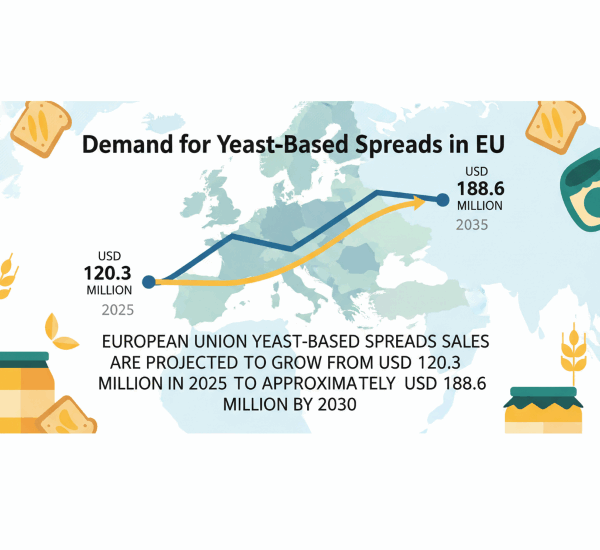
According to Future Market Insights’ latest report, “Demand for Yeast-Based Spreads in EU: Outlook and Forecast (2025–2035),” the European Union yeast-based spreads market is projected to expand from USD 120.3 million in 2025 to approximately USD 188.6 million by 2035, representing an absolute increase of USD 67.5 million and a CAGR of 4.6% over the forecast period. The market is expected to grow 1.56 times its current size as consumers across Germany, France, Italy, and other key European regions show rising interest in vitamin-rich, umami-flavored, and sustainable food options.
Despite the absence of the UK—the traditional yeast-spread powerhouse—the EU market continues to gain momentum through innovative formulations, organic certifications, and expanded retail and foodservice applications.\
Get this Report at $3500 | Exclusive Discount Inside! https://www.futuremarketinsights.com/reports/sample/rep-gb-27191
Rising Popularity of Nutrient-Dense, Plant-Based Spreads
The demand for yeast-based spreads in the EU is strongly influenced by changing dietary habits, particularly the growing adoption of plant-based and vegan lifestyles. With yeast spreads being a rich source of vitamin B12 and other essential B vitamins, they are gaining attention as both functional foods and culinary staples.
Between 2025 and 2030, the market will grow by USD 30.3 million, accounting for nearly half of the total decade’s expansion. This phase will be driven by health-conscious consumers, younger demographics seeking organic and low-sodium options, and a surge in plant-based protein awareness.
From 2030 to 2035, an additional USD 37.2 million in market value will be added as organic varieties reach nearly two-thirds of total sales and yeast spreads find new uses in hotel, restaurant, and café menus.
Established Leaders Meet New Innovators
While heritage brands such as Vitam-R and Marmite (Unilever Plc.) continue to dominate, accounting for significant shares of the market, new entrants and regional manufacturers are actively innovating with fortified, organic, and convenience-focused formulations.
- Vitam-R leads with a projected 20.0% market share in 2025, expected to reach 22.0% by 2035, driven by its German stronghold, multi-generational loyalty, and consistent product innovation.
- Unilever Plc., despite the exclusion of its UK base from EU data, retains a strong pan-European retail presence through Marmite, leveraging advanced distribution and brand trust.
- Emerging health-food producers and private label brands are rapidly scaling up production of organic, non-GMO spreads, appealing to consumers seeking transparency and sustainability.
These established and new manufacturers are not only expanding their product portfolios but also investing in advanced fermentation technologies, sodium reduction processes, and eco-friendly packaging solutions to meet evolving EU consumer expectations.
Organic and Sustainable Growth Take Center Stage
The organic segment is forecast to account for 62.0% of the market by 2035, up from 58.0% in 2025. This rise is driven by eco-conscious consumers who prioritize clean-label products and sustainable food systems.
Yeast-based spreads’ low environmental footprint—owing to resource-efficient fermentation and reuse of brewery by-products—has positioned them as a sustainable alternative to animal-based spreads. As European consumers increasingly align purchases with sustainability and circular economy values, organic-certified yeast spreads are expected to experience significant premiumization and brand loyalty.
Changing Retail Landscape: From Supermarkets to E-Commerce
Currently, hypermarkets and supermarkets dominate sales with a 40.0% share, though this is projected to decline to 36.0% by 2035 as online retail expands from 12.0% to 18.0%. Digital platforms and direct-to-consumer models are revolutionizing the yeast spreads category, offering subscription boxes, bundled health products, and home delivery convenience.
Business-to-consumer retail remains the top application, holding 65.0% share in 2025, as households continue to view yeast spreads as daily breakfast essentials and culinary enhancers.
Innovations Driving the Future of Yeast-Based Spreads
Manufacturers are investing in R&D to make yeast spreads healthier, tastier, and more convenient. Key innovation areas include:
- Reduced-Sodium Formulations: Advanced fermentation techniques and natural flavor enhancers allow for healthier spreads that maintain traditional taste.
- Protein Fortification: Integration of pea and nutritional yeast proteins enhances nutritional value, catering to fitness and vegan consumers.
- Convenient Packaging: Single-serve packs, squeeze tubes, and recyclable pouches address demand for on-the-go and portion-controlled consumption.
These developments reflect a broader industry trend of aligning with functional nutrition, sustainability, and consumer lifestyle shifts.
Germany Leads, France and Italy Follow
Among EU countries, Germany dominates with an estimated 43.3% share in 2025, growing at a 5.2% CAGR—the highest in the region. Germany’s strong breakfast culture, domestic production base, and loyal consumer following for brands like Vitam-R continue to anchor its leadership.
France ranks second with a 4.8% CAGR, integrating yeast spreads into culinary recipes and wellness diets, while Italy (4.3% CAGR) demonstrates growing interest driven by health awareness and international food trends. Spain and the Netherlands also show steady gains, supported by expanding vegetarian populations and premium organic product adoption.
Secure Your Discounted Report Today: https://www.futuremarketinsights.com/checkout/27191
Competitive Outlook: A Blend of Tradition and Transformation
The EU yeast-based spreads market remains fragmented yet dynamic, characterized by a mix of multinational corporations, regional specialists, and innovative startups. Leading companies include:
- Unilever Plc. (Marmite)
- VITAM (Vitam-R brand)
- Mars Foods
- Bega Cheese Limited (Vegemite)
- Cenovis, Three Threes Condiments, Premier Foods (Oxo), and regional health food producers
As consumer preferences evolve, these players—both established and emerging—are leveraging technology, sustainability, and nutritional science to strengthen their foothold in the evolving European yeast-based spreads landscape.
In conclusion, the EU yeast-based spreads market is poised for steady and sustainable growth, supported by shifting dietary trends, innovation in production, and rising health consciousness. From heritage brands modernizing their offerings to startups pioneering organic and fortified variants, the market’s future rests on its ability to blend traditional European flavor heritage with modern nutrition and sustainability goals.
About Future Market Insights (FMI)
Future Market Insights, Inc. (ESOMAR certified, recipient of the Stevie Award, and a member of the Greater New York Chamber of Commerce) offers profound insights into the driving factors that are boosting demand in the market. FMI stands as the leading global provider of market intelligence, advisory services, consulting, and events for the Packaging, Food and Beverage, Consumer Technology, Healthcare, Industrial, and Chemicals markets. With a vast team of over 400 analysts worldwide, FMI provides global, regional, and local expertise on diverse domains and industry trends across more than 110 countries.
Contact Us:
Future Market Insights Inc.
Christiana Corporate, 200 Continental Drive,
Suite 401, Newark, Delaware – 19713, USA
T: +1-347-918-3531
For Sales Enquiries: sales@futuremarketinsights.com
Website: https://www.futuremarketinsights.com
LinkedIn| Twitter| Blogs | YouTube