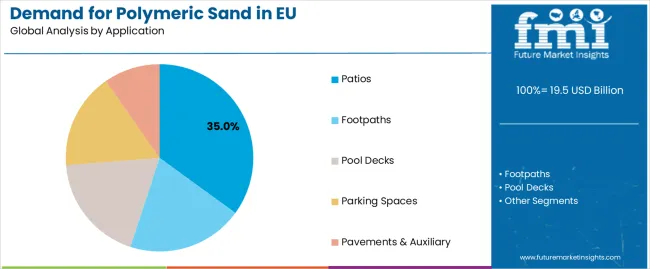
The European Union’s polymeric sand market demand is on a steady growth trajectory, expected to rise from USD 19.5 billion in 2025 to USD 27 billion by 2035, registering a compound annual growth rate (CAGR) of 3.3%. This growth underscores the region’s increasing focus on sustainable construction materials, outdoor living enhancement, and long-term paving solutions designed to improve both functionality and aesthetics. As construction trends evolve toward eco-consciousness and modernization, the polymeric sand industry is witnessing broad adoption across residential, commercial, and municipal sectors.
Between 2025 and 2030, the market is projected to add USD 3.4 billion in value, supported by growing residential landscaping, renovation projects, and the expansion of commercial outdoor spaces. From 2030 to 2035, the market will gain an additional USD 4.1 billion, marking the decade as one of steady expansion fueled by innovation and sustainability-focused initiatives across Europe.
Sustainable Construction and Hardscaping Trends Drive Market Expansion
The demand for polymeric sand in the EU is being propelled by its superior performance characteristics compared to traditional jointing materials. It offers enhanced durability, superior weed resistance, and reduced maintenance, making it an ideal choice for modern hardscaping projects. As homeowners and contractors increasingly prioritize aesthetics and functionality, polymeric sand has become integral to patios, driveways, pool decks, and pedestrian pathways.
Sustainability has become a key market driver. Manufacturers are developing eco-friendly formulations and permeable polymeric sands that allow water infiltration, supporting sustainable drainage systems (SuDS) and compliance with European green construction regulations. These environmentally responsible products align with EU directives promoting circular economy principles and reduced environmental impact in the construction industry.
The European market also benefits from heightened consumer awareness of the long-term cost benefits of polymeric sand. Contractors and homeowners alike are recognizing its role in extending the life of paved surfaces, minimizing repair costs, and ensuring long-lasting structural integrity even in high-traffic areas.
Segmental Insights: Dominance of Polymeric Sand and Patio Applications
By product type, polymeric sand commands an 82% share of the European market in 2025, maintaining its dominance as the preferred jointing solution for most paving systems. Known for its broad paver compatibility and reliable stabilization performance, polymeric sand provides contractors with flexibility and durability suited to a wide range of residential and commercial applications. The slight shift toward polymeric dust reflects growing adoption for narrow-joint installations and specialty projects.
In terms of applications, patios account for 35% of total demand in 2025, underlining their central role in residential outdoor design trends. The segment is bolstered by the region’s growing emphasis on outdoor living spaces and backyard renovations. Footpaths follow closely with 20% of the market share, driven by urban beautification initiatives and pedestrian pathway developments across European cities. The consistent rise in footpath installations reflects municipal and commercial investment in public infrastructure aimed at enhancing walkability and outdoor aesthetics.
Distribution Dynamics and the Rise of Eco-Friendly Formulations
Direct B2B sales dominate the EU polymeric sand market, accounting for 48% of sales in 2025. Contractors and commercial builders benefit from direct supply partnerships, ensuring quality assurance, technical support, and bulk procurement options. However, the rise of e-commerce and online retail platforms is reshaping the distribution landscape. Online sales are expected to grow from 8% to 15% by 2035 as DIY homeowners increasingly turn to digital channels for convenience and access to diverse color and formulation options.
A key trend reshaping the industry is the shift from conventional to eco-friendly formulations. While conventional polymeric sand holds 70% of market share in 2025, it is expected to drop to 50% by 2035. This reflects the strong movement toward green construction materials, particularly among younger homeowners and environmentally conscious developers. Manufacturers are responding with bio-based polymer binders, low-VOC additives, and recyclable packaging to meet sustainability targets.
Innovation and Technology: Redefining Performance and Aesthetics
Leading companies in the polymeric sand sector are investing heavily in advanced polymer technologies that enhance product performance. Innovations include rapid-setting chemistries that reduce installation times, high-strength bonding systems that improve weather resistance, and nanotechnology-based additives for superior color retention. These advancements not only meet professional contractor expectations but also expand appeal among homeowners seeking low-maintenance, premium outdoor finishes.
A growing emphasis on aesthetic customization has also become a key differentiator. Manufacturers now offer a wide palette of color-matched sands designed to complement various paver shades and surface textures. This trend caters to the demand for cohesive outdoor designs, particularly in luxury residential and commercial projects where visual appeal is as critical as durability.
Country-Level Insights: Germany Leads EU Growth
Among EU nations, Germany stands at the forefront with a CAGR of 3.6% through 2035, fueled by its well-established construction industry, strict quality standards, and an active culture of residential renovation. Italy follows with 3.4%, driven by a flourishing outdoor living culture and rising investments in commercial hardscaping linked to tourism infrastructure. France demonstrates a steady 3.2% CAGR supported by its ongoing urban beautification initiatives, while Spain records 3.1%, benefitting from tourism-driven property development and residential construction. The Netherlands, with a CAGR of 2.8%, represents a mature yet quality-driven market emphasizing innovation and professional-grade installation standards.
Purchase this Report for USD 5,000 Only | Get an Exclusive Discount Instantly! https://www.futuremarketinsights.com/checkout/27165
Everything You Need—within Your Budget. Request a Special Price Now! https://www.futuremarketinsights.com/reports/sample/rep-gb-27165
Competitive Landscape: Manufacturers Target Expansion and Innovation
The competitive landscape of the EU polymeric sand market is defined by a mix of established international brands and emerging regional manufacturers. Leading players such as ROMEX GmbH, GftK GmbH, Techniseal, Alliance Designer Products, Sakrete, SIKA Corporation, Unilock, Quikrete, SEK-Surebond, and Azpects dominate through technological innovation, distribution partnerships, and robust contractor networks.
ROMEX GmbH, holding approximately 12% market share, leads with its extensive jointing sand portfolio and contractor-focused support services. GftK GmbH maintains around 9% share, distinguished by its resin jointing technology and European distribution strength. Techniseal and Alliance Designer Products also remain key players, investing in product innovation and market expansion across Western and Southern Europe.
Meanwhile, smaller and new entrants are capitalizing on niche opportunities, especially in eco-friendly product categories. Their focus on sustainability, customization, and flexible distribution channels allows them to tap into growing consumer demand for environmentally responsible solutions.
About Future Market Insights (FMI)
Future Market Insights, Inc. (ESOMAR certified, recipient of the Stevie Award, and a member of the Greater New York Chamber of Commerce) offers profound insights into the driving factors that are boosting demand in the market. FMI stands as the leading global provider of market intelligence, advisory services, consulting, and events for the Packaging, Food and Beverage, Consumer Technology, Healthcare, Industrial, and Chemicals markets. With a vast team of over 400 analysts worldwide, FMI provides global, regional, and local expertise on diverse domains and industry trends across more than 110 countries.
Contact Us:
Future Market Insights Inc.
Christiana Corporate, 200 Continental Drive,
Suite 401, Newark, Delaware – 19713, USA
T: +1-347-918-3531
For Sales Enquiries: sales@futuremarketinsights.com
Website: https://www.futuremarketinsights.com
LinkedIn| Twitter| Blogs | YouTube