The European Union’s compressor oil market demand is entering a decisive decade of growth as manufacturers, industrial operators, and lubricant innovators accelerate adoption of next-generation synthetic and eco-compliant oils. According to Future Market Insights (FMI), EU compressor oil sales are projected to expand from USD 2 billion in 2025 to around USD 3.1 billion by 2035, marking an absolute increase of USD 1.1 billion and a compound annual growth rate (CAGR) of 4.5%. This steady expansion reflects Europe’s industrial transformation driven by automation, energy efficiency mandates, and sustainability-driven lubricant innovation.
The market’s growth is being shaped by Europe’s transition toward high-performance synthetic lubricants optimized for longer drain intervals, lower friction, and superior equipment protection. Across manufacturing, HVAC-R, oil and gas, automotive, and power generation sectors, industrial operators are increasingly replacing conventional mineral oils with synthetic and bio-based formulations that meet the continent’s stringent environmental regulations. Between 2025 and 2030, compressor oil demand will climb from USD 2 billion to USD 2.5 billion, contributing nearly half of the decade’s total growth. During this period, the adoption of advanced compressor oils in manufacturing automation and HVAC systems will play a pivotal role in boosting sales.
Between 2030 and 2035, the market is forecast to expand further to USD 3.1 billion as synthetic lubricants and predictive maintenance technologies redefine industrial lubrication standards. The second half of the decade will witness a pronounced shift toward data-integrated oil monitoring systems, allowing operators to extend lubricant life while improving compressor reliability and reducing energy consumption.
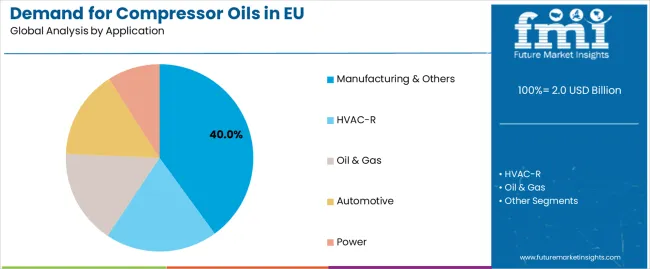
Synthetic oils already dominate the EU compressor oil landscape, accounting for 45% of total sales in 2025 and projected to reach 50% by 2035. Their superior oxidation resistance, thermal stability, and friction-reducing properties make them the preferred choice for manufacturers pursuing operational excellence. These oils deliver long-term cost advantages by minimizing maintenance frequency and power consumption—factors that are critical to Europe’s high-cost industrial economy. The manufacturing sector alone represents about 40% of compressor oil consumption, underscoring the product’s indispensable role in pneumatic systems, robotics, and automated assembly lines that define Industry 4.0 across European production facilities.
Major energy companies and lubricant producers are actively shaping this evolving market. ExxonMobil, with an estimated 15% share, leads through its premium Mobil Rarus and Mobil Pegasus lines, recognized for high-performance synthetic formulations validated by leading compressor OEMs. Shell, capturing roughly 12% of market share, continues to strengthen its position through extensive distribution networks and sustainable lubricant innovations designed for both industrial and HVAC-R applications. FUCHS Petrolub SE, one of Europe’s largest independent lubricant manufacturers, maintains about 8% share, leveraging its German engineering expertise to provide region-specific formulations meeting European industrial standards.
Alongside these leaders, several established and emerging players—including TotalEnergies, BP (Castrol), Chevron, Klüber Lubrication, Idemitsu Kosan, and Petro-Canada Lubricants—are expanding their operations through new technologies, advanced additive chemistries, and eco-compliant product portfolios. These companies are developing synthetic blends and bio-based lubricants that combine energy efficiency with reduced environmental impact, targeting customers eager to align with the EU’s sustainability objectives. Smaller regional producers across France, Spain, and the Netherlands are also investing in localized manufacturing and distribution to capture growing demand from industrial SMEs transitioning to synthetic solutions.
Regional performance highlights the dynamic nature of this market. France leads the European growth trajectory, recording a 4.6% CAGR through 2035, supported by its diverse manufacturing base and robust HVAC-R infrastructure. Spain follows closely at 4.5%, driven by rapid industrial expansion and modernization of production facilities. Germany remains a cornerstone of demand, contributing substantial volume through its globally renowned manufacturing sector and automation leadership, while Italy and the Netherlands maintain steady growth through industrial resilience and technical sophistication. Collectively, these regions are advancing Europe’s compressor lubrication capabilities through innovation, quality assurance, and energy optimization.
The EU’s transition toward sustainability is reshaping lubricant chemistry itself. Conventional mineral-based compressor oils, which held 62% of market share in 2025, are expected to decline to 48% by 2035. In contrast, eco-compliant formulations—engineered for biodegradability, low toxicity, and reduced emissions—will grow to over half of total market demand. This reflects a broader industrial shift toward carbon footprint reduction, circular economy alignment, and compliance with the EU’s Green Deal directives. Bio-based synthetics and PAO- or ester-based oils are becoming central to this sustainability transformation, providing performance equal to or exceeding mineral-based alternatives while ensuring environmental responsibility.
Purchase this Report for USD 5,000 Only | Get an Exclusive Discount Instantly! https://www.futuremarketinsights.com/checkout/27150
Everything You Need—within Your Budget. Request a Special Price Now! https://www.futuremarketinsights.com/reports/sample/rep-gb-27150
The integration of condition monitoring and predictive maintenance technology marks another major turning point for the compressor oil industry. European manufacturers and facility managers are adopting oil analysis programs and digital monitoring systems that track viscosity, contamination, and oxidation levels in real time. This approach ensures optimal maintenance scheduling, reduces waste oil generation, and extends service intervals—further justifying investment in premium synthetic oils. The synergy between lubricant chemistry and data-driven maintenance underscores Europe’s shift toward smarter, more sustainable industrial operations.
As energy costs rise across the continent, compressor oils are increasingly recognized as enablers of efficiency. Advanced low-viscosity formulations deliver measurable reductions in power consumption, directly supporting corporate sustainability goals and cost-optimization strategies. The development of bio-based synthetics and recyclable lubricant packaging further strengthens the EU’s position as a global leader in sustainable industrial lubrication.
About Future Market Insights (FMI)
Future Market Insights, Inc. (ESOMAR certified, recipient of the Stevie Award, and a member of the Greater New York Chamber of Commerce) offers profound insights into the driving factors that are boosting demand in the market. FMI stands as the leading global provider of market intelligence, advisory services, consulting, and events for the Packaging, Food and Beverage, Consumer Technology, Healthcare, Industrial, and Chemicals markets. With a vast team of over 400 analysts worldwide, FMI provides global, regional, and local expertise on diverse domains and industry trends across more than 110 countries.
Contact Us:
Future Market Insights Inc.
Christiana Corporate, 200 Continental Drive,
Suite 401, Newark, Delaware – 19713, USA
T: +1-347-918-3531
For Sales Enquiries: sales@futuremarketinsights.com
Website: https://www.futuremarketinsights.com
LinkedIn| Twitter| Blogs | YouTube