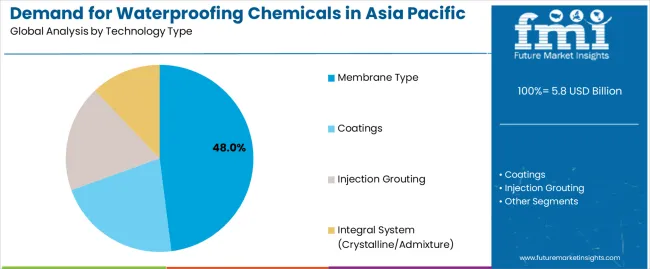
 The Asia Pacific waterproofing chemicals market demand is entering a transformative growth phase, with total market value projected to expand from USD 5.8 billion in 2025 to approximately USD 11.5 billion by 2035. This strong 7.1% compound annual growth rate (CAGR) reflects the region’s intensifying infrastructure development, urbanization, and industrial modernization. Future Market Insights (FMI) projects that overall sales will grow 2.4 times during this decade as construction operations across India, Vietnam, Indonesia, and China demand higher-quality waterproofing systems for durable, long-lasting structures.
Accelerated Growth from 2025 to 2035
Between 2025 and 2030, waterproofing chemical demand is set to rise from USD 5.8 billion to USD 8.9 billion — a 37.8% growth phase fueled by rapid infrastructure expansion in developing economies. India, Vietnam, and Indonesia are leading this period, propelled by government-led housing, transportation, and metro rail initiatives. Manufacturers are scaling production to meet rising complexity in construction applications, focusing on flexible membranes, injection grouting systems, and integral admixtures.
From 2030 to 2035, the market is expected to grow by another USD 5.1 billion, accounting for over 60% of the decade’s total value expansion. During this phase, eco-friendly formulations, advanced coating technologies, and standardized waterproofing practices will dominate the sector. The growing emphasis on green buildings, climate resilience, and performance-based design across Asia Pacific will encourage the adoption of low-VOC and water-based waterproofing systems.
Membrane Technologies Lead Market Evolution
Membrane-type waterproofing systems continue to be the dominant technology, accounting for nearly 48% of total demand. These systems — including APP and SBS bitumen membranes, PVC/TPO sheets, and EPDM membranes — remain essential for infrastructure, roofing, and basement applications. Innovations in self-adhesive membranes and prefabricated sheet technologies are improving installation efficiency, reducing torch use, and enhancing worker safety. These advances are especially significant in tropical Asia Pacific climates, where heavy rainfall and high humidity demand durable moisture barriers.
Direct Sales Drive Market Accessibility
Direct sales channels are forecast to account for 45% of the market by 2025. Large infrastructure contractors and real estate developers across China, India, and Southeast Asia increasingly source directly from manufacturers to ensure product authenticity and technical compliance. Direct procurement also facilitates access to on-site training, application support, and technical documentation, which are crucial for large-scale waterproofing projects like tunnels, metros, and bridge decks.
Country-Wise Market Leaders: Vietnam and India Set the Pace
Vietnam is projected to lead the Asia Pacific waterproofing chemicals market with a CAGR of 8.5%, driven by rapid industrial park development, port expansion, and climate-resilient construction practices. Foreign direct investments in manufacturing hubs are further propelling waterproofing system adoption. Manufacturers such as Mapei S.p.A., which recently expanded its Southeast Asia production capacity, are aligning local supply with infrastructure growth.
India follows closely with a CAGR of 8.3%, supported by mega-infrastructure projects like the Bharatmala highway program, extensive metro development, and government housing initiatives. Major players including Sika AG and Pidilite Industries (Dr. Fixit) have invested in new manufacturing lines and launched next-generation polyurethane liquid membranes tailored for Indian climatic conditions. These initiatives reinforce India’s leadership in waterproofing technology adoption and quality standardization.
Indonesia (8.1%) and the Philippines (8.0%) also contribute significantly, driven by capital city development, flood-control programs, and transportation infrastructure expansion. Meanwhile, China maintains the region’s largest consumption base with a CAGR of 7.4%, reflecting continuous urban renewal and renovation activity across major cities. Japan (6.8%) and Australia (6.2%) represent mature yet innovation-focused markets emphasizing low-VOC and sustainable waterproofing systems.
Sustainability and Green Building Initiatives Transform the Industry
A defining trend in the next decade will be the integration of sustainable waterproofing technologies. Manufacturers are shifting toward low-VOC polyurethane and water-based systems to meet regional environmental standards and international certifications such as LEED, GRIHA, and Green Mark. European and Japanese companies are leading this transition, while Asian producers are rapidly adopting eco-friendly materials and recyclable packaging to align with global sustainability mandates.
These advancements are not only reducing environmental footprints but also improving safety for applicators and building occupants. As urban Asia transitions toward energy-efficient and environmentally responsible construction, waterproofing chemicals will play a crucial role in achieving long-term building durability and resilience.
Purchase this Report for USD 5,000 Only | Get an Exclusive Discount Instantly! https://www.futuremarketinsights.com/checkout/27177
Everything You Need—within Your Budget. Request a Special Price Now! https://www.futuremarketinsights.com/reports/sample/rep-gb-27177
Competitive Landscape: Established Giants and Emerging Innovators
The market remains highly competitive, featuring a blend of established multinational players and rapidly growing regional manufacturers. Sika AG, with a 13.5% estimated regional share, continues to expand through localized production, including its 2024 waterproofing plant in India. BASF SE and Wacker Chemie AG lead in polymer-based and polyurethane systems, while Mapei S.p.A. focuses on liquid-applied membranes and integral admixtures for infrastructure applications.
India’s Pidilite Industries (Dr. Fixit) remains a regional leader, having launched next-gen PU membranes designed for climate adaptability and low emissions. Emerging Asian manufacturers such as Fosroc, Saint-Gobain Weber, and H.B. Fuller are strengthening distribution and technical networks to compete in fast-growing urban markets. Together, these companies are shaping a vibrant competitive ecosystem marked by innovation, sustainability, and advanced material science.
About Future Market Insights (FMI)
Future Market Insights, Inc. (ESOMAR certified, recipient of the Stevie Award, and a member of the Greater New York Chamber of Commerce) offers profound insights into the driving factors that are boosting demand in the market. FMI stands as the leading global provider of market intelligence, advisory services, consulting, and events for the Packaging, Food and Beverage, Consumer Technology, Healthcare, Industrial, and Chemicals markets. With a vast team of over 400 analysts worldwide, FMI provides global, regional, and local expertise on diverse domains and industry trends across more than 110 countries.
Contact Us:
Future Market Insights Inc.
Christiana Corporate, 200 Continental Drive,
Suite 401, Newark, Delaware – 19713, USA
T: +1-347-918-3531
For Sales Enquiries: sales@futuremarketinsights.com
Website: https://www.futuremarketinsights.com
LinkedIn| Twitter| Blogs | YouTube