The global Electrically Conductive Adhesives Market is on a trajectory of rapid expansion, poised to grow from USD 3.2 billion in 2025 to USD 7.2 billion by 2035, registering a compound annual growth rate (CAGR) of 8.5%. This growth is fueled by the increasing need for lightweight, flexible, and high-performance bonding solutions across industries such as automotive, consumer electronics, aerospace, and healthcare.
Unlike traditional soldering methods, electrically conductive adhesives offer manufacturers a cost-effective and reliable alternative that allows for miniaturization and increased design flexibility. They play an essential role in enabling the assembly of next-generation electronics where temperature sensitivity, stress reduction, and precision bonding are critical. As industries accelerate toward electrification, sustainability, and digital transformation, these adhesives are becoming integral to innovation in materials science and electronics manufacturing.
Why the Market Is Growing
The rising global demand for electric vehicles (EVs), 5G communication systems, and wearable electronics is significantly boosting the adoption of conductive adhesives. These materials deliver excellent electrical performance, superior fatigue resistance, and compatibility with diverse substrates, making them vital for delicate circuitry and high-frequency devices.
Advances in nanotechnology and advanced filler materials are improving thermal stability, conductivity, and mechanical strength, expanding their applicability to more demanding environments. At the same time, stringent regulations encouraging lead-free and eco-friendly materials are driving the replacement of traditional soldering with conductive adhesives.
Manufacturers are increasingly focusing on innovation to produce adhesives that offer both high electrical conductivity and environmental sustainability. From 3M and Henkel AG & Co. KGaA to emerging technology developers like Creative Materials Inc. and Panacol-Elosol GmbH, the market is witnessing strong competition and collaboration aimed at developing next-generation adhesive systems.
Segmental Insights
The Electrically Conductive Adhesives Market is segmented by type, application, filler, product type, and region. Among these, epoxy-based adhesives dominate the market and are expected to account for 32.4% of total revenue in 2025. Epoxy formulations are valued for their excellent adhesion, thermal stability, and chemical resistance. Their adaptability allows for tailored performance across various substrates including metals, ceramics, and polymers—qualities essential for high-precision applications such as circuit board assembly and sensor bonding.
Epoxy adhesives also offer long shelf life and compatibility with automated processes, ensuring efficiency and cost savings for manufacturers. As industries seek high-performance, lightweight, and thermally conductive materials, epoxy adhesives continue to set the benchmark for reliability and scalability in conductive bonding.
Automotive Industry Leading Application Segment
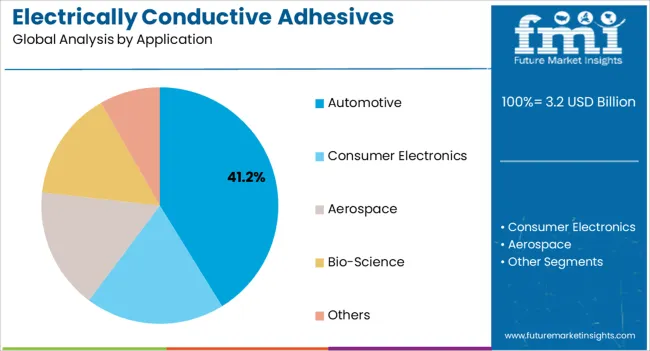
The automotive segment stands as the dominant application area, projected to capture 41.2% of total revenue in 2025. Electrically conductive adhesives are increasingly replacing solder in automotive electronics due to their superior durability, thermal management, and resistance to vibration and shock. They are extensively used in battery management systems, control units, sensors, and electric drivetrains, supporting the shift toward smarter, more connected vehicles.
As electric vehicle adoption accelerates globally, automakers are integrating conductive adhesives to enhance energy efficiency and safety. Their ability to enable compact circuit designs and ensure strong, long-lasting electrical connections positions them as a cornerstone technology for the EV revolution.
Moreover, as advanced driver assistance systems (ADAS) and autonomous driving technologies become mainstream, the demand for high-reliability adhesives will continue to rise, solidifying the automotive sector’s leadership in this market.
Silver Filler Segment Dominates by Performance
In terms of filler materials, silver remains the dominant choice, representing 40.1% of market revenue in 2025. Silver-based fillers are prized for their unparalleled electrical and thermal conductivity, chemical resistance, and stability, making them ideal for high-performance electronics and medical applications.
Despite being costlier than copper or carbon fillers, silver continues to lead due to its reliability in mission-critical environments such as aerospace components, medical implants, and precision sensors. Advances in nano-silver technology are further optimizing conductivity while reducing material costs, ensuring the segment’s continued leadership.
The sustained demand for silver-filled adhesives underscores the industry’s commitment to performance, quality, and innovation—key factors shaping the next generation of conductive materials.
Regional Outlook: Asia-Pacific Leads Global Growth
The Electrically Conductive Adhesives Market demonstrates strong regional diversity, with Asia-Pacific emerging as the most dynamic growth hub. China, growing at a CAGR of 11.5%, leads global production and consumption due to its booming electronics and automotive industries. India, expanding at 10.6% CAGR, is rapidly developing as a manufacturing hub for EVs and semiconductor components.
In Western Europe, countries like Germany, France, and the United Kingdom continue to see stable expansion supported by high innovation intensity and strong regulatory standards. Germany, in particular, held the dominant share in 2024 and is expected to sustain a CAGR of 9.8%.
In North America, the United States market, valued at USD 1.1 billion in 2025, is forecasted to double to USD 2.2 billion by 2035. Growth here is fueled by increased R&D in electric mobility, aerospace applications, and next-generation consumer electronics. While Brazil posts a moderate CAGR of 6.4%, its progress reflects expanding electronics manufacturing capabilities in Latin America.
Japan and South Korea, valued at USD 162.3 million and USD 91.7 million respectively in 2025, are focusing on miniaturized adhesives for microelectronics and medical devices, further diversifying global growth avenues.
Purchase this Report for USD 5,000 Only | Get an Exclusive Discount Instantly! https://www.futuremarketinsights.com/checkout/2876
Everything You Need—within Your Budget. Request a Special Price Now! https://www.futuremarketinsights.com/reports/sample/rep-gb-2876
Key Market Players Driving Innovation
The competitive landscape of the Electrically Conductive Adhesives Market is defined by a blend of established giants and agile innovators. 3M, Henkel AG & Co. KGaA, Dow Inc., and H.B. Fuller lead global innovation through large-scale R&D investments and environmentally sustainable product lines.
Emerging companies like Aremco, Master Bond Inc., Creative Materials Inc., and Permabond are carving a niche by focusing on customized formulations for specialized applications such as biomedical devices and aerospace electronics. Meanwhile, Parker Hannifin Corp., Panacol-Elosol GmbH, and HITEK Electronic Materials Ltd are leveraging regional expertise to serve diverse market segments with advanced adhesive technologies.
Collaborations between adhesive manufacturers and electronics producers are also becoming common, as stakeholders align to meet rising performance demands and sustainability goals.
Technological Innovations Shaping the Future
Breakthroughs in nanomaterial engineering, isotropic and anisotropic conductive adhesives, and low-temperature curing systems are redefining product capabilities. These technologies allow adhesives to perform reliably in high-frequency circuits and flexible electronics, opening new opportunities across the consumer, automotive, and aerospace sectors.
Sustainability is also reshaping production, with manufacturers developing lead-free and solvent-free adhesives that comply with global environmental standards. Enhanced production efficiency through digitalized manufacturing and AI-based quality control is further accelerating innovation.
With 5G networks expanding and demand for compact, energy-efficient electronics growing, the Electrically Conductive Adhesives Market is expected to remain central to the technological evolution of multiple industries.
About Future Market Insights (FMI)
Future Market Insights, Inc. (ESOMAR certified, recipient of the Stevie Award, and a member of the Greater New York Chamber of Commerce) offers profound insights into the driving factors that are boosting demand in the market. FMI stands as the leading global provider of market intelligence, advisory services, consulting, and events for the Packaging, Food and Beverage, Consumer Technology, Healthcare, Industrial, and Chemicals markets. With a vast team of over 400 analysts worldwide, FMI provides global, regional, and local expertise on diverse domains and industry trends across more than 110 countries.
Contact Us:
Future Market Insights Inc.
Christiana Corporate, 200 Continental Drive,
Suite 401, Newark, Delaware – 19713, USA
T: +1-347-918-3531
For Sales Enquiries: sales@futuremarketinsights.com
Website: https://www.futuremarketinsights.com
LinkedIn| Twitter| Blogs | YouTube