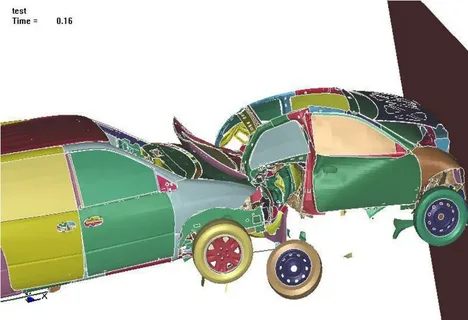
The automotive crash impact simulator market, valued at USD 957.4 million in 2025, is projected to reach USD 2,144.9 million by 2035, growing at a CAGR of 8.4%. A breakpoint analysis reveals key inflection points throughout the forecast period. From 2021 to 2025, the market is projected to grow from USD 639.7 million to USD 957.4 million, with annual increments reaching USD 693.4 million, USD 751.7 million, USD 814.8 million, and USD 883.2 million. This early phase represents steady adoption of crash simulation technologies by automotive manufacturers for improving vehicle safety and regulatory compliance.
The Automotive Crash Impact Simulator Market is witnessing rapid growth globally, fueled by rising emphasis on vehicle safety, technological advancements in simulation tools, and the increasing integration of digital engineering in automotive design. These simulators play a crucial role in replicating real-world crash scenarios to evaluate vehicle structure, occupant safety, and performance under impact, helping manufacturers develop safer and more reliable vehicles.
Market Overview
Automotive crash impact simulators are essential tools used by automotive OEMs and research institutions to analyze vehicle crashworthiness without the need for physical prototypes. The technology supports engineers in assessing impact dynamics, optimizing material performance, and complying with stringent safety standards. As electric and autonomous vehicles enter mainstream production, simulation-based design and testing are becoming vital to ensure compliance with evolving global safety norms.
The growing shift toward virtual product development, coupled with rising R&D investments in the automotive sector, is accelerating the adoption of crash simulation systems. These systems enable faster design cycles, reduced testing costs, and improved predictive accuracy, giving manufacturers a competitive edge in the global market.
Key Growth Drivers
- Rising Safety Standards and Regulations: Governments across North America, Europe, and Asia-Pacific have implemented strict vehicle safety regulations. Crash impact simulators help automakers ensure compliance with these standards by virtually testing vehicles under various conditions.
- Advancements in Simulation Technologies: Integration of artificial intelligence (AI), finite element analysis (FEA), and real-time data modeling enhances the accuracy of crash simulations, reducing dependency on physical crash tests.
- Growth of Electric and Autonomous Vehicles: With the rapid development of EVs and AVs, manufacturers rely heavily on simulation tools to understand crash dynamics related to battery placement, sensor integration, and lightweight materials.
- Cost and Time Efficiency: Virtual simulation drastically reduces the cost and duration of vehicle testing, allowing automakers to bring new models to market faster.
- Focus on Lightweight Vehicle Design: The industry’s shift toward lightweight materials like carbon fiber and aluminum requires advanced crash simulation to validate safety without compromising performance.
Regional Insights
North America leads the global market, driven by the presence of major automotive manufacturers, safety technology providers, and stringent federal safety standards.
Europe follows closely, supported by advanced R&D infrastructure, crash testing facilities, and the strong presence of luxury automakers investing in digital design technologies.
Asia-Pacific is emerging as a high-growth region due to expanding automotive production in countries like China, Japan, and India. The increasing adoption of simulation tools by local OEMs and suppliers is reshaping vehicle safety development in the region.
Latin America and the Middle East are also showing steady progress as automotive safety awareness and regulatory frameworks continue to evolve.
Future Outlook
The Automotive Crash Impact Simulator Market is expected to maintain robust growth as the automotive industry continues its digital transformation. Integration of advanced computing technologies, cloud-based simulation, and AI-driven analytics will further enhance simulation accuracy and flexibility.
The trend toward fully digital product development ecosystems—where design, testing, and validation occur in virtual environments—will make crash impact simulation a core component of vehicle engineering. Manufacturers that invest in these technologies will gain a strategic advantage by improving safety performance while reducing production costs and timelines.
As the focus on sustainability and electrification grows, the automotive crash impact simulator industry will play a central role in shaping safer, greener, and smarter mobility solutions for the future.
Get Instant Access for Only $5000 | Don’t Miss This Exclusive Offer!
https://www.futuremarketinsights.com/reports/sample/rep-gb-25959
Checkout Now to Access Industry Insights:
https://www.futuremarketinsights.com/checkout/25959
About Future Market Insights (FMI)
Future Market Insights, Inc. (ESOMAR certified, recipient of the Stevie Award, and a member of the Greater New York Chamber of Commerce) offers profound insights into the driving factors that are boosting demand in the market. FMI stands as the leading global provider of market intelligence, advisory services, consulting, and events for the Packaging, Food and Beverage, Consumer Technology, Healthcare, Industrial, and Chemicals markets. With a vast team of 400 analysts worldwide, FMI provides global, regional, and local expertise on diverse domains and industry trends across more than 110 countries.
Contact Us:
Future Market Insights Inc.
Christiana Corporate, 200 Continental Drive,
Suite 401, Newark, Delaware – 19713, USA
T: +1-845-579-5705
For Sales Enquiries: sales@futuremarketinsights.com
Website: https://www.futuremarketinsights.com
LinkedIn| Twitter| Blogs | YouTube