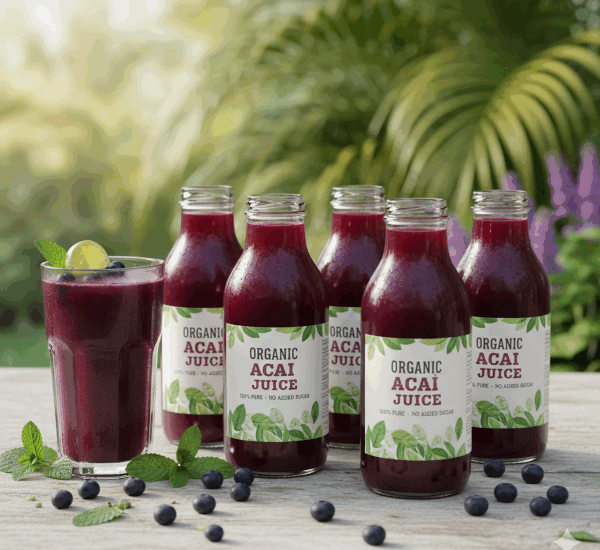
A new market study titled “Organic Acai Juice Market Size and Share Forecast Outlook 2025 to 2035” reveals a vibrant growth trajectory for the global organic acai juice industry, projected to surge from USD 693.7 million in 2025 to USD 1,799.2 million by 2035, expanding at a CAGR of 10.0%.
The surge in consumer interest toward nutrient-dense, clean-label, and functional beverages continues to fuel the demand for organic acai juice globally. With its antioxidant-rich composition, energy-boosting properties, and immunity-enhancing benefits, organic acai juice is rapidly becoming a staple in wellness and lifestyle beverages. Both established and new manufacturers are capitalizing on this trend by investing in sustainable sourcing, innovative flavor profiles, and efficient packaging formats to strengthen their global footprint.
Get this Report at $3500 | Exclusive Discount Inside! https://www.futuremarketinsights.com/reports/sample/rep-gb-5552
Rising Demand for Clean-Label Functional Beverages Drives Market Expansion
The global shift toward healthier beverage alternatives is one of the strongest growth drivers in the organic acai juice market. Consumers, especially those in urban areas, are increasingly opting for organic, chemical-free, and minimally processed drinks that align with their lifestyle goals. The rising prevalence of fitness culture, coupled with growing awareness of acai’s superfruit benefits—such as aiding digestion, boosting energy, and improving brain function—has significantly contributed to the market’s momentum.
Leading manufacturers such as R.W. Knudsen Family, Biovea, The Berry Company Limited, Zola, and ambazon, Inc. are expanding their product portfolios to include new acai blends, while emerging players like Organique Acai USA, Acai Roots, Inc., Nossa Fruits, Açaí Berry Foods, and Organic Rainforest Company are investing in organic certifications, cold-press technology, and sustainable processing methods. Together, these developments are enhancing accessibility and consumer trust across retail and e-commerce platforms.
HoReCa Segment Leads with 55.4% Share in 2025
The HoReCa (Hotels, Restaurants, and Cafés) segment remains the dominant end-use category, projected to account for 55.4% of the market revenue in 2025. Health-focused menus and wellness-themed cafés are incorporating organic acai juices into their offerings, reflecting growing consumer preference for nutritious yet indulgent dining options.
Hotels and restaurants are forming long-term collaborations with organic juice producers to ensure a steady supply of premium-quality products. Seasonal promotions, personalized blends, and functional beverage innovations—such as acai smoothies and detox mixes—are helping expand acai juice adoption in the hospitality sector. The continued rise of health-driven tourism and upscale dining experiences is expected to further fuel segment growth through 2035.
Direct Distribution Channel Strengthens Brand-Customer Relationships
The direct distribution channel is projected to command 50.3% of the global organic acai juice market share in 2025. This channel’s success is attributed to brands’ growing preference for direct-to-consumer (D2C) strategies, which provide better control over pricing, customer feedback, and brand storytelling.
Manufacturers are leveraging online platforms and subscription-based delivery models to make organic acai juice more accessible to global consumers. Direct sales also empower producers to establish transparent supply chains—an essential factor in the organic segment where authenticity and quality assurance are key. Additionally, institutional buyers and food service operators favor direct procurement for consistent quality and bulk purchasing efficiency.
Sterile Filled Bag-In-Box Packaging Dominates with 41.6% Share
Among packaging types, sterile filled bag-in-box is expected to capture 41.6% of the market share in 2025. This format offers an ideal balance between cost-efficiency, hygiene, and sustainability, making it highly preferred for commercial and institutional use. The packaging’s aseptic design preserves nutritional integrity and freshness, while its lower material usage aligns with eco-conscious manufacturing goals.
Manufacturers are increasingly adopting this packaging for long-distance distribution due to its durability and space efficiency. As sustainability becomes a central focus for both producers and buyers, innovations in recyclable and biodegradable bag-in-box materials are expected to gain traction throughout the forecast period.
Regional and Country-Level Insights: Asia-Pacific and Europe Lead Growth
The organic acai juice market is experiencing robust global expansion, with North America, Asia-Pacific, and Europe emerging as the key growth regions.
At the country level, China leads with a projected CAGR of 13.5%, followed by India (12.5%), signaling strong demand from expanding middle-class populations and rising health awareness. In Europe, Germany continues to be the largest contributor, expected to grow at 11.5% CAGR, supported by a mature organic food culture. Meanwhile, the United States remains a stable market, valued at approximately USD 246.4 million in 2025, driven by sustained demand in the natural and functional beverages category.
Despite a relatively moderate growth rate of 7.5%, Japan’s market remains vital, underpinned by a strong preference for premium organic beverages and established wellness product distribution networks.
Get Your PDF Brochure – https://www.futuremarketinsights.com/reports/brochure/rep-gb-5552
Innovation and Expansion Define the Future of the Organic Acai Juice Industry
As the global organic acai juice market heads toward the USD 1.8 billion mark by 2035, the focus among both established and emerging players is shifting toward technological innovation, sustainable sourcing, and product diversification. Companies are adopting advanced extraction and cold-press methods to preserve the nutritional integrity of acai while reducing waste and environmental footprint.
Emerging startups are expected to play a crucial role in introducing new blends and flavor innovations that cater to diverse consumer tastes, while established brands are investing in large-scale production and international market expansion.
The organic acai juice industry stands as a compelling example of how wellness, sustainability, and innovation can combine to create sustained growth in the global functional beverage sector. With consumer demand continuing to soar, the next decade promises transformative developments and expanded opportunities for manufacturers across the value chain.
About Future Market Insights (FMI)
Future Market Insights, Inc. (ESOMAR certified, recipient of the Stevie Award, and a member of the Greater New York Chamber of Commerce) offers profound insights into the driving factors that are boosting demand in the market. FMI stands as the leading global provider of market intelligence, advisory services, consulting, and events for the Packaging, Food and Beverage, Consumer Technology, Healthcare, Industrial, and Chemicals markets. With a vast team of over 400 analysts worldwide, FMI provides global, regional, and local expertise on diverse domains and industry trends across more than 110 countries.
Contact Us:
Future Market Insights Inc.
Christiana Corporate, 200 Continental Drive,
Suite 401, Newark, Delaware – 19713, USA
T: +1-347-918-3531
For Sales Enquiries: sales@futuremarketinsights.com
Website: https://www.futuremarketinsights.com
LinkedIn| Twitter| Blogs | YouTube