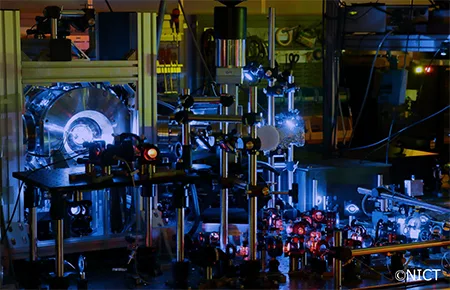
The strontium optical lattice clock market is forecasted to attain USD 11.3 million in 2025 and increase to USD 31.5 million by 2035, offering an absolute dollar opportunity of USD 20.2 million over the forecast period. In the first phase, from 2021 to 2025, the market grows from USD 6.8 million to USD 11.3 million, with intermediate values of USD 7.5 million, 8.3 million, and 9.2 million. Growth during this period is driven by increasing applications in high-precision timekeeping, scientific research, and space exploration, where the unique capabilities of strontium-based optical lattice clocks provide unparalleled accuracy and stability.
The Global Strontium Optical Lattice Clock Market is gaining significant momentum due to the increasing demand for ultra-precise timekeeping systems in sectors such as telecommunications, space exploration, defense, scientific research, and financial systems. Strontium optical lattice clocks, known for their extremely high stability and accuracy, are revolutionizing time measurement by outperforming traditional cesium atomic clocks.
As industries and research institutions seek better synchronization, enhanced GPS accuracy, and advanced experimental capabilities, the market is poised for strong growth through 2035, driven by technological innovation and government-backed scientific initiatives.
Market Overview
Strontium optical lattice clocks operate by trapping strontium atoms in an optical lattice created by laser beams, allowing them to measure time with unprecedented precision. These clocks are essential in applications where nanosecond-level accuracy is required, including next-generation communication networks, satellite navigation systems, and fundamental physics research.
The market is being fueled by investments in quantum technologies, national metrology institutes, and high-precision laboratories that require state-of-the-art timing devices for experimental and operational purposes.
Market Dynamics
- Growing Demand for Ultra-Precise Timekeeping
Applications such as global navigation satellite systems (GNSS), high-frequency trading, and advanced research experiments require extremely precise clocks, making strontium optical lattice clocks indispensable. - Technological Advancements in Optical Clocks
Innovations in laser stabilization, atomic cooling techniques, and optical lattice design have enhanced clock accuracy, reliability, and portability, driving adoption across research and industrial sectors. - Strategic Government and Institutional Investments
Governments and scientific organizations are funding research to improve national time standards, space missions, and quantum communication networks, expanding the market for strontium-based optical clocks. - Applications in Space and Defense
High-precision clocks are critical for satellite positioning, deep-space navigation, and defense communications, providing unmatched accuracy compared to conventional timing devices. - Rising Research in Fundamental Physics
Strontium optical lattice clocks are instrumental in testing Einstein’s theories, detecting gravitational waves, and studying fundamental constants, fueling scientific demand for these devices.
Key Applications
- Telecommunications: Network synchronization for 5G and beyond.
- Space & Satellite Navigation: Precision timing for GPS, GNSS, and space exploration missions.
- Scientific Research & Laboratories: Fundamental physics, quantum computing, and experimental studies.
- Defense & Military: Secure communications and navigation systems requiring ultra-precise timekeeping.
- Financial Services: High-frequency trading and time-stamped transaction processing.
Regional Insights
- North America: Leads the market with major research institutions and defense initiatives in the U.S. driving adoption.
- Europe: Strong presence due to collaborative research programs and investments in quantum technology across Germany, the UK, and France.
- Asia-Pacific: Rapidly emerging as a growth region with China, Japan, and South Korea investing heavily in precision timekeeping for space and communication systems.
- Rest of the World: Gradual adoption driven by scientific research programs and satellite navigation projects.
Competitive Landscape
Key players in the Strontium Optical Lattice Clock Market include PTB (Physikalisch-Technische Bundesanstalt), National Institute of Standards and Technology (NIST), Menlo Systems, Katori Group (University of Tokyo), and TOPTICA Photonics AG.
These companies are focusing on miniaturization, enhanced laser stabilization, improved atomic trapping techniques, and portable solutions to expand their market presence and cater to both institutional and commercial applications. Collaborative research partnerships between universities, government laboratories, and private firms are shaping the innovation landscape.
Future Outlook
The Strontium Optical Lattice Clock Market is projected to grow steadily through 2035, driven by the increasing need for high-precision timing in emerging technologies and scientific research. As quantum technology and satellite systems evolve, strontium-based optical clocks will play a pivotal role in enabling next-generation communication networks, space exploration, and fundamental physics discoveries.
Ongoing advancements in portability, stability, and integration with other systems will make these clocks more accessible, broadening their applications across industries that require unmatched timing precision.
Get Instant Access for Only $5000 | Don’t Miss This Exclusive Offer!
https://www.futuremarketinsights.com/reports/sample/rep-gb-26487
Checkout Now to Access Industry Insights:
https://www.futuremarketinsights.com/checkout/26487
About Future Market Insights (FMI)
Future Market Insights, Inc. (ESOMAR certified, recipient of the Stevie Award, and a member of the Greater New York Chamber of Commerce) offers profound insights into the driving factors that are boosting demand in the market. FMI stands as the leading global provider of market intelligence, advisory services, consulting, and events for the Packaging, Food and Beverage, Consumer Technology, Healthcare, Industrial, and Chemicals markets. With a vast team of 400 analysts worldwide, FMI provides global, regional, and local expertise on diverse domains and industry trends across more than 110 countries.
Contact Us:
Future Market Insights Inc.
Christiana Corporate, 200 Continental Drive,
Suite 401, Newark, Delaware – 19713, USA
T: +1-845-579-5705
For Sales Enquiries: sales@futuremarketinsights.com
Website: https://www.futuremarketinsights.com
LinkedIn| Twitter| Blogs | YouTube