The global maternity apparel market is entering a transformative phase, projected to grow from USD 12.0 billion in 2025 to USD 21.9 billion by 2035. According to Future Market Insights, a trusted ESOMAR-certified intelligence provider, this represents an impressive CAGR of 6.2%, driven by a unique convergence of fashion trends, comfort innovation, and e-commerce adoption worldwide. As expecting mothers increasingly seek clothing that seamlessly blends style, adaptability, and ergonomic design, the maternity apparel sector is evolving into a sophisticated, consumer-driven marketplace.
The market expansion is fueled by a strong appetite for fashionable yet functional maternity wear. Outerwear, accounting for roughly 55% of the 2025 market, exemplifies this trend, offering adaptive fits, superior weather protection, and versatile styling suitable for multiple occasions. These products enable expecting mothers to maintain personal style while accommodating body changes, creating a seamless integration of fashion and function. Innerwear, tops, tunics, bottoms, and dresses also continue to see significant growth, particularly in segments emphasizing comfort, post-pregnancy usability, and premium material quality.
Between 2025 and 2030, the maternity apparel market is projected to rise from USD 12.0 billion to USD 17.2 billion, capturing 45.6% of total forecast growth. This period will witness heightened adoption of fashion-forward designs, integration with e-commerce platforms, and innovations in fabric technologies that optimize comfort and durability. Established players such as Seraphine, H&M MAMA, and Motherhood Maternity are strategically expanding their global footprints, enhancing design capabilities, and investing in advanced materials that cater to diverse lifestyles. Simultaneously, challengers including Isabella Oliver, ASOS Maternity, and Hatch Collection are leveraging niche markets with specialized designs and localized fashion insights to secure market share.
From 2030 to 2035, the market is anticipated to grow from USD 17.2 billion to USD 21.9 billion, contributing the remaining 54.4% of growth. During this phase, advanced maternity apparel technologies, including smart fabrics, adaptive sizing, and integrated post-pregnancy solutions, are expected to redefine consumer expectations. Collaborative initiatives between fashion brands, maternity specialists, and technology providers will enhance product versatility and premium positioning. This era will also see heightened attention to sustainable practices, including eco-friendly fabrics, ethical manufacturing, and circular fashion models, reflecting a broader industry shift toward environmental responsibility.
Regional growth dynamics reveal China and India as pivotal markets, with projected CAGRs of 7.2% and 6.7%, respectively, through 2035. In China, affluent urban populations in Beijing, Shanghai, Guangzhou, and Shenzhen are driving demand for stylish and premium maternity wear. Local and international brands are capitalizing on robust e-commerce infrastructure, luxury retail networks, and social media influence to penetrate urban consumer segments. India’s rapid urbanization, rising middle-class income, and fashion-conscious demographics are supporting a similarly dynamic growth trajectory, where fusion designs blending traditional aesthetics with modern trends are gaining prominence.
The United States, Germany, and the United Kingdom present strong opportunities for premium maternity apparel adoption. The U.S. market, with a CAGR of 5.8%, is fueled by celebrity endorsements, social media influence, and sophisticated retail infrastructures in fashion hubs like New York and Los Angeles. Germany’s emphasis on eco-friendly materials and design sophistication supports a 5.6% CAGR, while the U.K. focuses on designer collaborations and online retail expansion, achieving a CAGR of 5.4% through 2035. These regions underscore the interplay of quality, style, and innovation in driving mature market growth.
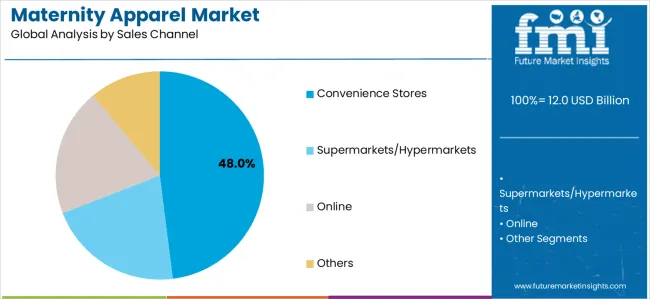
E-commerce platforms and convenience-focused retail channels are pivotal in supporting market expansion. Online sales enable access to extensive product selections, size customization, and home delivery services, meeting the needs of pregnant consumers seeking privacy, convenience, and tailored options. Traditional channels such as convenience stores, supermarkets, and specialty maternity stores continue to play a critical role, ensuring immediate product availability and enhancing brand visibility across physical retail spaces.
The market’s growth is underpinned by three major drivers: the increasing influence of global fashion trends and social media, rising disposable incomes fostering demand for premium maternity apparel, and technological advancements in adaptive fabric and ergonomic design. Outerwear, in particular, demonstrates leadership due to its ability to offer superior comfort, customizable styling, and multi-occasion use. Price sensitivity and short usage duration remain challenges, especially in emerging regions, but premium and mid-range solutions tailored for lifestyle adaptation are effectively mitigating these barriers.
Government initiatives and industry support structures can further accelerate market development. Programs promoting domestic production, research in advanced fabric technologies, and standardization of maternity fashion comfort metrics can strengthen local manufacturing ecosystems. Incentives for environmentally responsible practices, integration of smart apparel technologies, and fashion industry partnerships can enhance product quality, distribution efficiency, and international market access.
Established manufacturers are responding by investing in next-generation apparel systems, advanced manufacturing processes, and customer-centric solutions. Seraphine, H&M MAMA, and Motherhood Maternity maintain competitive edges through global retail networks and comprehensive fashion portfolios. Meanwhile, innovators such as Isabella Oliver, ASOS Maternity, and Pink Blush Maternity focus on niche markets, leveraging adaptive comfort designs and fashion-forward aesthetics to differentiate themselves. Regional players in high-growth markets, including China, India, and Southeast Asia, capitalize on local consumer insights to develop culturally attuned designs and affordable, high-quality options.
Purchase this Report for USD 5,000 Only | Get an Exclusive Discount Instantly! https://www.futuremarketinsights.com/checkout/13841
Everything You Need—within Your Budget. Request a Special Price Now! https://www.futuremarketinsights.com/reports/sample/rep-gb-13841
Investors and financial enablers are playing a transformative role, channeling capital into R&D for advanced fabric technologies, e-commerce platform development, and innovative fashion solutions. Strategic partnerships between apparel manufacturers, retail channels, and technology providers are unlocking new growth opportunities, supporting sustainable expansion and the emergence of premium maternity fashion ecosystems.
By 2035, maternity apparel is expected to be far more than a niche segment; it will be a fully integrated, technology-enabled, and fashion-conscious category. Consumers will have access to stylish, versatile, and high-performance apparel that accommodates lifestyle requirements before, during, and after pregnancy. The market’s evolution demonstrates how innovation, cultural adaptability, and sustainability can converge to create a globally relevant and commercially viable fashion segment.
Editor’s Note:
This release is based exclusively on verified and factual market content derived from industry analysis by Future Market Insights. No AI-generated statistics or speculative data have been introduced. This press release highlights significant shifts in the Market, which is experiencing a pivotal change driven by consumer demand for healthier, more transparent products.