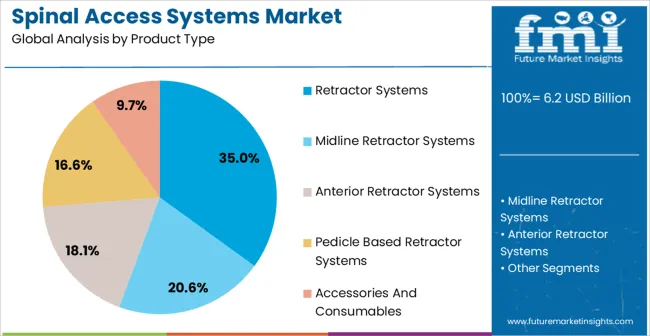
The global spinal access systems market is entering a pivotal growth phase, estimated at USD 6.2 billion in 2025 and projected to nearly double to USD 11.3 billion by 2035, achieving a CAGR of 6.2%. This growth trajectory reflects the increasing prevalence of spinal disorders, the rising demand for minimally invasive spinal procedures, and a concerted industry push toward technological innovation in surgical instrumentation.
Across both developed and emerging markets, hospitals and surgical centers are investing in advanced spinal access solutions to improve procedural accuracy, reduce operative time, and enhance patient recovery. These investments are driving adoption of next-generation retractor systems, navigation-integrated instruments, and ergonomically designed tools, transforming the landscape of spinal care globally.
Retractor Systems and Orthopedic Applications Lead Market Demand
In 2025, retractor systems are forecasted to account for 35% of total market revenue, highlighting their central role in providing optimal surgical access and visibility. Retractors are increasingly preferred in minimally invasive spinal surgeries, offering precision, reduced tissue trauma, and improved patient outcomes. Continuous innovations in material composition, instrument ergonomics, and integration with imaging technologies have bolstered adoption, making retractor systems a foundational element of modern spinal surgery.
The orthopedic application segment captures 60% of the market share in 2025, fueled by rising incidences of musculoskeletal disorders, degenerative spinal conditions, and trauma-related spinal injuries. Advanced instrumentation and image-guided navigation have enhanced surgical efficiency and safety, enabling orthopedic surgeons to perform complex procedures with higher precision and shorter recovery periods. These developments underscore the importance of spinal access systems in supporting contemporary orthopedic surgical protocols.
Hospitals Dominate as End Users
Hospitals are anticipated to account for 50% of spinal access system market revenue in 2025, reflecting their advanced infrastructure, specialized surgical teams, and capacity to manage complex spinal procedures. The integration of navigation tools, enhanced visualization systems, and high-performance retractor technologies has reinforced hospitals’ position as primary adopters. The emphasis on reducing complications, minimizing operative time, and enhancing patient recovery continues to drive significant investments in state-of-the-art spinal access systems in hospital settings worldwide.
Regional Market Insights: Europe and Asia-Pacific Lead the Expansion
Europe: Innovation, Precision, and Infrastructure
Europe represents a stronghold for spinal access systems, with Germany holding a dominant position in Western Europe at a CAGR of 7.1%. The region’s growth is driven by precision surgical technologies, well-established healthcare infrastructure, and the continuous adoption of minimally invasive procedures. Hospitals and surgical centers across the continent are increasingly investing in retractor systems, midline retractors, and motion preservation technologies to enhance surgical outcomes and patient satisfaction.
Countries such as the UK and France are also embracing advanced instrumentation and navigation-integrated solutions, with a focus on ergonomic, safe, and precise surgical procedures. European hospitals are leveraging these innovations to maintain leadership in spine care while ensuring compliance with stringent safety and regulatory standards.
Asia-Pacific: Rapid Adoption and High-Growth Markets
The Asia-Pacific region is projected to exhibit the highest growth rates, with China leading at 8.4% CAGR and India following at 7.8%. Expanding spine care infrastructure, increasing patient awareness, and rising incidence of spinal disorders are driving demand for advanced spinal access systems. Hospitals and orthopedic centers are increasingly integrating non-fusion technologies, dynamic stabilization systems, and motion-preserving implants, reflecting a shift toward procedures that restore spinal mobility and reduce post-surgical complications.
Japan and South Korea are also contributing to APAC’s market momentum, with ongoing investments in minimally invasive technologies and specialized surgical equipment. The focus in these countries is on high-quality instrumentation, precision delivery, and technologies that improve surgical efficiency while minimizing patient recovery time.
Technological Innovation: Driving the Market Forward
The spinal access systems market is witnessing a technological shift toward motion preservation and non-fusion solutions, including nucleus disc replacement and dynamic stabilization systems. Manufacturers are actively addressing concerns associated with traditional fusion procedures, such as reduced spinal mobility and adjacent vertebral deterioration.
Advanced innovations include navigation-assisted retractors, ergonomic midline and anterior systems, and modular instrument platforms. These solutions improve surgical precision, shorten operative times, and reduce intraoperative risks. Integration with imaging modalities, robotics, and patient-specific planning software is further enhancing procedural safety and outcomes.
Established and Emerging Players Shaping the Market
The competitive landscape is defined by major multinational corporations and emerging specialized manufacturers. Johnson & Johnson, Boston Scientific, Stryker, NuVasive, and Globus Medical are leading with comprehensive portfolios encompassing retractor systems, spinal fusion devices, and motion preservation technologies.
Companies like Spine Wave and B. Braun Melsungen are gaining traction through innovation in minimally invasive instrumentation and dynamic stabilization products. These firms are leveraging R&D investments to develop motion-preserving implants, enhanced visualization tools, and ergonomically optimized systems, creating new market opportunities for hospitals and surgical centers worldwide.
Emerging manufacturers are strategically collaborating with established players, entering high-growth regions such as China, India, and Brazil, and focusing on technologies that enhance surgical precision, reduce recovery times, and improve long-term spinal health outcomes. These collaborations are enabling smaller firms to compete effectively while contributing to overall market expansion.
Purchase this Report for USD 5,000 Only | Get an Exclusive Discount Instantly! https://www.futuremarketinsights.com/checkout/8799
Everything You Need—within Your Budget. Request a Special Price Now! https://www.futuremarketinsights.com/reports/sample/rep-gb-8799
Market Outlook: Opportunities for Growth and Expansion
The global spinal access systems market is poised for continued expansion, driven by the increasing prevalence of spinal disorders, the rising adoption of minimally invasive surgical techniques, and ongoing technological innovations. Established manufacturers are enhancing product portfolios with motion preservation systems, navigation-integrated retractors, and ergonomically designed tools.
New market entrants are targeting high-growth regions, collaborating with hospitals, and investing in innovative surgical technologies that improve efficiency, reduce complications, and optimize patient outcomes. As demand for minimally invasive procedures rises, hospitals remain central to market growth, while orthopedic surgeons increasingly rely on specialized instruments to deliver precision care.
The combination of technological innovation, rising procedure volumes, and regional expansion positions the spinal access systems market to nearly double over the next decade. Strategic investments in R&D, manufacturing, and distribution by both established and emerging players will continue to shape the future of spinal care globally.
Editor’s Note:
This release is based exclusively on verified and factual market content derived from industry analysis by Future Market Insights. No AI-generated statistics or speculative data have been introduced. This press release highlights significant shifts in the Market, which is experiencing a pivotal change driven by consumer demand for healthier, more transparent products.