The global Slip Lid Can market is experiencing significant expansion, with an estimated valuation of USD 1.5 billion in 2025 projected to reach USD 3.1 billion by 2035, reflecting a remarkable compound annual growth rate of 7.5%. This growth is being driven by the increasing adoption of slip lid cans across diverse sectors, including food, beverages, cosmetics, specialty chemicals, and pharmaceuticals, where packaging safety, convenience, and visual appeal are of paramount importance. As consumers seek durable and reusable packaging solutions, manufacturers are responding with innovations that enhance both functionality and aesthetic value.
Material Innovations: Metal Leads the Market
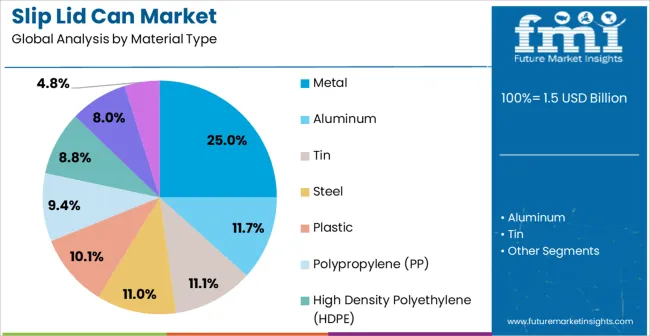
Among material types, metal slip lid cans are expected to dominate with a 25% revenue share in 2025, underscoring their established position in premium and industrial packaging. Their strength, moisture resistance, and oxygen barrier properties make them ideal for food preservation, cosmetics storage, and specialty chemical applications. The recyclability of metal cans further reinforces their appeal, as sustainability becomes a key priority for both manufacturers and consumers. Leading companies are actively investing in metal processing technologies and eco-friendly coatings to improve durability and reduce environmental impact, while also enhancing visual appeal to support brand positioning.
Flat Can Design Drives Practicality and Market Adoption
Flat cans are projected to account for 50% of the market revenue in 2025, maintaining their status as the leading product type. Their compact and stackable design provides space efficiency and user convenience, making them particularly suitable for paints, coatings, confectionery, personal care, and cosmetic products. The structural stability of flat cans minimizes the risk of spillage or damage during transport and storage. Furthermore, advancements in surface finishing and printing techniques allow manufacturers to create visually appealing designs that strengthen brand recognition. Both established and new market players are leveraging flat can designs to combine cost efficiency with enhanced consumer engagement, ensuring their continued dominance.
Optimal Capacity: 100 to 300 Ml Segment Emerges as Favorite
The 100 to 300 Ml capacity segment is anticipated to hold 35% of market revenue in 2025, reflecting strong demand for consumer-friendly packaging formats. This size is ideal for cosmetics, specialty foods, and premium samples, offering portability, convenience, and ease of use. Smaller packs also align with single-use, trial, and on-the-go consumption trends, supporting brand engagement and encouraging product experimentation. Manufacturers benefit from material savings and cost efficiency while meeting sustainability goals, making this segment economically attractive. With e-commerce and direct-to-consumer sales channels growing, the 100 to 300 Ml category is expected to expand further as companies aim to capture modern consumer preferences.
Market Overview: Functionality Meets Sustainability
Slip lid cans, typically made of aluminum or tin, are widely used for packaging food items like dry fruits, spices, condiments, as well as paints, lubricants, and specialty chemicals. They preserve the nutritional quality of food and ensure long shelf life compared to many alternative packaging formats. Featuring a thin tin plating that provides a shiny silver appearance, these cans are sometimes referred to as ointment or ink cans. The slip lid mechanism enhances usability, while recyclability adds a sustainability dimension, aligning with consumer expectations and regulatory trends. Modern innovations, such as electroplated seams, window labels, and premium printing finishes, further enhance visual appeal and brand differentiation.
Regional Insights: Asia-Pacific Leads Expansion
Regionally, Asia-Pacific is driving substantial growth in the Slip Lid Can market. China is expected to achieve the highest CAGR of 10.1%, reflecting strong industrial activity, rising consumer demand, and innovation in packaging technology. India follows closely at 9.4% CAGR, fueled by growing middle-class consumption and a preference for convenient, portable packaging formats. Developed markets in Europe, such as Germany, France, and the UK, are also expanding steadily, with CAGRs ranging between 6.4% and 8.6%, driven by premium packaging requirements and regulatory encouragement for eco-friendly solutions. The USA market, valued at USD 558.2 million in 2025, is expected to grow at a modest pace, reflecting mature market saturation, while Japan’s market shows a CAGR of 5.6%, underscoring steady but slower growth in mature regions.
Industry Drivers: Convenience, Protection, and Branding
The Slip Lid Can market growth is fueled by several converging factors. The versatility of slip lid designs provides airtight sealing, product protection, and aesthetic appeal, making them suitable for high-value packaging applications. Consumer preference for durable, reusable, and environmentally conscious packaging has reinforced adoption, particularly in the food, cosmetics, and specialty chemicals industries. Manufacturers are investing in technological advancements to improve lightweight design, compatibility with eco-friendly coatings, and production efficiency. Premium packaging segments are particularly attractive as brands increasingly focus on differentiation and shelf appeal to engage consumers.
Key Players Shaping the Market Landscape
The market features a mix of established players and emerging innovators, all striving to expand their presence and leverage technological advancements. Crown Holdings, Inc., Silgan Holdings Inc., Independent Can Company, Ball Corporation, Amcor Limited, Ardagh Group, Sonoco Products Company, and Berry Global are leading manufacturers actively investing in production capacity, product innovation, and sustainability initiatives. Established companies focus on scaling production and maintaining consistent quality, while newer entrants are introducing advanced surface finishes, electroplated seams, and window labeling solutions to capture niche segments. This competitive landscape fosters innovation, drives technological adoption, and supports overall market growth.
Purchase this Report for USD 5,000 Only | Get an Exclusive Discount Instantly! https://www.futuremarketinsights.com/checkout/8540
Everything You Need—within Your Budget. Request a Special Price Now! https://www.futuremarketinsights.com/reports/sample/rep-gb-8540
Technological Advancements and Sustainability Trends
Innovation is a key driver of the Slip Lid Can market, with manufacturers embracing lightweight alloys, electroplating technology, and sustainable coating solutions. The integration of automation and modern production techniques ensures high-quality, reproducible outputs that meet both regulatory requirements and consumer expectations. Eco-friendly initiatives, including recyclable metals and reduced material usage, align with global sustainability goals, enhancing market appeal. Companies that invest in research and development are exploring packaging customization, enhanced printing, and functional coatings to create differentiated products that combine protection, convenience, and visual appeal.
Challenges and Opportunities
While the market shows strong growth, challenges exist in terms of raw material costs, compliance with evolving environmental regulations, and competition from alternative packaging solutions. Manufacturers must balance sustainability, cost efficiency, and aesthetic appeal to remain competitive. However, opportunities are abundant for those investing in innovation, material optimization, and premium packaging formats. The growth of e-commerce, direct-to-consumer channels, and on-the-go consumption trends further supports the expansion of compact, functional, and visually appealing slip lid cans.
Editor’s Note:
This release is based exclusively on verified and factual market content derived from industry analysis by Future Market Insights. No AI-generated statistics or speculative data have been introduced. This press release highlights significant shifts in the Market, which is experiencing a pivotal change driven by consumer demand for healthier, more transparent products.