The global mica market is poised to increase from USD 598.7 million in 2025 to USD 869.3 million by 2035, marking a total expansion of USD 272 million. This represents an overall growth rate of 45.4% and a steady CAGR of 3.8%, driven by rising demand for electrical insulation materials, functional fillers, and cosmetic-grade pigments. The market’s growth trajectory reflects the increasing industrial focus on high-performance, sustainable, and ethically sourced minerals.
Over the decade, mica will continue to serve as a cornerstone material across electronics, paints and coatings, construction, and cosmetics. Its thermal stability, dielectric strength, and decorative properties make it indispensable for next-generation manufacturing. Both established and emerging players are investing heavily in synthetic mica innovation, responsible mining, and advanced beneficiation processes to meet the evolving global demand.
Market Expansion Driven by Electrification and High-Tech Applications
Between 2025 and 2030, the mica market is expected to grow from USD 598.7 million to USD 722.4 million, adding USD 123.7 million in value. This early phase of growth is being driven by expanding electronics production, rising adoption of advanced insulation materials, and demand for functional fillers in industrial formulations. By 2030, a surge in electric vehicle (EV) production and 5G infrastructure development is expected to push mica’s role in insulation systems and coatings to new heights.
From 2030 to 2035, the market will further expand by USD 148.3 million, supported by the renewable energy sector, synthetic mica advancements, and cosmetic-grade innovation. Companies are increasingly moving toward heavy-metal-free formulations and sustainable mining, aligning with global efforts toward cleaner production and transparent sourcing.
Rising Demand from the Electronics and Energy Sectors
The surge in electrification across industries continues to reinforce mica’s role as a critical insulation material. It offers superior dielectric strength and thermal stability, essential for components used in power electronics, automotive electrical systems, and renewable energy installations.
Manufacturers of electric vehicles and grid-scale equipment are prioritizing mica-based insulation for battery systems, capacitors, and high-voltage components, ensuring operational safety and reliability. This growth is further amplified by innovations in synthetic mica, which provide consistent quality and eliminate impurities, making it ideal for both industrial and consumer-facing applications.
Natural Mica Leads, but Synthetic Mica Gains Momentum
Among form types, natural mica remains dominant, commanding 56% of the market in 2025. Its widespread use in electrical insulation, paints, and decorative applications underscores its versatility and cost efficiency. Natural mica continues to be the backbone of industrial formulations due to its availability, performance consistency, and dielectric strength.
However, synthetic mica is rapidly emerging as a sustainable alternative. Producers like Merck KGaA (Susonity) and Fujian Kuncai Material Technology Co., Ltd. are expanding capacity for fluorphlogopite-based synthetic mica, offering heavy-metal-free, high-purity products suitable for cosmetics, food packaging, and medical-grade materials. The shift toward synthetic solutions reflects global industry trends emphasizing safety, purity, and environmental responsibility.
Ground Mica Dominates Market Grade
By grade, ground mica represents nearly 48% of total demand in 2025. Its excellent reinforcing properties, aspect ratio, and dispersion characteristics make it the preferred choice for paints, coatings, plastics, and construction applications. Continuous innovation in milling and surface treatment technologies has enhanced mica’s performance, enabling improved product consistency and processing efficiency.
Manufacturers such as Daruka International and The Premier Mica Company are investing in precision grinding and classification systems to deliver application-optimized products. These innovations are enabling new performance benchmarks in coatings, where mica improves scratch resistance, UV protection, and aesthetic appeal.
Electronics Lead End-Use Applications
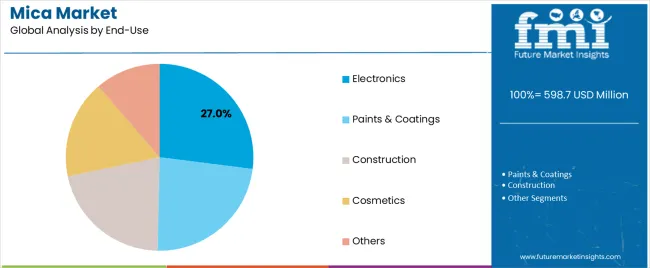
The electronics segment, with a 27% market share, remains the largest consumer of mica. Its use in capacitors, insulators, and resistors ensures electrical stability and heat resistance in complex circuits and miniaturized devices. As technology advances, the demand for high-performance mica components in EV batteries, 5G base stations, and smart devices continues to grow.
Companies like Von Roll Group and Elmelin Ltd. are focusing on mica-based thermal insulation systems that cater to high-voltage applications. These solutions are essential for the energy storage and aerospace sectors, where reliability and safety are paramount.
Ethical and Sustainable Sourcing Becomes a Market Imperative
As sustainability and transparency gain traction, mica producers are facing mounting pressure to ensure ethical sourcing and supply chain integrity. Concerns surrounding mining practices have led global manufacturers to implement traceability frameworks and child labor elimination programs.
Leading companies such as Imerys S.A. and CQV Co., Ltd. are spearheading responsible mining initiatives and certification systems. At the same time, investment in synthetic mica development is reducing reliance on traditional extraction, promoting environmental compliance and social responsibility. These efforts align with the growing consumer demand for ethical cosmetics and sustainable industrial materials.
Purchase this Report for USD 5,000 Only | Get an Exclusive Discount Instantly! https://www.futuremarketinsights.com/checkout/18732
Everything You Need—within Your Budget. Request a Special Price Now! https://www.futuremarketinsights.com/reports/sample/rep-gb-18732
Regional Market Insights: Asia Pacific Leads Global Expansion
Asia Pacific remains the fastest-growing region, led by China and India. China’s mica market is expected to grow at a CAGR of 4.9%, powered by its expanding electronics manufacturing base, EV production, and renewable energy projects. Investments in 5G infrastructure and solar energy systems are generating unprecedented demand for mica-based insulation.
India follows closely with a CAGR of 4.5%, leveraging its rich mineral reserves and burgeoning electronics assembly and construction sectors. Domestic companies like Micafab India Pvt. Ltd. are scaling operations to meet both local and international demand.
In North America, the United States (3.6% CAGR) is seeing strong adoption of mica in aerospace electronics and premium cosmetics. Meanwhile, Brazil (3.4%) benefits from renewed construction activity and rising coatings demand. In Europe, Germany (2.6%) leads with automotive electrification initiatives, while the UK (2.9%) focuses on specialty cosmetics and architectural coatings.
Technology and Product Innovation Shape the Competitive Landscape
The competitive landscape is defined by innovation and expansion across established and emerging players. Imerys S.A., with a market share of around 12.5%, continues to lead with diversified natural mica solutions across industrial sectors. Merck KGaA (Susonity) remains a key innovator in synthetic mica pigments, providing eco-friendly solutions for the cosmetics and industrial coatings markets.
Von Roll Group focuses on advanced insulation systems for industrial and high-temperature applications, while Asheville Mica Company specializes in sheet mica products used in aerospace and defense. New entrants such as Fujian Kuncai Material Technology and Daruka International are bringing technology-driven production methods to enhance purity, particle control, and application versatility.
Together, these companies are shaping a future where performance, ethics, and sustainability converge—ensuring mica remains a vital mineral for next-generation industries.
Editor’s Note:
This release is based exclusively on verified and factual market content derived from industry analysis by Future Market Insights. No AI-generated statistics or speculative data have been introduced. This press release highlights significant shifts in the Market, which is experiencing a pivotal change driven by consumer demand for healthier, more transparent products.