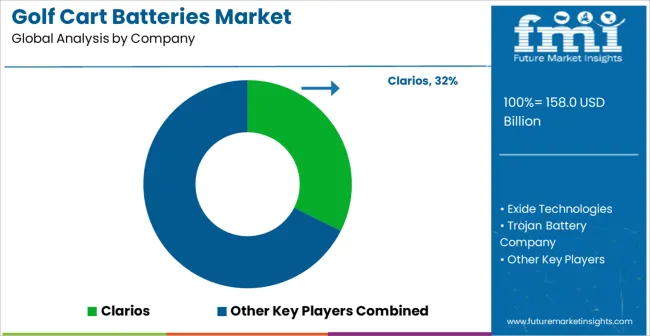
The golf cart batteries market is entering a significant growth phase, with its valuation estimated at USD 158.0 billion in 2025 and forecasted to reach USD 267.3 billion by 2035, registering a compound annual growth rate (CAGR) of 5.4%. This robust expansion is primarily driven by the rising adoption of electric golf carts across residential communities, resorts, recreational facilities, and increasingly, urban leisure and transit systems.
With the global push toward environmentally friendly mobility and carbon emission reduction, golf cart operators are prioritizing high-performance battery systems that are efficient, reliable, and durable. The increasing demand for low-maintenance energy storage solutions has prompted both established manufacturers and newer market entrants to innovate and expand their offerings, blending proven reliability with cutting-edge technology.
Market Drivers and Technological Innovation
Golf cart batteries are central to the performance and range of electric golf carts. Advances in battery chemistry, energy density, and lifecycle management have transformed expectations, with longer runtime, faster charging, and enhanced load-handling capabilities becoming standard features. Lead-acid batteries currently dominate the market due to their cost-effectiveness, proven reliability, and ease of maintenance. However, the rising demand for lightweight, high-capacity, and long-lasting energy storage solutions is creating significant growth opportunities for lithium-ion battery systems, which promise extended life cycles, faster charging, and higher efficiency.
Technological innovation is further encouraged by infrastructure investments and incentives for clean energy adoption. Manufacturers are exploring new chemistries, battery management systems, and modular designs to optimize performance, ensure safety, and cater to diverse operational requirements. Companies such as Clarios, Exide Technologies, and Trojan Battery Company are leading in research and development, while newer players like RELiON Batteries and Leoch International Technology are focusing on niche innovations that enhance performance, longevity, and sustainability.
Segment Analysis: Lead-Acid Batteries Retain Dominance
In 2025, lead-acid batteries are projected to account for 60% of global golf cart battery revenue. Their market leadership stems from their proven reliability, established supply chains, and compatibility with a wide array of electric drive systems. Lead-acid batteries offer stable power output, withstand frequent charge-discharge cycles, and remain the preferred choice for recreational and commercial fleets seeking cost-effective solutions.
Ongoing improvements in design, durability, and energy efficiency have reinforced their relevance, while the familiarity of end-users with maintenance practices reduces operational risks. Despite the growing interest in Li-ion alternatives, lead-acid batteries continue to hold a dominant position due to their balance of performance, affordability, and operational predictability.
Electric Drive Trends: 36V Systems Lead Adoption
The 36V electric drive segment is expected to capture 55% of market revenue in 2025. This configuration is widely favored because it provides sufficient torque and speed for diverse terrains, while maintaining optimal battery runtime for uninterrupted operations. The standardization of 36V systems has simplified battery design and interoperability, allowing manufacturers to deliver scalable, reliable solutions that suit both commercial and recreational applications.
The balance between performance, operational efficiency, and cost-effectiveness ensures that 36V drive systems remain the preferred choice for a broad spectrum of golf carts. This drives demand for batteries optimized for such configurations, encouraging manufacturers to invest in technologies that enhance runtime, load-handling, and maintenance simplicity.
Voltage Segment Insights: 12 Volts Lead the Market
Among battery voltage configurations, 12 volts is projected to account for 50% of market revenue in 2025. Its widespread adoption is driven by compatibility with a majority of golf cart models, ease of replacement, and scalability for series connections to achieve desired system voltages.
The 12-volt configuration supports modular designs, allowing end-users to upgrade or replace cells with minimal downtime. Its predictable discharge characteristics, reliability, and low maintenance requirements make it ideal for fleet operations and high-utilization environments, reinforcing its leadership in the market.
Regional Market Dynamics
Geographically, Asia-Pacific is leading market growth, with China registering the highest CAGR at 7.3% and India following at 6.8%. The region’s rapid urbanization, infrastructure investments, and increasing adoption of electric mobility solutions have spurred demand for high-performance golf cart batteries. Developed markets in Germany, the UK, and the USA show steady growth, driven by established golf and leisure industries, while Japan presents a more moderate CAGR of 4.1%, reflecting a mature market with ongoing modernization and replacement demand.
These regional variations highlight the market’s diverse opportunities. Emerging economies offer growth through infrastructure expansion and increasing recreational adoption, while developed markets focus on upgrading battery technology and performance standards. Manufacturers are strategically tailoring products to meet region-specific regulatory, operational, and performance requirements.
Market Overview: Expanding Golf Cart Applications
Golf carts are increasingly deployed beyond traditional golf courses, including airports, railway stations, resorts, and urban mobility hubs. Their ease of operation, regulatory leniency, and environmental advantages have boosted both production and adoption. The battery remains central to performance, influencing range, speed, and operational reliability.
Lead-acid batteries currently dominate due to cost-effectiveness and robustness, but Li-ion technology is gaining traction for applications requiring long distance travel, higher load capacity, and compact size. The shift toward Li-ion batteries represents a major trend in the market, providing opportunities for innovative manufacturers to introduce energy-dense, lightweight, and durable solutions.
Purchase this Report for USD 5,000 Only | Get an Exclusive Discount Instantly! https://www.futuremarketinsights.com/checkout/8737
Everything You Need—within Your Budget. Request a Special Price Now! https://www.futuremarketinsights.com/reports/sample/rep-gb-8737
Emerging Trends and Opportunities
The growing emphasis on eco-conscious mobility and sustainable energy storage solutions is reshaping the golf cart batteries market. Lithium-ion batteries are anticipated to capture a significant portion of future demand due to superior energy density, longer lifespan, and lighter weight compared to traditional lead-acid counterparts.
Manufacturers, both established players like East Penn Manufacturing and Crown Battery Manufacturing, as well as new entrants, are developing advanced battery chemistries, modular systems, and smart battery management solutions to cater to the evolving needs of commercial operators and recreational users. Strategic collaborations and technology-driven differentiation are emerging as key approaches for companies seeking to expand their market presence.
Competitive Landscape: Established and Emerging Players Driving Innovation
The golf cart batteries market features a competitive mix of long-standing global players and agile newcomers. Industry leaders such as Clarios, Exide Technologies, and Trojan Battery Company dominate with large-scale production capabilities, established distribution networks, and continuous innovation. Meanwhile, emerging players like RELiON Batteries and Leoch International Technology are capitalizing on niche technologies, lightweight designs, and high-energy-density solutions, catering to increasingly sophisticated user requirements.
Collaboration between traditional and innovative players is becoming common, combining operational scale with cutting-edge technology. This dynamic fosters product differentiation, enhances performance, and drives the market forward by delivering both reliable and advanced energy storage solutions for golf carts.
Editor’s Note:
This release is based exclusively on verified and factual market content derived from industry analysis by Future Market Insights. No AI-generated statistics or speculative data have been introduced. This press release highlights significant shifts in the Market, which is experiencing a pivotal change driven by consumer demand for healthier, more transparent products.