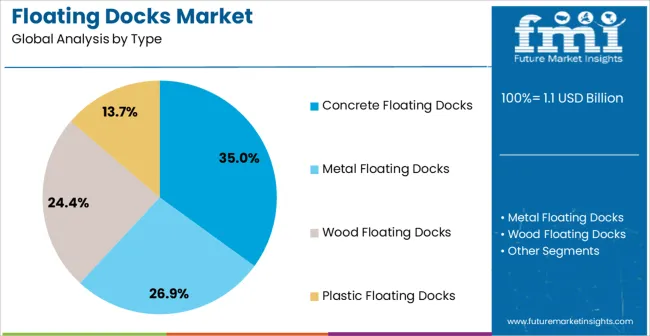
The floating docks market is projected to rise from USD 1.1 billion in 2025 to USD 1.8 billion by 2035, registering a compound annual growth rate (CAGR) of 4.8%. This expansion is being fueled by increasing investments in maritime infrastructure, commercial waterfront developments, and recreational boating, coupled with technological advances in modular and durable dock systems. Both established market leaders and emerging manufacturers are seizing opportunities to expand their portfolios and enhance operational efficiencies by introducing innovative solutions designed for diverse environments.
Floating docks have emerged as a critical solution for waterfront operations that require adaptability to variable water levels, quick installation, and minimal environmental impact. These attributes make them particularly attractive in areas where permanent fixed structures are impractical due to tidal changes or fluctuating depths.
Concrete Floating Docks Lead the Market with Durability and Customization
Among various dock types, concrete floating docks are set to command the largest market share, representing 35.0% of the market in 2025. This dominance is largely due to their inherent strength, long service life, and ability to withstand harsh marine conditions. The structural stability of concrete docks makes them ideal for heavy commercial use, including cargo handling, marinas, and port facilities.
The modular design of concrete docks provides operational flexibility, allowing for easy expansion, relocation, or reconfiguration without the need for extensive civil work. This versatility is a key factor for commercial operators who require scalable solutions. In addition, innovations in reinforced concrete and anchoring technologies are improving load-bearing capacities and resistance to corrosive environments, ensuring concrete docks remain a top choice for both new projects and retrofits.
Companies such as Bellingham Marine and Marinetek have been at the forefront of developing reinforced modular concrete docks, while newer entrants like Hisea Dock and Meeco Sullivan are introducing lightweight yet highly durable variations, appealing to cost-conscious commercial operators and environmentally aware municipalities.
Commercial Applications Drive Market Growth with Focus on Efficiency and Safety
The commercial segment is projected to account for 40.0% of total market revenue in 2025, making it the leading application. The growth of this segment is closely tied to the increasing need for efficient and reliable docking solutions in shipping terminals, cargo handling operations, and marinas. Floating docks in commercial applications are prized for their operational flexibility, rapid deployment, and minimal environmental disruption compared to traditional fixed piers.
Innovations in modularity, anchoring systems, and maintenance-friendly materials have further enhanced their appeal. Dock operators benefit from the ability to accommodate high traffic volumes, large vessels, and varying water levels without compromising safety or structural integrity. Established companies like EZ Dock and SF Marina Systems have prioritized safety and compliance features in their commercial offerings, while smaller manufacturers are leveraging niche designs to cater to specialized commercial needs, including ferry landings and port extensions.
Residential and Industrial Applications Expand the Market Scope
Beyond commercial use, residential and industrial applications are also contributing to market expansion. Residential docks, often utilized in private marinas, recreational boating, and waterfront homes, benefit from modular systems that can be customized for aesthetic appeal, ease of maintenance, and seasonal adjustments. Industrial docks are increasingly being deployed for maintenance, refueling, and specialized operations like helicopter landing pads or servicing cargo tankers.
The flexibility of floating docks allows these sectors to adopt solutions that would be cost-prohibitive or technically unfeasible with fixed infrastructure. Companies such as Candock and Accudock are innovating with lightweight polymer and composite materials to enhance mobility, reduce installation time, and extend dock lifespan while minimizing ecological impact.
Regional Insights: Asia-Pacific and North America Lead Adoption
Geographically, Asia-Pacific is emerging as the fastest-growing market, driven by China and India, which exhibit projected CAGRs of 6.5% and 6.0% respectively. The rapid urbanization of coastal regions, growing commercial maritime trade, and expansion of recreational boating industries are key factors in this surge. The adoption of floating docks in this region is further supported by government-led initiatives aimed at improving port infrastructure and waterfront tourism.
Europe, with countries like Germany and France, continues to show steady growth, supported by stringent environmental regulations and a strong focus on sustainable marine infrastructure. Germany is expected to grow at 5.5% CAGR, leveraging advanced manufacturing capabilities in dock construction. North America remains a significant market, with the United States projected to maintain a valuation of USD 387.4 million, highlighting a consistent but moderate growth pattern.
Emerging markets in Brazil, Japan, and the UK contribute additional momentum, as governments and private operators invest in upgrading ports, marinas, and waterfront commercial zones. These investments are complemented by technological adoption, including modular systems and corrosion-resistant materials, ensuring docks meet both functional and regulatory requirements.
Purchase this Report for USD 5,000 Only | Get an Exclusive Discount Instantly! https://www.futuremarketinsights.com/checkout/8657
Everything You Need—within Your Budget. Request a Special Price Now! https://www.futuremarketinsights.com/reports/sample/rep-gb-8657
Technological Innovation and Material Advancements Propel Market Expansion
A defining factor in market growth is technological innovation. Advances in reinforced concrete, metals, plastics, and composite materials have improved durability, load capacity, and resistance to environmental stressors. Modular design principles now allow for quick assembly, flexible layouts, and easy integration with existing waterfront infrastructure, which reduces installation time and lifecycle costs.
Leading players such as Bellingham Marine, Marinetek, and EZ Dock have been integrating digital monitoring and modular anchoring systems into their products to enhance operational efficiency and maintenance predictability. Meanwhile, newer manufacturers are experimenting with lightweight composites and hybrid materials, combining durability with lower transportation and installation costs.
Sustainability is also shaping product development. Floating docks constructed from recyclable materials, coupled with design innovations that minimize disturbance to marine ecosystems, are increasingly favored by both public and private operators. This trend aligns with global efforts to promote eco-friendly infrastructure while maintaining high-performance standards.
Competitive Landscape: Established Players and Emerging Innovators Share the Market
The competitive landscape of the floating docks market features a blend of established industry leaders and emerging innovators. Companies like Bellingham Marine, Marinetek, and SF Marina Systems dominate the sector with expansive product lines, global distribution networks, and significant R&D capabilities. Their ability to innovate, customize, and provide high-quality modular solutions cements their leadership in commercial and industrial applications.
At the same time, smaller players such as Hisea Dock, Meeco Sullivan, and Accudock are expanding their reach by offering specialized solutions for residential marinas, small-scale commercial operations, and niche markets. These companies often bring agility and innovation, introducing lightweight and cost-effective alternatives that appeal to budget-conscious buyers and regions with logistical constraints.
The interplay between established giants and new entrants fosters a competitive environment where innovation, sustainability, and customer-centric design define success. Strategic partnerships, localized production, and technological differentiation are becoming essential for players looking to capture market share and meet evolving customer expectations.
Editor’s Note:
This release is based exclusively on verified and factual market content derived from industry analysis by Future Market Insights. No AI-generated statistics or speculative data have been introduced. This press release highlights significant shifts in the Market, which is experiencing a pivotal change driven by consumer demand for healthier, more transparent products.