The global Dechlorination Chemical Market is projected to rise from USD 1.5 billion in 2025 to USD 2.5 billion by 2035, reflecting a steady CAGR of 5.7%. As environmental regulations tighten and water infrastructure expands worldwide, the market’s evolution underscores the increasing emphasis on water safety, sustainability, and chemical innovation.
According to insights from Future Market Intelligence’s verified global materials database, which tracks industrial resins, coatings, and additives, the market’s expansion is being powered by the escalating need to neutralize residual chlorine in municipal and industrial water systems. The demand for efficient chlorine neutralization solutions is driven by growing awareness of aquatic ecosystem protection, compliance with stringent water quality standards, and the global shift toward sustainable water management practices.
Demand Driven by Safe Water Management and Sustainability
Dechlorination chemicals play a pivotal role in enabling municipal utilities and industrial facilities to neutralize chlorine before water discharge or reuse. These chemicals—ranging from sulfur-based compounds, sodium bisulfite, sodium sulfite, and sulfur dioxide—are essential for preventing environmental contamination, ensuring safety, and maintaining regulatory compliance.
The market’s expansion is underpinned by growing infrastructure investment in both developed and emerging economies. Governments worldwide are modernizing water treatment systems and enforcing tighter environmental policies. In countries like India, China, and Brazil, national initiatives aimed at achieving zero liquid discharge (ZLD) and improving wastewater reuse are propelling adoption.
Conversely, in mature markets such as the United States, Germany, and the United Kingdom, retrofits of aging water treatment facilities, combined with increasingly stringent discharge permits, are driving upgrades in chemical dosing systems and process optimization technologies.
Between 2025 and 2030, the dechlorination chemical market is forecast to grow by USD 486 million, primarily fueled by municipal and industrial wastewater projects, the rise of automated dosing systems, and integration with real-time water quality monitoring technologies. From 2030 to 2035, the industry will see an additional USD 594 million growth, emphasizing specialized, high-purity formulations and sustainable production practices.
Technological Progress and Industry Innovation
Leading chemical manufacturers are channeling investments into advanced formulations, automation, and sustainable chemistry initiatives. Solvay SA, BASF SE, and Kemira Oyj, the top-tier players controlling around 38% of the global market, have expanded production capacity and adopted eco-friendly chemical manufacturing processes.
Their focus on liquid formulations, which dominate with 72.0% market share, aligns with the industry’s move toward automated chemical dosing systems that ensure precise chlorine neutralization. These systems enhance efficiency and reduce waste, making them vital for both large-scale municipal facilities and industrial users.
Companies such as Chemtrade Logistics, INEOS Calabrian, and Hawkins Inc. are strengthening their regional footprints through strategic acquisitions, while Jay Dinesh Chemicals (India) and Guangdong Hanyan Activated Carbon Technology Co., Ltd. (China) are gaining ground in Asia through cost-effective and localized production.
Market Segmentation Highlights
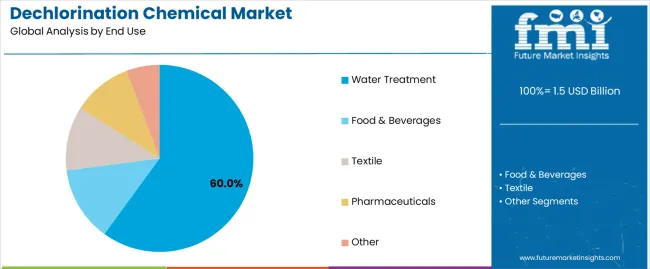
The water treatment sector remains the cornerstone of the dechlorination chemical market, capturing 60.0% of total demand in 2025. The dominance of this segment underscores the indispensable role of chlorine neutralization in municipal water systems, drinking water purification, and industrial effluent treatment.
The food and beverage industry ranks second, accounting for 18.0% market share, driven by the need for chlorine-free process water that safeguards product quality and regulatory compliance. Textiles, pharmaceuticals, and other manufacturing sectors collectively contribute to the remaining share, with each emphasizing purity, environmental responsibility, and process optimization.
In terms of chemical type, sulfur-based dechlorination agents continue to dominate the landscape due to their efficiency and cost-effectiveness, although concerns regarding handling complexity and regulatory scrutiny over sulfur discharge persist.
Asia-Pacific Leads Global Expansion
The Asia-Pacific region emerges as the fastest-growing market, with India (6.4% CAGR) and China (6.1% CAGR) leading the global charge. India’s rapid industrialization and focus on ZLD implementation in textiles, chemicals, and pharmaceuticals make it a key growth hub. Major states like Maharashtra, Gujarat, and Tamil Nadu are spearheading infrastructure development for wastewater treatment and chemical manufacturing.
China’s growth trajectory is anchored in stricter environmental compliance and large-scale investments in municipal and industrial wastewater treatment facilities. Initiatives such as the Water Pollution Prevention and Control Action Plan continue to elevate the adoption of advanced chemical systems for dechlorination and reuse.
South Korea maintains a strong position through its focus on high-purity formulations catering to electronics and semiconductor applications. Its integration of precision chemical dosing and quality monitoring technologies makes it a technological leader in the region.
Meanwhile, Brazil drives Latin America’s demand, supported by growing pulp and paper production and beverage manufacturing, while Germany, the UK, and the USA maintain steady performance driven by infrastructure modernization and compliance with strict environmental regulations.
Europe’s Balanced Market Development
Across Europe, the market is projected to increase from USD 392 million in 2025 to USD 683 million by 2035, maintaining a consistent 5.7% CAGR. Germany leads with 22% of the regional share, followed by the UK, France, Italy, and Spain. Germany’s emphasis on pharma- and food-grade dechlorination formulations aligns with the country’s advanced regulatory standards, while the UK’s focus on river quality improvement underlines its environmental commitment.
Nordic countries and the Benelux region continue to prioritize low-toxicity and automation-enabled dosing technologies, setting benchmarks in sustainability and innovation.
Evolving Market Dynamics and Future Outlook
The next decade of the dechlorination chemical market will be shaped by three key dynamics: stricter environmental standards, increasing automation in water treatment processes, and rising adoption of high-purity formulations.
While sulfur-based chemicals remain central to market growth, companies are actively researching eco-friendly alternatives and hybrid chemical technologies that offer similar performance with lower environmental risks. The integration of real-time chlorine monitoring and smart chemical dosing systems is transforming how facilities manage water quality and resource efficiency.
At the same time, challenges persist. The complexity of sulfur-based chemical handling, volatility in raw material prices, and potential regulatory limits on sulfite discharge require continuous innovation. Industry leaders are therefore focusing on safety training, product certification, and sustainability to ensure long-term resilience.
Purchase this Report for USD 5,000 Only | Get an Exclusive Discount Instantly! https://www.futuremarketinsights.com/checkout/18046
Everything You Need—within Your Budget. Request a Special Price Now! https://www.futuremarketinsights.com/reports/sample/rep-gb-18046
Collaboration Across Stakeholders
The market’s evolution reflects a growing collaboration between governments, industry bodies, chemical manufacturers, and technology providers. Policy support in the form of infrastructure investment, water quality regulation, and sustainable chemistry funding will accelerate adoption.
Governments are expected to play a critical role by implementing stricter discharge norms and supporting infrastructure programs that incorporate advanced dechlorination systems. Meanwhile, industry bodies are defining standardized safety and handling guidelines and certification programs to ensure product consistency across manufacturers.
Technology providers are expanding their focus on integrated treatment solutions, combining dechlorination chemicals with automation and monitoring systems to deliver turnkey water management packages. Investors, in turn, are fueling capacity expansion, R&D initiatives, and acquisitions aimed at strengthening global supply chains and specialized production capabilities.
Key Players Powering Global Growth
The competitive landscape remains moderately concentrated, with Solvay SA, BASF SE, and Kemira Oyj maintaining a leadership edge through extensive production capacity, R&D strength, and global service networks. Chemtrade Logistics, INEOS Calabrian, Esseco USA LLC, and Hawkins Inc. reinforce the market’s stability through regional expertise, while Hydrite Chemical, Jay Dinesh Chemicals, and Guangdong Hanyan Activated Carbon Technology Co., Ltd. contribute to dynamic regional growth.
Editor’s Note:
This release is based exclusively on verified and factual market content derived from industry analysis by Future Market Insights. No AI-generated statistics or speculative data have been introduced. This press release highlights significant shifts in the Market, which is experiencing a pivotal change driven by consumer demand for healthier, more transparent products.