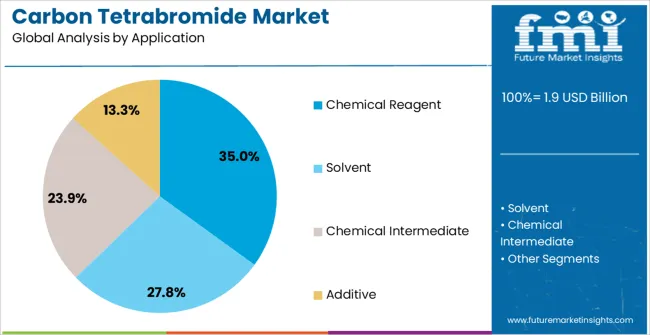
The Carbon Tetrabromide market is estimated valuation of USD 1.9 billion in 2025 projected to reach USD 2.8 billion by 2035, reflecting a compound annual growth rate of 3.7%. This growth trajectory underscores the compound’s crucial role as a brominating agent and its wide-ranging applications across chemical synthesis, industrial processes, and specialty manufacturing. Future Market Insights (FMI) highlights how both established players and emerging innovators are strategically positioning themselves to leverage technological advancements, improve process efficiency, and expand market reach over the next decade.
Powder and Granule Forms Lead Market Adoption
Among product forms, the powder and granule segment dominates with an expected 55% market share in 2025. These forms offer unparalleled ease of handling, storage, and precise dosing, making them particularly suitable for chemical manufacturing and laboratory applications. The uniform particle size and high solubility contribute to consistent reaction performance, enhancing operational efficiency in industrial processes. Manufacturers are increasingly adopting powder and granule forms to meet rising demand for standardized, reliable reagents. Robust production processes and widespread distribution channels have further cemented this form’s dominance, positioning it as the preferred choice for both domestic and international customers.
Chemical Reagents Remain the Primary Application
The chemical reagent segment is projected to account for 35% of market revenue in 2025, reflecting Carbon Tetrabromide’s essential role as a brominating and halogenating agent in chemical synthesis. Its high reaction efficiency, reproducibility, and purity make it indispensable for research laboratories, pharmaceutical development, and industrial chemical manufacturing. The growth of modern synthesis techniques and the increasing emphasis on precise reaction control continue to reinforce the importance of Carbon Tetrabromide as a reliable reagent. Manufacturers focused on process optimization and high-quality outputs are driving demand for the compound in applications requiring stringent performance and safety standards.
Chemicals Industry Emerges as Key End-Use Segment
The chemicals end-use sector accounts for approximately 40% of market revenue in 2025, driven by the increasing need for brominated intermediates, flame retardants, and industrial additives. Carbon Tetrabromide’s ability to deliver high purity and consistent performance makes it a trusted reagent in chemical production. The ongoing expansion of chemical manufacturing capacity, coupled with rising industrial activity, supports steady growth in this sector. As global industries increasingly prioritize advanced reagents to meet regulatory and performance requirements, Carbon Tetrabromide remains a critical component in specialty chemical synthesis and production workflows.
Market Overview: Properties and Production
Carbon Tetrabromide, also known as tetrabromomethane, is a dense crystalline solid, generally colorless but occasionally presenting a yellowish-brown tinge. With a molecular weight of 331.627 g/mol and density 3.42 times that of water, it is insoluble in water but soluble in solvents such as chloroform, ethanol, and ethyl ether. While non-combustible, the compound decomposes upon heating, releasing corrosive and toxic fumes. Its high reactivity with alkali metals presents potential explosive hazards, emphasizing the importance of proper handling.
The compound is produced via bromination of methane in the presence of bromine or hydrogen bromide, an endothermic reaction requiring a temperature of 100°C. The relatively straightforward production process, coupled with consistent performance characteristics, contributes to its widespread adoption in chemical, pharmaceutical, and materials applications worldwide.
Regional Insights: Asia-Pacific Leads Growth
China leads the global market with a CAGR of 5%, reflecting substantial demand for brominating agents in chemical synthesis and industrial applications. India follows closely with 4.6% CAGR, benefiting from expanding chemical manufacturing capacity and a growing emphasis on high-purity reagents. Developed markets in Europe and North America, including Germany, the USA, and the UK, show steady growth rates between 3.1% and 4.3%, driven by regulatory compliance, high-quality manufacturing standards, and specialty chemical demand. Japan posts a slightly lower CAGR of 2.8%, yet continues to contribute to the global market’s overall positive trajectory.
Key Players and Competitive Landscape
The Carbon Tetrabromide market is composed of both established manufacturers and emerging innovators focused on expanding production capabilities and developing new technologies. Leading players include Shanghai Qian Chemical, Hangzhou Dayangchem, Toronto Research Chemicals, Acme Chemical, Alfa Aesar, American Elements, Acros Organics (Fisher Scientific), and Aladdin.
Established companies are investing in process optimization, ensuring consistent product quality, and strengthening global distribution networks. For instance, Shanghai Qian Chemical and Hangzhou Dayangchem are scaling production to meet rising demand in Asia-Pacific, while American Elements and Alfa Aesar focus on delivering high-purity products for research and industrial applications. Emerging players are innovating with sustainable manufacturing methods and advanced synthesis technologies to enhance product differentiation and gain market share. These companies are increasingly targeting high-value applications in specialty chemicals, pharmaceuticals, and industrial intermediates.
Purchase this Report for USD 5,000 Only | Get an Exclusive Discount Instantly! https://www.futuremarketinsights.com/checkout/8833
Everything You Need—within Your Budget. Request a Special Price Now! https://www.futuremarketinsights.com/reports/sample/rep-gb-8833
Technological Advancements Driving Market Expansion
Technological innovation is a major driver of growth in the Carbon Tetrabromide market. Advanced manufacturing processes, improved quality control protocols, and automated production systems are enabling manufacturers to deliver precise, reproducible reagents at competitive costs. Bio-based and environmentally conscious production methods are emerging, particularly in regions with stringent regulatory requirements, offering both sustainability benefits and competitive differentiation.
Ongoing research and development investments are supporting new applications, process optimization, and integration into modern chemical synthesis workflows. The emphasis on high-purity intermediates and precise dosing standards is fostering growth across industrial and laboratory segments, further reinforcing Carbon Tetrabromide’s position as a critical reagent in diverse applications.
Market Challenges and Opportunities
While the market is expected to grow steadily, it faces challenges related to chemical safety regulations, environmental compliance, and raw material availability. Proper handling and storage protocols are essential due to the compound’s toxicity and reactivity. Additionally, competition from alternative brominating agents and halogenated chemicals can influence pricing and adoption in certain applications.
Nevertheless, opportunities abound for manufacturers that focus on process optimization, innovation, and high-quality production. The growing demand for specialty chemicals, coupled with the expansion of chemical manufacturing capacity in emerging economies, provides an ideal environment for companies to invest in capacity expansion, technology development, and regional market penetration.
Editor’s Note:
This release is based exclusively on verified and factual market content derived from industry analysis by Future Market Insights. No AI-generated statistics or speculative data have been introduced. This press release highlights significant shifts in the Market, which is experiencing a pivotal change driven by consumer demand for healthier, more transparent products.