The global crotonic acid market is projected to increase from USD 0.8 billion in 2025 to USD 2.2 billion by 2035. This substantial growth, at a 9.8% CAGR, reflects the accelerating adoption of hot-melt adhesives, water-borne coating systems, and high-purity pharmaceutical intermediates across sectors including packaging, automotive, construction, and electronics. According to Future Market Insights (FMI), crotonic acid is evolving from a niche chemical intermediate into a strategic building block that enables manufacturers to meet stringent regulatory standards while enhancing formulation performance.
Early Decade Growth Driven by Adhesives and Water-Borne Systems
Between 2025 and 2030, the market is expected to grow from USD 0.8 billion to approximately USD 1.35 billion. This phase is marked by a shift toward water-borne adhesive systems, driven by tighter VOC regulations and the global push for environmentally responsible production. Advanced hot-melt formulations and bio-based production routes are becoming standard expectations. Manufacturers are responding to the rising demand for flexible packaging adhesives that deliver strong bonding performance, heat-seal integrity, and food-contact safety.
During this phase, established specialty chemical players such as Zhejiang Guoguang Biochemistry and WeylChem International are expanding their portfolios to include advanced adhesive and coating technologies. Pharmaceutical-grade producers are simultaneously focusing on scaling high-purity intermediate production and integrating sustainable manufacturing practices. The market dynamics in this period reflect regulatory compliance acceleration and cost-efficient production processes, laying a foundation for broader adoption across multiple end-use sectors.
Accelerated Growth Through High-Purity and Specialty Applications
The latter half of the decade, from 2030 to 2035, is expected to witness an accelerated expansion from USD 1,347.2 million to USD 2.2 billion. Growth in this period is being driven by mass-market penetration of high-purity pharmaceutical intermediates, integration with UV-curable coating supply chains, and deployment across advanced electronics and automotive infrastructure. Crotonic acid’s applications are evolving from specialized use cases to mainstream requirements in high-performance adhesives, coatings, and pharmaceutical-grade production.
During this phase, competition is expected to mature, with the focus shifting from basic crotonic acid production to comprehensive specialty resin optimization. Companies like Kono Chem Co., Ltd. and Xuchang Dongfang Chemical are pioneering bio-based routes to reduce carbon footprints and appeal to environmentally conscious manufacturers. At the same time, traditional petrochemical producers continue to enhance production efficiency, expand specialty acid capacity, and deliver high-purity formulations for regulated applications.
Regional Insights: Asia Leads Adoption, Developed Markets Follow
Asia-Pacific emerges as the fastest-growing region, with India achieving a 10.7% CAGR through aggressive packaging expansion and water-borne adhesive development. Indian manufacturers are leveraging government initiatives under programs like “Make in India” to strengthen domestic production, reduce import dependency, and integrate advanced crotonic acid derivatives into flexible packaging and architectural coatings. Industrial hubs such as Maharashtra, Gujarat, Tamil Nadu, and Karnataka have become centers of specialty chemical innovation, combining local raw materials with sophisticated processing technologies to meet both domestic and export demands.
China follows closely, growing at 10.3% CAGR, driven by specialty resin integration and expansion of adhesive and coating value chains. Major chemical production centers in Zhejiang, Jiangsu, Shandong, and Guangdong have invested in vertical integration, ensuring supply reliability and cost optimization for packaging and industrial applications. Japan’s crotonic acid market grows at 10% CAGR, supported by automotive and electronics sectors. Here, high-purity pharmaceutical intermediates and bio-based innovations maintain Japan’s leadership in specialty resin development and regulatory compliance.
In the United States, growth remains steady at 9.6% CAGR, fueled by VOC compliance, medical packaging, and high-purity specialty applications. Texas, New Jersey, Pennsylvania, and California host established crotonic acid operations supporting pharmaceutical intermediates and specialty packaging markets. Germany’s 9.1% CAGR is driven by automotive coatings and Green Deal-aligned sustainable chemistry, while South Korea focuses on electronics and electric vehicle supply chains at 9.2% CAGR. Brazil shows steady growth at 8.8% CAGR, primarily due to construction repaint cycles and flexible packaging expansion.
Application Segments: Adhesive Resins and Paints Lead Demand
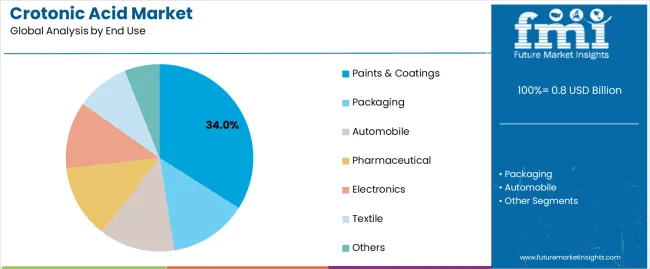
Adhesive resins dominate the crotonic acid market with approximately 48.5% share, benefiting from hot-melt optimization, water-borne formulation compatibility, and pressure-sensitive adhesive applications. These systems are widely adopted in flexible packaging for food and consumer goods, offering low-odor, VOC-compliant, and heat-sealable solutions. Paints and coatings account for 34% of market demand, driven by architectural coatings and automotive finishes requiring enhanced durability, weather resistance, and regulatory compliance.
Plasticizers and other specialty applications capture smaller yet significant shares, supporting flexible film production, wire and cable coating, and industrial finish applications. High-purity grades, representing 27% of the market, cater to pharmaceutical intermediates and electronics applications that demand precise impurity control and stringent quality standards.
Purchase this Report for USD 5,000 Only | Get an Exclusive Discount Instantly! https://www.futuremarketinsights.com/checkout/13150
Everything You Need—within Your Budget. Request a Special Price Now! https://www.futuremarketinsights.com/reports/sample/rep-gb-13150
Strategic Pathways for Growth and Innovation
Crotonic acid market participants are exploring multiple pathways to secure long-term growth. Adhesive resins remain a primary focus, with hot-melt technology, water-borne systems, and low-odor formulations enabling product differentiation. India’s market expansion presents opportunities to scale domestic production and integrate crotonic acid into flexible packaging and construction coatings. High-purity pharmaceutical applications provide long-term strategic positioning, while water-borne adhesive innovation supports VOC compliance and environmental sustainability goals. Packaging end-use diversification, bio-based production routes, and renewable feedstock integration further open new revenue streams and enhance competitive positioning.
Competitive Landscape: Established Players and Emerging Innovators
The crotonic acid market is moderately concentrated, with leading companies controlling roughly 30–35% of the global market share. Zhejiang Guoguang Biochemistry leads with a 12.5% share, expanding adhesive-grade output through debottlenecking projects. WeylChem International has upgraded production processes to improve yields and reduce solvent usage, while Tianjin Jinhui Pharmaceutical focuses on high-purity intermediates. Innovative entrants such as Kono Chem Co., Ltd. and Xuchang Dongfang Chemical are pioneering bio-based crotonic acid routes and sustainable production methods to differentiate their offerings. Regional specialists like TCI Chemicals, Alfa Aesar, Parchem, and Spectrum Chemical Manufacturing target niche applications, including pharmaceutical-grade formulations and research-grade chemicals.
Editor’s Note:
This release is based exclusively on verified and factual market content derived from industry analysis by Future Market Insights. No AI-generated statistics or speculative data have been introduced. This press release highlights significant shifts in the Market, which is experiencing a pivotal change driven by consumer demand for healthier, more transparent products.